
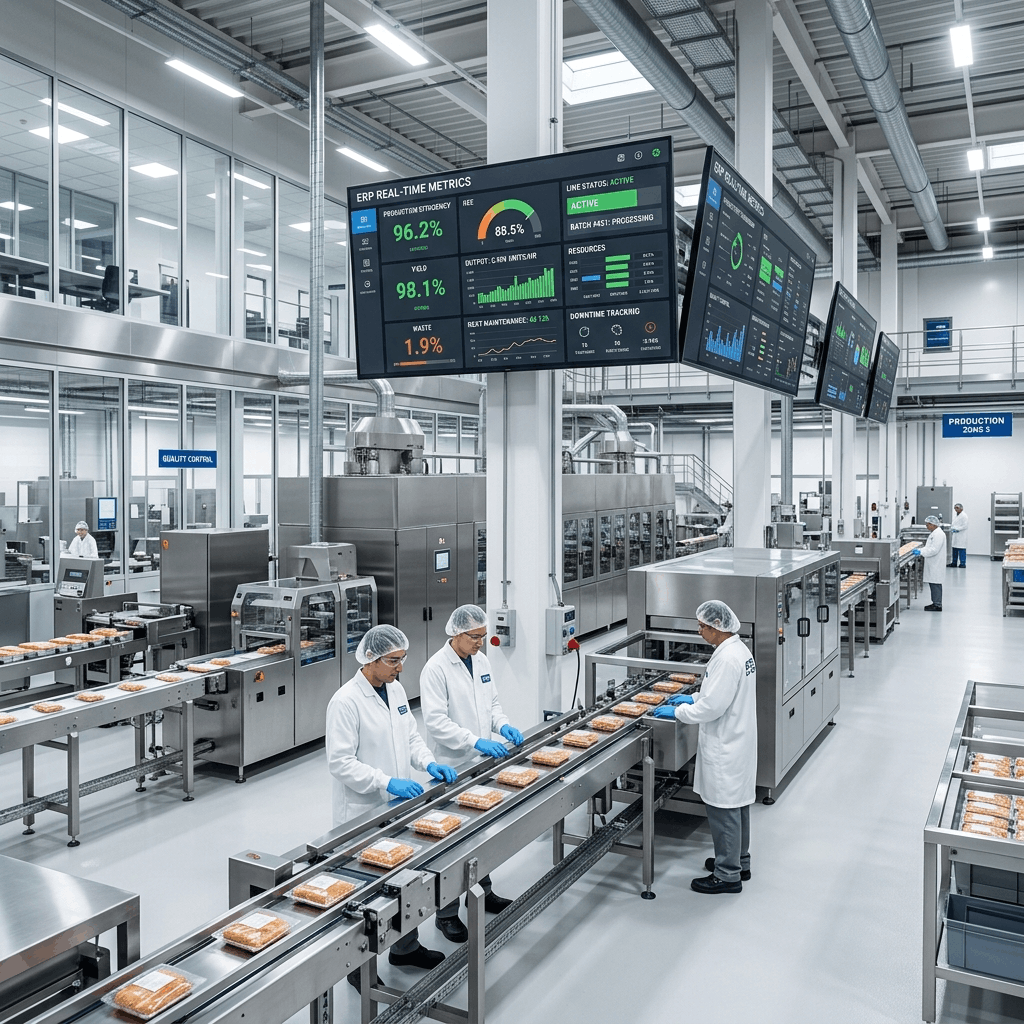
Introduction: The Need for Food ERP in Modern Manufacturing
The food and beverage industry operates under incredibly stringent conditions. Margins are often tight, consumer expectations regarding product quality are exceptionally high, and regulatory authorities impose strict guidelines. From the sourcing of raw materials to the packaging of the final product, every single step in the manufacturing process must be precise, documented, and fully optimized. To survive and thrive in this highly competitive environment, food manufacturers are increasingly shifting away from legacy systems and disconnected spreadsheets toward comprehensive, integrated technological solutions. The focal point of this technological revolution is the Food Enterprise Resource Planning (ERP) system.
A robust, purpose-built manufacturing ERP fundamentally alters how food businesses operate. It acts as the central nervous system of your business, seamlessly connecting departments that historically worked in silos—procurement, production, quality assurance, inventory, and sales. By breaking down these data silos, a Food ERP eliminates redundant data entry, minimizes human error, and ensures that everyone in the organization is working with a single source of truth. When data flows freely and accurately across the enterprise, productivity naturally skyrockets.
However, implementing an ERP is not just about replacing paper with digital screens; it is about completely reimagining business processes. A standard ERP might help an electronics manufacturer, but food processing has unique demands: variable yields, catch weight processing, complex recipe management, expiration dates, and meticulous lot traceability. This is why a specialized Food ERP is so critical. In this comprehensive guide, we will explore in profound detail the top 4 ways that a Food ERP system dramatically increases productivity, reduces waste, and propels your business toward sustained profitability.
Way 1: Streamlined Recipe and Formula Management
At the very core of any food manufacturing business is the recipe. The recipe dictates the raw materials required, the exact proportions, the processing instructions, and the expected yield. Managing recipes on spreadsheets or in physical notebooks is a recipe for disaster in a growing enterprise. Such manual methods leave businesses vulnerable to inconsistencies, version control issues, and intellectual property theft. A Food ERP system revolutionizes this aspect of the business by introducing highly structured, secure, and dynamic recipe management capabilities.
Precision and Consistency at Scale
When scaling production, maintaining consistency across different batches is paramount. A Food ERP allows food technologists and production managers to define exact ingredient quantities, allowable substitutions, and precise manufacturing instructions. If the price of a certain raw material spikes, the ERP can quickly suggest pre-approved alternative ingredients and calculate the subsequent impact on nutritional values, allergen profiles, and overall costs. This dynamic adaptability ensures that production never stalls due to minor supply chain disruptions, thereby keeping productivity at its peak.
Automated Bill of Materials (BOM) Generation
Every recipe translates into a specific Bill of Materials (BOM) for production. In a traditional setup, calculating the BOM for a large, multi-stage production run is an arduous, time-consuming process prone to miscalculations. A modern Food ERP automates this entirely. Once a production order is initiated, the system instantly calculates the exact quantities of raw materials required based on the master recipe, taking into account current inventory levels and expected variable yields. It seamlessly integrates with supply chain management software to trigger automated purchase orders if ingredients are running low, ensuring that production teams are never waiting on missing materials.
Version Control and Nutritional Analysis
Consumer tastes evolve, and recipes must evolve with them. Whether it’s reducing sugar content or substituting an allergen, recipe iteration is constant. A Food ERP maintains strict version control, ensuring that the factory floor always accesses the most current, approved version of a formula. Furthermore, the system automatically calculates the nutritional information and generates accurate ingredient labels based on the specific formulation being used. This entirely eliminates the tedious and error-prone process of manually recalculating nutritional facts, saving hundreds of hours of administrative work and directly contributing to a more productive workforce.
Way 2: Advanced Inventory and Batch Tracking (FEFO)
In the food industry, inventory is not static; it is highly perishable. Effective inventory management is not just about knowing how much of an item you have; it is about knowing exactly when that item will expire, where it is located, and how it should be utilized to maximize yield and minimize spoilage. Poor inventory practices lead to expired ingredients, overstocking, and massive financial losses. Food ERP software introduces sophisticated inventory tracking methodologies, most notably FEFO (First Expired, First Out), to fundamentally optimize warehousing and material utilization.
Eliminating Spoilage with FEFO
Unlike standard FIFO (First In, First Out) which focuses solely on the receiving date, FEFO prioritizes the expiration date. A shipment received today might expire sooner than a shipment received last week due to variations in supplier manufacturing dates. A Food ERP tracks the exact shelf life of every single batch of raw material. When a production order is generated, the system automatically directs warehouse personnel to pick the ingredients that are closest to expiration. This intelligent routing ensures that materials are consumed before they spoil, drastically reducing waste and maximizing the financial return on procured goods.
End-to-End Lot Traceability
Traceability is non-negotiable in the food and beverage industry. If a contamination issue occurs, businesses must be able to trace a product back to its exact origin within minutes. Manual tracking systems fail spectacularly under this pressure. A Food ERP provides instantaneous, bi-directional traceability. From a finished product, you can trace backwards to identify every raw material batch, the supplier, the specific production line, and the operators involved. Conversely, from a specific raw material batch, you can trace forwards to see exactly which finished goods it was used in and which distributors received those goods. This capability turns a potential multi-week recall nightmare into a swift, targeted operation taking only minutes, thereby minimizing operational downtime.
Real-Time Stock Visibility and Catch Weight
Many food ingredients, particularly meats and dairy, are managed using catch weights—meaning the weight of individual items varies. Standard ERPs struggle with items that are counted in boxes but priced and consumed by exact weight. Food ERP systems natively handle dual units of measure and catch weights, ensuring that inventory valuation and production consumption records are flawlessly accurate. Real-time dashboards provide procurement teams with exact visibility into current stock levels, pending orders, and projected usage based on the production schedule. This precision prevents over-purchasing and frees up valuable working capital, which can be reinvested into more productive areas of the business.
Quick Contact for ERP Consultation
Are you looking to enhance your food manufacturing productivity? Fill out the quick form below, and our ERP experts will get in touch with you shortly to discuss your specific business needs.
Request a Free ERP Consultation
Way 3: Automated Quality Control and Compliance
Quality control (QC) in food manufacturing cannot be an afterthought; it must be deeply integrated into the entire production lifecycle. When QC processes are isolated from the main production system, communication breakdowns occur. Products might be shipped before test results are finalized, leading to costly recalls, or production might be unnecessarily halted while waiting for paper-based approvals. A comprehensive Food ERP embeds quality checkpoints at every critical stage, automating compliance and dramatically increasing the speed and reliability of production.
In-Line Quality Inspections
With a Food ERP, quality assurance is an active participant in the workflow. The system can be configured to halt production automatically if critical control points (CCPs) fall outside defined parameters. For instance, if an oven temperature sensor records a drop below the required safety threshold, the ERP immediately flags the batch, quarantines the affected products, and alerts the quality team. Technicians can use tablets on the factory floor to enter visual inspection data, pH levels, or moisture content directly into the ERP. If the inputs fail the predefined tolerance levels, the system restricts the inventory from moving to the next stage. This real-time, integrated approach prevents defective products from ever leaving the facility, significantly boosting the overall yield of high-quality goods.
Effortless Regulatory Compliance and Audits
Navigating the labyrinth of food safety regulations—be it FSSAI in India, FDA in the US, or global GFSI standards—requires meticulous record-keeping. Preparing for an audit using physical binders and disjointed spreadsheets is a massive drain on company productivity, often requiring teams to work overtime for weeks. A Food ERP digitizes the entire compliance framework. It automatically maintains an immutable audit trail of every transaction, quality check, supplier certification, and sanitation procedure. When an auditor arrives, pulling a comprehensive traceability report or demonstrating compliance with specific safety protocols takes mere clicks. The automation of these compliance tasks allows quality managers to focus on proactive process improvements rather than reactive paperwork gathering.
Supplier Quality Management
Quality begins with the raw materials. A robust ERP evaluates supplier performance over time. It tracks delivery timelines, the frequency of rejected shipments due to quality issues, and the validity of supplier certifications. If a supplier's safety certification expires, the ERP can automatically block the procurement team from issuing new purchase orders to that vendor. By ensuring that only high-quality, compliant ingredients enter the facility, food manufacturers minimize production interruptions caused by sub-standard inputs, thereby keeping the manufacturing lines running smoothly and productively.
Way 4: Real-Time Production Analytics and Reporting
In the modern industrial landscape, data is the most valuable currency. However, data is only useful if it is accurate, timely, and actionable. Food manufacturers relying on legacy systems often operate on outdated information. By the time the end-of-month reports are generated, the opportunity to correct a production inefficiency has long passed. A Food ERP transforms this dynamic by providing real-time analytics, dashboards, and deep insights into every facet of the operation, empowering leaders to make data-driven decisions that instantly enhance productivity.
Visibility Across the Enterprise
An ERP system centralizes data from finance, sales, inventory, and the shop floor into a single unified database. Through customized, role-based dashboards, a production manager can instantly view machine utilization rates, a procurement officer can monitor real-time raw material consumption, and the CEO can track daily profitability margins. This complete visibility eliminates the time wasted compiling reports from different departments. Meetings become focused on strategy and optimization rather than arguing over whose spreadsheet contains the correct numbers. When decision-makers have immediate access to accurate data, they can rapidly identify bottlenecks—whether it's a specific machine causing delays or a product line with declining margins—and take immediate corrective action.
Optimizing Production Scheduling
Efficient production scheduling is a complex puzzle involving machine capacity, labor availability, raw material constraints, and customer delivery deadlines. A Food ERP features advanced planning and scheduling tools that analyze all these variables to generate the most efficient production sequence. The system minimizes changeover times—for example, by scheduling the production of light-colored products before dark-colored ones, or allergen-free products before those containing nuts—thereby drastically reducing the time spent cleaning machines between runs. This intelligent scheduling maximizes machine uptime, optimizes labor utilization, and ensures that customer orders are fulfilled on time, every time.
Costing and Profitability Analysis
Understanding the true cost of production is notoriously difficult in the food industry due to fluctuating commodity prices and variable yields. A Food ERP continuously calculates actual costs against standard costs in real time. It tracks the exact amount of labor, machine overhead, and raw material consumed for every specific batch. If a batch of raw material yields less finished product than expected, the ERP immediately flags the variance. This granular financial visibility allows companies to identify exactly which products, customers, and production lines are the most profitable. Armed with this knowledge, sales teams can focus on high-margin products using an integrated CRM software, while production teams can focus on reducing waste in underperforming lines, driving massive improvements in overall enterprise productivity.
Conclusion: Transforming the Food Manufacturing Landscape
The implementation of a specialized Food ERP system is no longer merely a technological upgrade; it is a fundamental strategic imperative for any food and beverage manufacturer aiming to remain competitive in today’s rapidly evolving market. As we have explored in this guide, an ERP fundamentally transforms the operational fabric of a company.
By streamlining complex recipe and formula management, manufacturers can scale rapidly without sacrificing consistency or quality. The implementation of advanced, FEFO-driven inventory and batch tracking systems obliterates massive sources of waste, preventing spoilage and ensuring meticulous traceability that protects the brand. Automated, in-line quality control and digitized compliance frameworks not only accelerate production cycles but also safeguard the enterprise against regulatory disasters. Finally, the provision of real-time, actionable production analytics empowers leadership to make swift, data-driven decisions that continuously refine operations and maximize profitability.
When these four powerful capabilities converge within a single, integrated platform, the result is a massive, sustainable surge in productivity. Disconnected processes are replaced by seamless workflows. Guesswork is replaced by precision. And reactive management is replaced by proactive optimization. If your food manufacturing business is still struggling with spreadsheets, manual data entry, and isolated software systems, it is time to embrace the future. Investing in a robust Food ERP is investing in the long-term efficiency, scalability, and ultimate success of your enterprise.
Streamline operations, reduce costs, and scale faster with Delight ERP.