
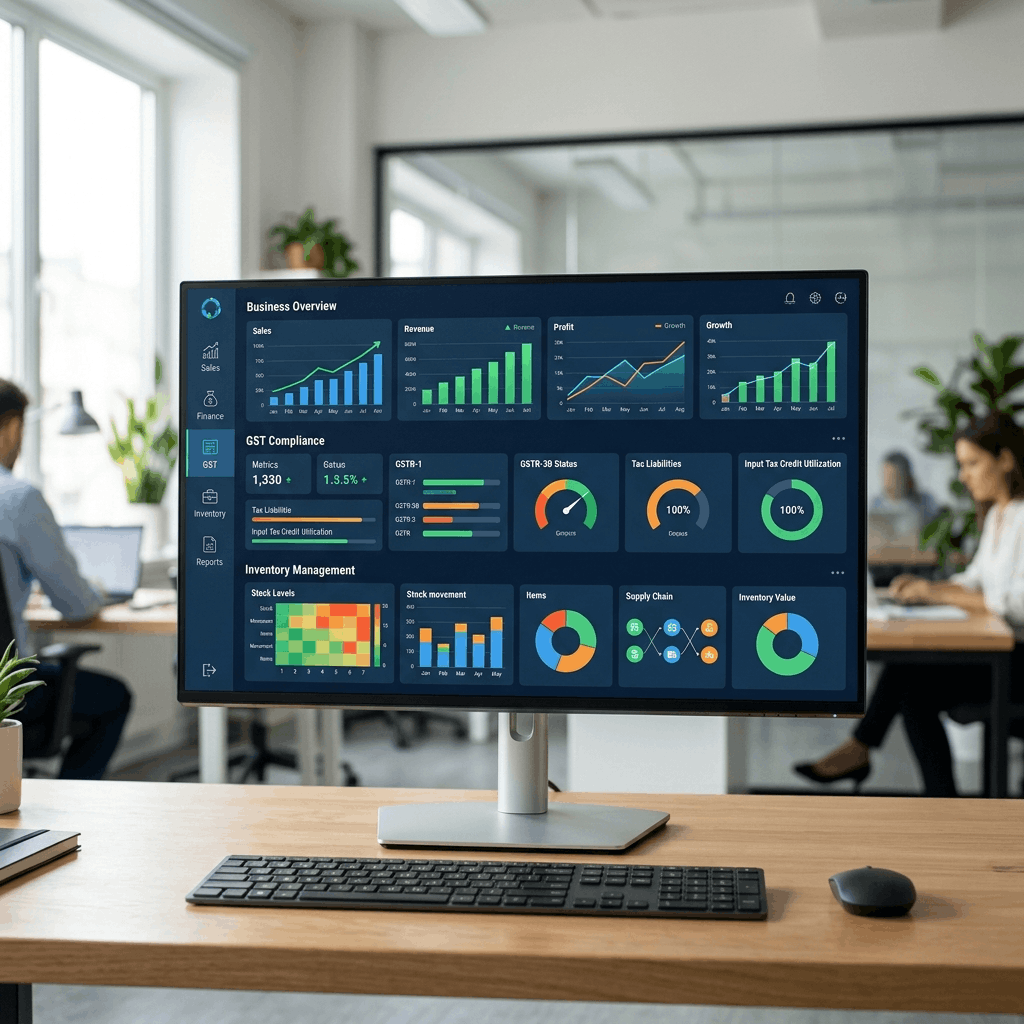
India's manufacturing and distribution sector is undergoing its biggest technological transformation in decades. By 2026, over 60% of Indian SMBs (small and medium businesses) with 50–500 employees will have adopted some form of cloud-based ERP — up from just 18% in 2021. The catalyst? The convergence of affordable cloud infrastructure, mandatory GST digitisation, and a generation of business owners comfortable with SaaS applications.
If you're running a manufacturing unit in Rajkot, a distribution business in Ahmedabad, or a textile operation in Surat, this guide will walk you through everything you need to know about Cloud ERP — from what it is to how to implement it and what ROI to expect.
What Is Cloud ERP and Why Does It Matter?
Enterprise Resource Planning (ERP) is a category of software that integrates all core business functions — manufacturing, procurement, inventory, sales, finance, HR, and CRM — into a single unified database. When a salesperson raises a sales order, the inventory module instantly updates stock, the production module schedules manufacturing, and the finance module posts the receivable — all automatically.
Cloud ERP specifically refers to ERP software hosted on remote cloud servers (like AWS, Google Cloud, or Microsoft Azure) rather than on local servers in your factory or office. You access it through a web browser or mobile app — the same way you access Gmail or your bank account.
The Indian SMB ERP Landscape in 2026
The Indian SMB sector faces unique challenges that make ERP adoption both critical and complex:
- GST Compliance Complexity: With multiple tax slabs, e-invoicing mandates, and GSTR-2B reconciliation, manual accounting is increasingly unviable for businesses with turnover above ₹5 crore.
- Multi-Location Operations: A typical Indian manufacturer may have a factory in Rajkot, a warehouse in Ahmedabad, and customers across 15 states — requiring real-time visibility across all locations.
- Mobile-First Workforce: Indian field sales teams and warehouse staff are highly mobile. Modern Cloud ERP must work seamlessly on Android phones, which are ubiquitous in tier-2 and tier-3 cities.
- Language and Localisation: Invoices, delivery challans, and reports must support multiple languages and comply with Indian regulatory formats.
- Cash Flow Management: Indian SMBs typically operate with tight working capital. ERP helps by optimising inventory levels, accelerating collections, and improving payment cycles.
The good news? Indian Cloud ERP vendors have built solutions specifically for this context — with native GST, local payment gateway integrations (RazorPay, PayU), and support for Indian document formats like e-way bills and delivery challans.
Cloud ERP vs On-Premise ERP: The Real Comparison
Many Indian business owners who grew up seeing large corporations invest crores in SAP or Oracle installations are surprised to learn that cloud alternatives now offer comparable functionality at a fraction of the cost. Here's an honest comparison:
| Factor | Cloud ERP | On-Premise ERP |
|---|---|---|
| Initial Cost | ₹0 (subscription model) | ₹50 lakh – ₹2 crore |
| Monthly Cost (20 users) | ₹40,000–₹1,00,000/month | Maintenance: ₹5–₹15 lakh/year |
| Implementation Time | 8–16 weeks | 6–24 months |
| IT Staff Required | None | 1–3 dedicated IT staff |
| Mobile Access | Native — works on any device | Requires VPN setup |
| Updates | Automatic, included | Manual, expensive |
| Disaster Recovery | Automatic cloud backup | Requires separate infrastructure |
| GST Updates | Vendor handles compliance updates | Requires paid upgrade projects |
| Scalability | Add users/modules instantly | Requires hardware upgrades |
Key Features Every Indian Business Needs
Not all Cloud ERP systems are created equal. When evaluating options, ensure your chosen system includes these critical modules:
1. Manufacturing & Production Management
For manufacturers, this is the core of the system. Look for: Bill of Materials (BOM) management, Material Requirements Planning (MRP), production order management, shop floor control with real-time work-in-progress tracking, job costing, and quality control checkpoints. Delight ERP's manufacturing module covers all of these with support for both discrete and process manufacturing.
2. Inventory Management
Multi-warehouse inventory with real-time stock visibility, automatic reorder points, FIFO/FEFO batch tracking, barcode and QR code scanning, and stock valuation (moving average, FIFO). Indian manufacturers lose an average of 12% of revenue to excess inventory and stockouts annually — proper inventory management eliminates both problems.
3. Sales & CRM
Lead management, quotation generation with product configurator, sales order processing, delivery tracking, and customer payment tracking. Field sales mobile app with GPS tracking is essential for businesses with dealer networks across India.
4. Finance & Accounting
Complete accounting with multi-company support, GST compliance, TDS/TCS management, bank reconciliation, P&L, balance sheet, and cash flow statements. Must include e-invoicing (IRN generation) and e-way bill integration.
5. Purchase & Vendor Management
Vendor quotation comparison, purchase order management, goods receipt, vendor payment tracking, and vendor performance scorecards.
GST Compliance and E-Invoicing
For Indian businesses, GST compliance is not optional — it's a legal requirement with significant penalties for non-compliance. As of 2026, e-invoicing is mandatory for businesses with turnover above ₹5 crore, and this threshold continues to decrease annually.
A quality Cloud ERP system should handle:
- Auto GST Calculation: Automatic calculation of CGST/SGST/IGST based on HSN codes, customer location, and product type
- GSTR-1 Generation: Automatic compilation of all outward supplies for monthly/quarterly filing
- GSTR-3B Summary: Auto-populated summary return with input tax credit calculation
- E-Invoicing (IRN): Direct integration with the Invoice Registration Portal (IRP) for IRN generation and QR code embedding
- E-Way Bill: Automatic e-way bill generation for shipments above ₹50,000
- GSTR-2B Reconciliation: Automated matching of vendor invoices with GSTR-2B to maximise ITC claims
How to Choose the Right Cloud ERP
With dozens of Cloud ERP vendors targeting Indian SMBs, selection requires a structured approach. Here's a proven 6-step evaluation framework:
- Define Your Core Requirements: List the 10–15 most critical business processes that need to be automated. Distinguish between "must-have" and "nice-to-have" features.
- Industry Specialisation: A textile ERP and a pharmaceutical ERP have very different requirements. Choose a vendor with proven experience in your specific industry — not a generic system that claims to do everything.
- GST & Compliance Track Record: Ask for proof of GST compliance, e-invoicing integration, and how quickly they updated the system when GST rules changed.
- Data Localisation: Ensure your data is stored on servers within India (required for certain regulated industries) and ask about data backup frequency and disaster recovery procedures.
- Implementation Support: The software is only half the battle. Evaluate the vendor's implementation methodology, number of dedicated consultants, and post-go-live support response times.
- Total Cost of Ownership: Get a complete breakdown including software subscription, implementation fee, data migration, training, and annual maintenance. Hidden costs are common in the ERP industry.
Implementation Roadmap for Indian SMBs
A successful Cloud ERP implementation follows a structured methodology. Here's what to expect during a typical 12-week implementation:
Phase 1: Discovery & Design (Weeks 1–2)
Business process documentation, gap analysis, master data audit (customers, suppliers, products, opening balances), and system design decisions. This phase is critical — skipping it leads to expensive rework later.
Phase 2: Configuration & Customisation (Weeks 3–6)
System configuration based on the approved design, chart of accounts setup, tax configuration, workflow definition, and any custom reports or forms required (e.g., Indian invoice format, delivery challan).
Phase 3: Data Migration & Testing (Weeks 7–9)
Historical data migration (customers, suppliers, products, opening balances), parallel testing where both old and new systems run simultaneously, and user acceptance testing with key users from each department.
Phase 4: Training & Go-Live (Weeks 10–12)
Department-wise user training, cutover planning, go-live execution, and hypercare support (intensive hand-holding during the first 2–4 weeks after go-live).
Ready to Transform Your Business?
Over 1,200 Indian businesses trust Delight ERP. Get a personalised demo tailored to your industry.
Book a Free Demo → Explore FeaturesROI: What to Expect After Go-Live
Indian businesses implementing Cloud ERP typically see ROI within 12–18 months. Here are benchmark results from Delight ERP customers across different industries:
| Business Benefit | Typical Improvement | Timeframe |
|---|---|---|
| Inventory carrying cost reduction | 20–35% | 6 months |
| Order fulfilment time improvement | 30–50% | 3 months |
| Financial close time reduction | 60–70% | 3 months |
| GST filing time reduction | 80–90% | 1 month |
| Purchase cost reduction (better vendor negotiation) | 5–15% | 12 months |
| Customer complaint reduction | 40–60% | 6 months |
| Sales forecast accuracy improvement | 35–50% | 9 months |
Conclusion
The Cloud ERP revolution in India is not a future trend — it is happening right now. Businesses that adopt modern, integrated ERP systems are gaining measurable advantages over competitors still running on spreadsheets and disconnected software. The question is not whether to adopt Cloud ERP, but how quickly you can do so.
With implementation timelines of 8–16 weeks, subscription pricing that eliminates capital risk, and ROI visible within 6–12 months, the barriers to Cloud ERP adoption have never been lower. Delight ERP is purpose-built for Indian manufacturers, distributors, and retailers — with native GST compliance, mobile-first design, and deep industry expertise across 50+ sectors.
The manufacturers winning in 2026 are those who are treating technology as a strategic advantage, not just an operational tool. Start your Cloud ERP journey today.
Streamline operations, reduce costs, and scale faster with Delight ERP.