
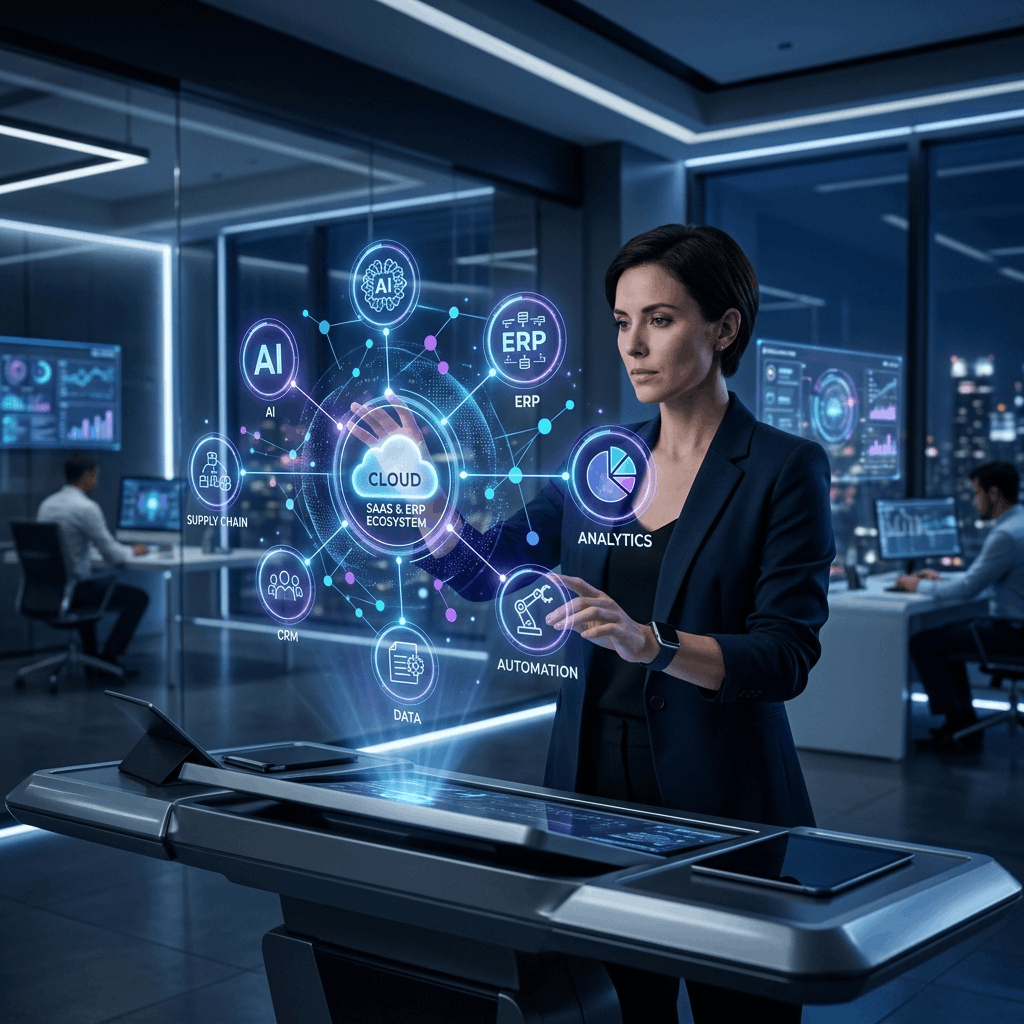
India's SaaS ERP market crossed the ₹10,000 crore mark in 2025 and is accelerating. Every quarter, more Indian manufacturers, distributors, and retailers are abandoning spreadsheets and legacy systems for cloud-native ERP that delivers real-time visibility, AI-powered insights, and automatic compliance. But the SaaS ERP landscape itself is evolving rapidly. Here are the 7 trends that will define the next chapter of Indian business software.
Why SaaS ERP Is Transforming Indian Business in 2026
Three converging forces have created the perfect conditions for SaaS ERP adoption in India: First, the GST system has made digital financial records not just beneficial but legally required — creating an immediate need for software that can handle GST compliance accurately. Second, the PLI (Production Linked Incentive) scheme is incentivising manufacturing scale-ups that require professional operations management. Third, a generation of business owners who grew up using smartphones and SaaS apps have low tolerance for the complexity of traditional on-premise ERP.
The result is a market that is growing at 25–30% annually, with adoption spreading from large enterprises to mid-market and SMB segments faster than any previous software category.
Trend 1: AI-Embedded ERP — From Reporting to Prediction
The ERP systems of 2020 reported what happened. The ERP systems of 2026 predict what will happen and recommend what to do about it. AI is being embedded throughout the ERP stack:
- Demand Forecasting: ML models trained on 3+ years of sales data produce item-level demand forecasts that are 30–40% more accurate than moving averages, reducing both stockouts and excess inventory.
- Anomaly Detection: AI monitors thousands of transactions daily, flagging statistical outliers that may indicate fraud, data entry errors, or unusual business patterns — tasks that would take a human analyst weeks to identify.
- Natural Language Queries: Finance users can ask "what was our gross margin on product X in Q2?" in plain language and receive instant answers, without knowing how to write database queries.
- Automated Reconciliation: AI matches bank transactions, purchase invoices, and GSTR-2B entries automatically, reducing reconciliation time by 80–90%.
Trend 2: Vertical SaaS — Industry-Specific ERP Goes Mainstream
For the past decade, Indian businesses had two ERP choices: generic horizontal systems that required extensive customisation to fit industry needs, or expensive custom development. In 2026, a third option has matured: vertical SaaS — pre-built ERP solutions designed specifically for a single industry.
Vertical SaaS ERP vendors for Indian industries: pharmaceutical manufacturers get batch-controlled inventory with GMP documentation, food processors get recipe management with FSSAI compliance, textile manufacturers get yarn-to-fabric tracking with colour and count management, and bearing manufacturers get single-piece flow tracking with quality certification management. These vertical solutions offer 80–90% relevant functionality out of the box, compared to 40–50% for generic systems, dramatically reducing implementation time and customisation cost.
Discover Delight ERP's Industry-Specific Solutions
15+ years building ERP for Indian manufacturing. 50+ industries. 1,200+ successful implementations.
Book Free Demo →Trend 3: Embedded Finance Within ERP
A major innovation of 2026 is the embedding of financial services directly within ERP platforms. Rather than using your ERP to manage business and then separately arranging credit through a bank, embedded finance allows you to: access working capital financing directly within the ERP (using your confirmed sales orders as collateral), offer your buyers BNPL (Buy Now Pay Later) options financed by a third party while you receive instant payment, and access supply chain financing so your suppliers receive immediate payment while you pay in 30/60/90 days.
Trend 4: Composable ERP — Best-of-Breed Modules
Traditional ERP was monolithic — you either used the whole suite or went elsewhere. Composable ERP reverses this: businesses can start with their most critical modules (say, manufacturing and inventory), add HR and payroll 6 months later, and integrate a specialised quality management system from a different vendor through pre-built APIs. This reduces initial complexity and cost while enabling businesses to adopt best-in-class solutions for specific needs without replacing their entire ERP.
Trend 5: Mobile-First and Offline-Capable ERP
The majority of ERP interactions in Indian manufacturing happen away from a desk: warehouse staff scanning goods, production supervisors confirming order completions, field sales reps entering orders. Mobile-first ERP design — where the mobile interface is the primary experience, not an afterthought — is becoming the standard expectation. Crucially, offline capability is essential for Indian deployments where factory floor WiFi may be unreliable. Modern mobile ERP apps queue transactions locally when offline and sync when connectivity is restored.
Trend 6: Voice and Conversational Interfaces
A production supervisor on the factory floor cannot stop to type queries into a phone — but can speak naturally: "What is the current WIP for Production Order 1234?" or "Show me the rejection rate for the last shift." Voice interfaces integrated with ERP are emerging as the next interaction paradigm for operational users, reducing the training barrier for non-technical staff and enabling hands-free operation in factory environments.
Trend 7: Sustainability Reporting Integration
As large enterprise customers and export markets increasingly require sustainability data from their supply chains, ERP is evolving to track: carbon emissions per unit of production (Scope 1 and 2), energy consumption and renewable energy percentage, water usage and recycling rates, and waste generation and recycling rates. Indian manufacturers exporting to EU markets are already facing CBAM (Carbon Border Adjustment Mechanism) pressure, making sustainability tracking a business necessity rather than a CSR gesture.
Conclusion
The SaaS ERP landscape of 2026 is moving faster than ever, with AI, vertical specialisation, embedded finance, and mobile-first design reshaping what businesses expect from their ERP systems. The good news for Indian businesses: these innovations are arriving at price points that make them accessible to mid-market and SMB companies, not just enterprises. The businesses that adopt these capabilities now will compound their competitive advantage year after year. Delight ERP incorporates all of these trends in a platform purpose-built for Indian businesses.
Streamline operations, reduce costs, and scale faster with Delight ERP.