
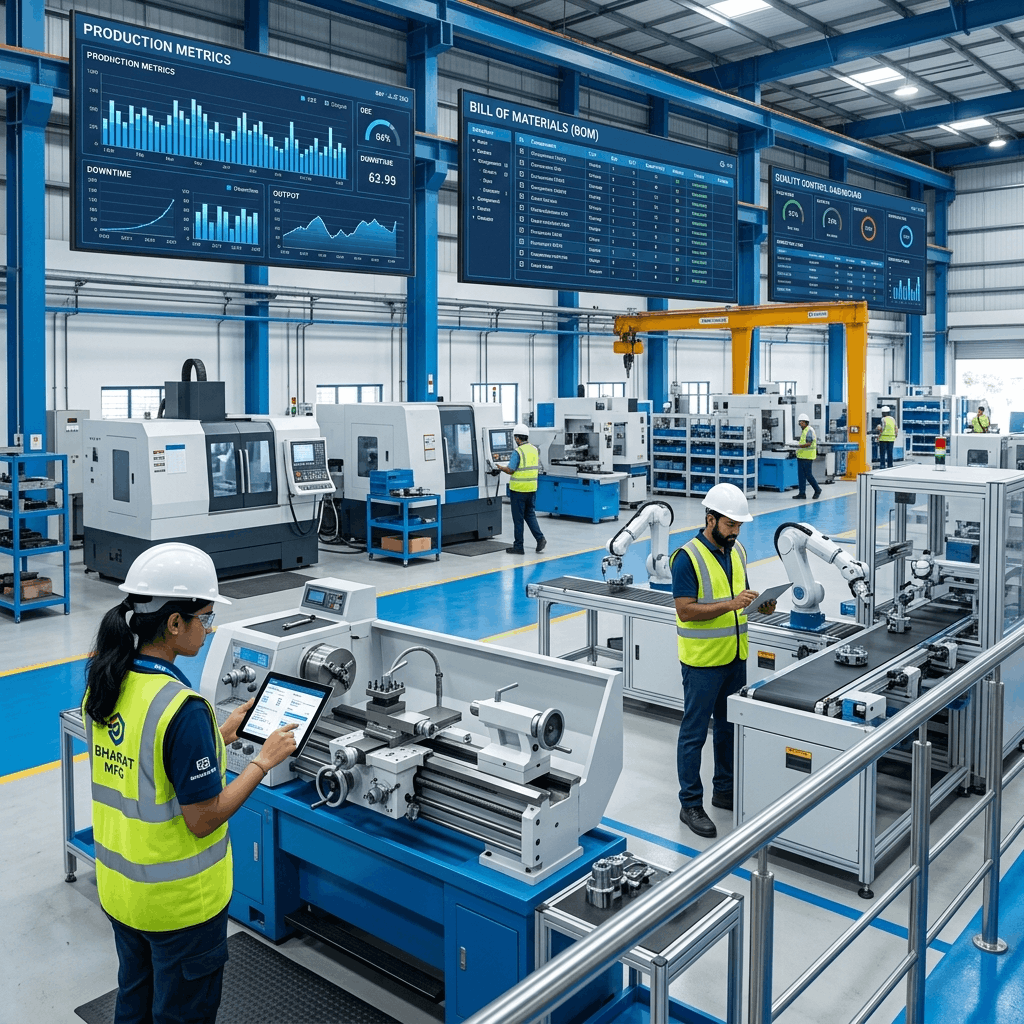
Choosing the right ERP software for your manufacturing company is one of the most consequential technology decisions you will make. The wrong choice leads to years of costly workarounds and frustrated employees. The right choice delivers measurable ROI within 12 months — reduced inventory, faster production cycles, better quality control, and real-time financial visibility. This guide helps Indian manufacturing companies make that decision with confidence.
What to Look for in Manufacturing ERP Software
Not all ERP systems are built for manufacturing. Generic accounting software masquerading as ERP will fail your production team. A true manufacturing ERP must include: Bill of Materials (BOM) with multi-level support for assemblies and sub-assemblies, Material Requirements Planning (MRP) that automatically calculates what to buy and when, Production Order Management with real-time work-in-progress tracking, Shop Floor Control for machine scheduling and operator performance, Job Costing to understand the true cost of each production run, and Quality Management with inspection checklists and rejection tracking.
Manufacturing ERP Features: Tier 1 vs Tier 2 vs Tier 3
Manufacturing ERP systems fall into three tiers based on size and complexity:
- Tier 1 (SAP, Oracle): Designed for enterprises with 1,000+ employees. Costs ₹5–₹50 crore to implement. Not suitable for Indian SMBs.
- Tier 2 (Microsoft Dynamics, Epicor): Mid-market solutions for 200–1,000 employees. Implementation costs ₹1–₹10 crore. Powerful but complex.
- Tier 3 (Delight ERP, Tally ERP): Designed for Indian SMBs with 10–500 employees. Cloud-first, affordable subscription pricing, quick implementation, GST-native.
For Indian manufacturing SMBs, Tier 3 cloud-native solutions deliver 80% of Tier 1 functionality at 10% of the cost.
Top Manufacturing ERP Modules Every Company Needs
Here are the essential modules for Indian manufacturing companies:
1. Production Planning & Scheduling
Auto-generates production schedules based on sales orders and available capacity. Prevents over-scheduling and identifies bottlenecks before they cause delays. Delight ERP's production module supports both make-to-order and make-to-stock workflows.
2. Bill of Materials Management
Multi-level BOM support is critical for manufacturers with assemblies. Change one component in the BOM and the system automatically updates cost calculations across all finished goods.
3. Inventory & Store Management
Raw material, WIP, and finished goods inventory across multiple stores and locations. Batch tracking, serial number tracking, and FIFO costing for accurate P&L.
4. Quality Control
Inspection at goods receipt, in-process quality checks, and final inspection before dispatch. Rejection tracking with reason codes helps identify systemic quality issues.
GST Compliance for Manufacturers: What ERP Must Handle
Indian manufacturers face complex GST compliance requirements that generic software cannot handle effectively:
- Input Tax Credit (ITC): Manufacturing involves multiple layers of procurement — raw materials, consumables, capital goods. Your ERP must track ITC for each category separately (eligible, ineligible, capital goods amortisation).
- Job Work: Sending materials to job workers under GST requires challan issuance, tracking return within time limits, and ITC reversal for non-returned goods.
- E-Invoicing: Mandatory for manufacturers above ₹5 crore turnover. Your ERP must generate IRN and QR codes directly through IRP integration.
- Reverse Charge Mechanism (RCM): Purchases from unregistered vendors attract RCM. The ERP must auto-identify and book these liabilities.
How to Evaluate Manufacturing ERP Vendors
Use this structured scorecard when evaluating vendors:
| Criterion | Weight | What to Check |
|---|---|---|
| Functional fit | 30% | Demo with your actual data, not canned demos |
| Industry references | 20% | Ask for 3 references in your specific industry |
| Implementation capability | 20% | Number of certified consultants, average go-live time |
| GST & compliance | 15% | E-invoicing, GSTR-2B reconciliation |
| Total cost of ownership | 15% | Include implementation, training, annual cost |
Delight Manufacturing ERP
MRP · Multi-level BOM · Shop floor control · Job costing · Quality management for Indian manufacturers
Book Free Demo →Manufacturing ERP Implementation: Step-by-Step Guide
A successful manufacturing ERP implementation follows these phases:
- Requirement Gathering (2 weeks): Document all manufacturing processes, exception cases, and integration requirements. Map current workflows to ERP standard processes.
- Master Data Preparation (2 weeks): Clean and standardise item master (with HSN codes, UOM, standard costs), customer master, and vendor master data.
- System Configuration (4 weeks): Setup BOM structures, production routing, warehouse locations, chart of accounts, and GST configuration.
- UAT & Training (2 weeks): Test with production team using real data. Train all user groups — store, production, quality, finance, management.
- Go-Live & Hypercare (2 weeks): Parallel run if possible, then cutover. Intensive support during first month.
Expected ROI from Manufacturing ERP
Based on Delight ERP customer data across 150+ manufacturing implementations:
A mid-sized pump manufacturer in Rajkot with 120 employees saw: inventory carrying costs reduced by ₹68 lakhs annually, production schedule adherence improved from 64% to 91%, and customer complaints down 67% — all within 9 months of go-live.
Conclusion
Choosing the right manufacturing ERP transforms your factory from a cost centre into a competitive advantage. With real-time production visibility, automated GST compliance, and integrated quality management, you can quote faster, deliver on time, and know your true profitability on every job. Delight ERP is purpose-built for Indian manufacturers — with deep expertise across 50+ manufacturing sub-sectors and proven implementations in Rajkot, Ahmedabad, Pune, and across India.
Frequently Asked Questions
MRP · Multi-level BOM · Shop floor control · Job costing · Quality management for Indian manufacturers