
Introduction: The Productivity Imperative in Industrial Manufacturing
Industrial manufacturing is the backbone of the global economy, involving the production of heavy machinery, automotive components, aerospace parts, and complex structural materials. In this high-stakes environment, the margins for error are incredibly thin. Global competition is fierce, supply chains are increasingly volatile, and the costs of raw materials, labor, and energy continue to fluctuate unpredictably. To maintain profitability and secure a competitive edge, industrial manufacturers cannot simply rely on working harder; they must work exponentially smarter. The key to unlocking this heightened state of efficiency lies in maximizing productivity across every square inch of the factory floor and every node of the supply chain.
Historically, many industrial manufacturers have managed their complex operations using a patchwork of disconnected systems—spreadsheets for production scheduling, legacy software for accounting, and whiteboards for shop floor management. This fragmented approach inevitably leads to massive inefficiencies: machines sit idle waiting for delayed raw materials, production bottlenecks go unnoticed until deadlines are missed, and countless labor hours are wasted on duplicate data entry. To overcome these archaic limitations, forward-thinking manufacturers are embracing comprehensive Enterprise Resource Planning (ERP) software as the cornerstone of their digital transformation strategy.
A robust, manufacturing-centric ERP system is not merely an IT upgrade; it is a fundamental re-engineering of the business process. It acts as a digital nervous system, seamlessly integrating engineering, procurement, production, quality control, inventory, and sales into a single, cohesive platform. By breaking down departmental silos and providing real-time visibility into every operational facet, an ERP system empowers manufacturers to optimize their resources with unprecedented precision. In this extensive article, we will explore the top 5 ways that implementing a modern ERP software drastically boosts productivity in industrial manufacturing companies, turning operational chaos into synchronized efficiency.
Way 1: Dynamic Production Planning and Scheduling
In industrial manufacturing, time is quite literally money. If a multi-million dollar CNC machine is sitting idle because of a scheduling conflict, the company is bleeding capital. Creating an optimal production schedule manually is a Herculean task, often requiring planners to balance machine capacity, labor availability, raw material constraints, and shifting customer delivery dates. A single urgent order can throw a manually created schedule into complete disarray. A modern ERP system revolutionizes this process through dynamic, algorithmic production planning and scheduling tools.
Automating the Master Production Schedule (MPS)
An ERP system automatically generates a Master Production Schedule (MPS) by analyzing historical sales data, current customer orders, and projected demand forecasts. It evaluates the exact capacity of every machine and the availability of skilled labor on the shop floor. Instead of a planner spending hours updating spreadsheets, the ERP instantly generates a highly optimized schedule that maximizes machine utilization and minimizes changeover times. If an urgent, high-margin order comes in, the system can dynamically recalculate the entire schedule, suggesting the least disruptive way to accommodate the new job while still meeting existing critical deadlines.
Constraint-Based Routing
Industrial manufacturing often involves complex, multi-stage routing where a component must pass through cutting, welding, milling, and assembly. An ERP system understands the constraints of each routing step. For example, if a specific welding station is undergoing maintenance, the ERP automatically routes the workflow to an alternative, available station, preventing a massive bottleneck. This intelligent, constraint-based routing ensures a smooth, continuous flow of materials through the factory, significantly boosting overall throughput and productivity.
Way 2: Real-Time Shop Floor Control and Visibility
The factory floor is the beating heart of an industrial manufacturing company. Yet, paradoxically, it is often the area where management has the least real-time visibility. Relying on end-of-shift paper reports means that management only learns about a machine breakdown or a drop in production speed hours after the fact. A manufacturing ERP introduces comprehensive Shop Floor Control (SFC) mechanisms, digitizing the factory floor and providing instantaneous visibility into every operation.
Digitizing Work Orders and Instructions
Paper-based work orders are easily lost, damaged, or misinterpreted. With an ERP, work orders are digitized and delivered directly to tablets or ruggedized screens at individual workstations. Operators receive real-time access to the most current CAD drawings, precise assembly instructions, and quality control checklists. This eliminates the time wasted searching for documentation and drastically reduces manufacturing errors caused by using outdated engineering blueprints.
Tracking Overall Equipment Effectiveness (OEE)
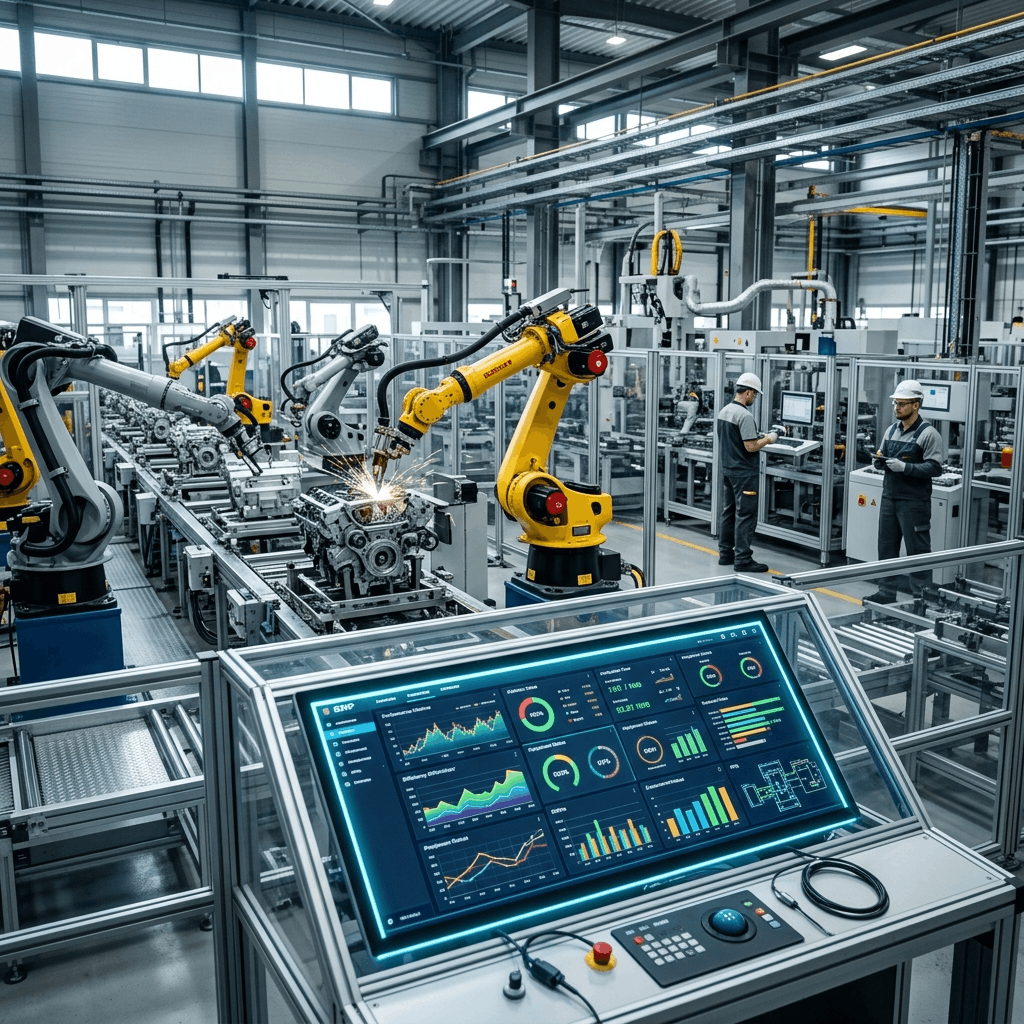
Modern ERP systems integrate directly with IoT (Internet of Things) sensors embedded in manufacturing machinery. This allows the ERP to automatically track machine run times, cycle speeds, and defect rates in real-time, calculating the Overall Equipment Effectiveness (OEE). If a machine’s performance drops below a designated threshold, the system immediately flags the issue on a centralized dashboard. Floor supervisors can instantly intervene—perhaps adjusting a machine calibration or providing additional operator training—before the minor inefficiency cascades into a major production shortfall. This immediate feedback loop is critical for maintaining high productivity levels.
Quick Contact for ERP Evaluation
Are you ready to modernize your factory floor and boost production efficiency? Fill out this quick form, and our manufacturing software experts will contact you for a personalized ERP evaluation.
Request a Manufacturing ERP Demo
Way 3: Optimized Inventory and Material Requirements Planning (MRP)
In industrial manufacturing, inventory is a double-edged sword. Holding too little raw material risks catastrophic production halts; holding too much ties up vital working capital and takes up expensive warehouse space. Striking the perfect balance manually is virtually impossible given the complexities of long lead times, variable supplier reliability, and fluctuating demand. An ERP system solves this through highly sophisticated inventory management and Material Requirements Planning (MRP).
Just-in-Time (JIT) Manufacturing Enablement
The core principle of MRP within an ERP is to ensure that the right materials arrive at the right workstation at the exact moment they are needed—enabling Just-in-Time (JIT) manufacturing. The ERP analyzes the production schedule, explodes the Bill of Materials (BOM) for every product, calculates the required raw materials, checks current inventory levels, and factors in supplier lead times. It then automatically generates precise purchase orders. This precision eliminates the need for massive "just in case" safety stocks, freeing up warehouse space and significantly reducing carrying costs, which directly improves the company's financial productivity.
Automating Procurement Workflows
The procurement process in many companies is bogged down by manual approvals, emails, and phone calls. An ERP automates this entirely. When inventory levels for a critical component drop below the reorder point, the system automatically triggers a purchase requisition. Depending on the value, it routes the request through a digital approval chain to the appropriate managers. Once approved, the PO is electronically dispatched to the vendor. This automation allows the procurement team to stop acting as order-placers and start acting as strategic negotiators, focusing their energy on securing better vendor contracts and bulk pricing discounts.
Way 4: Automated Preventive Maintenance
Unplanned machine downtime is the silent killer of manufacturing productivity. When a critical piece of equipment breaks down unexpectedly, the entire production line grinds to a halt. Operators stand idle, delivery deadlines are missed, and expensive emergency repairs must be commissioned. Traditional "run-to-failure" or manual calendar-based maintenance schedules are deeply inefficient. A modern ERP system integrates equipment maintenance directly into the operational workflow through automated preventive and predictive maintenance strategies.
Scheduling Based on Actual Utilization
Instead of scheduling maintenance arbitrarily every three months, an ERP system schedules maintenance based on actual machine utilization data collected from the shop floor. If a CNC machine is rated for maintenance every 5,000 hours of operation, the ERP tracks those hours precisely. When the machine approaches 4,800 hours, the system automatically generates a maintenance work order, reserves the necessary spare parts from inventory, and flags the production scheduler to route jobs away from that machine during the planned maintenance window. This ensures that maintenance occurs exactly when needed, maximizing the lifespan of the equipment while minimizing disruption to the production schedule.
Predictive Maintenance Capabilities
Advanced ERP systems leverage AI and IoT data to move beyond preventive maintenance into predictive maintenance. By analyzing historical breakdown data and monitoring real-time indicators like machine vibration, temperature, or power consumption, the ERP can predict a failure before it actually occurs. Alerting technicians to a slight anomaly allows them to replace a degrading bearing during a scheduled shift change, preventing a catastrophic motor failure during peak production hours. This predictive capability virtually eliminates unplanned downtime, ensuring maximum equipment productivity.
Way 5: Unified Data Architecture for Faster Decision Making
In a fast-paced industrial environment, management must make critical decisions rapidly. Should we accept this rush order? Are we pricing this custom fabrication job profitably? Do we need to authorize overtime this weekend? When data is scattered across multiple systems—sales data in a CRM, production data on spreadsheets, financial data in an accounting package—gathering the necessary information to answer these questions takes hours or even days. By the time the data is compiled, the opportunity may be lost.
The Single Source of Truth
The ultimate value of an ERP system lies in its unified data architecture. It establishes a "single source of truth" for the entire enterprise. When an executive opens their ERP dashboard, they are looking at real-time, highly accurate data synthesized from every department. They can instantly see current cash flow, outstanding receivables, real-time factory floor output, and inventory valuations. This immediate access to comprehensive data empowers leadership to make highly informed, strategic decisions instantaneously.
Accurate Job Costing and Profitability Tracking
Industrial manufacturing often involves highly customized, project-based work. Accurately determining the profitability of these jobs is notoriously difficult using manual methods. An ERP system tracks every single cost associated with a job in real-time—the exact cost of raw materials consumed, the precise labor hours logged by operators, and the allocated machine overhead costs. By comparing these actual costs against the initial estimated costs, management gains crystal-clear visibility into job profitability. This data allows the sales team to quote future jobs more accurately and enables production teams to identify and eliminate specific inefficiencies, driving sustained profitability across the enterprise.
Conclusion: Forging a More Productive Future
The challenges facing industrial manufacturing companies are complex and relentless. However, the tools available to overcome these challenges have never been more powerful. A comprehensive manufacturing ERP system is no longer an optional luxury for large corporations; it is a critical necessity for any industrial manufacturer looking to survive and thrive in the modern era.
By implementing dynamic production scheduling, manufacturers can ensure their expensive machinery is utilized to its absolute maximum potential. Real-time shop floor control digitizes the factory, providing the visibility needed to instantly identify and resolve inefficiencies. Advanced MRP capabilities strip away costly excess inventory while ensuring materials are always available precisely when needed. Automated preventive maintenance transforms unexpected breakdowns into planned, manageable events. And finally, a unified data architecture provides leadership with the real-time intelligence required to make rapid, strategic decisions.
Transitioning to an ERP system requires vision, commitment, and a willingness to embrace change. But the reward—a massive, sustainable boost in enterprise productivity, a drastic reduction in operational waste, and a fortified competitive advantage—is well worth the effort. It is time to leave the fragmented spreadsheets behind and forge a smarter, more productive future with an integrated ERP solution.
Streamline operations, reduce costs, and scale faster with Delight ERP.