
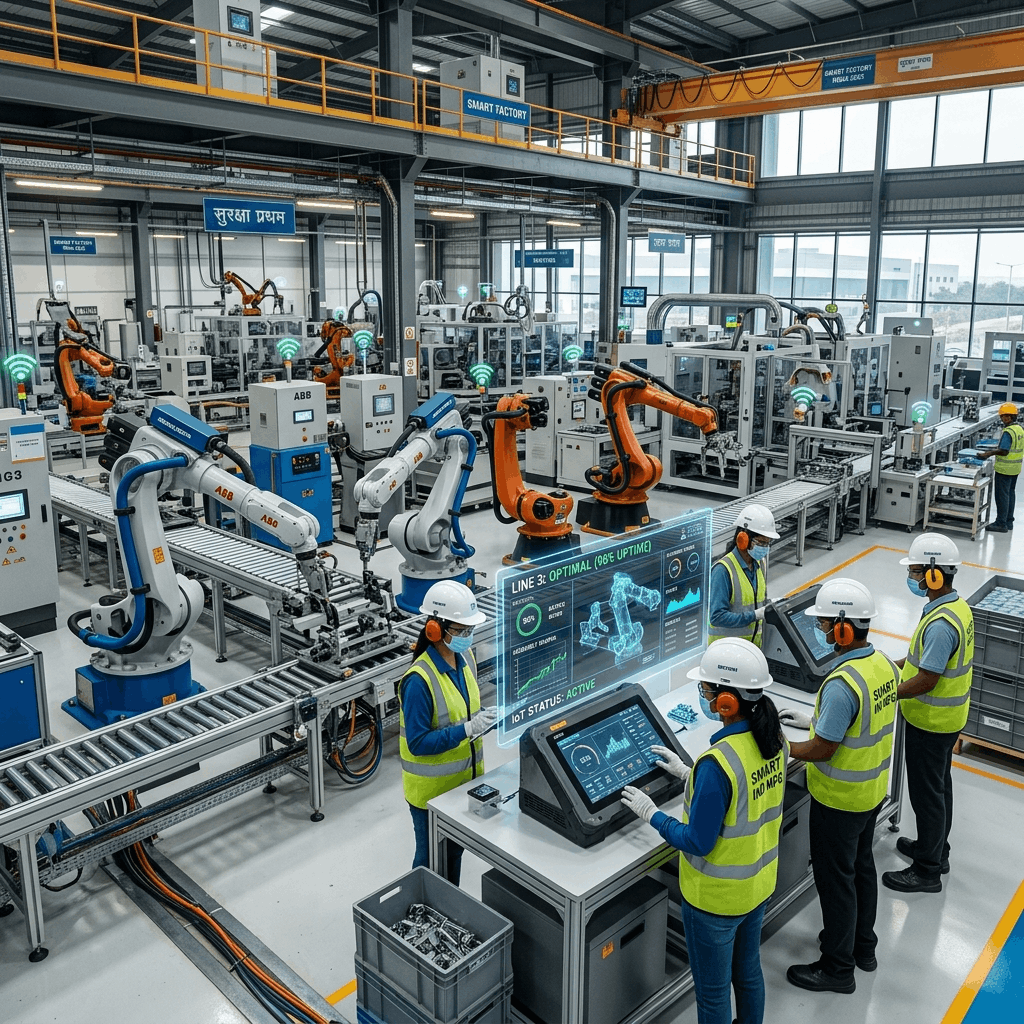
The manufacturing sector is undergoing its most profound transformation in a generation. Driven by the pressures of global competition, rising labour costs, volatile supply chains, and the disruptive force of Industry 4.0 technologies, manufacturers who fail to adapt risk irrelevance within this decade. For Indian manufacturers — who now supply everything from automotive components to pharmaceuticals to global brands — understanding and embracing these trends is not optional; it is existential.
This comprehensive guide explores the 8 key trends shaping the manufacturing industry in 2025 and 2026, with a particular focus on how Indian businesses can leverage these shifts to build sustainable competitive advantages. Crucially, we examine how a modern Manufacturing ERP system like Delight ERP serves as the technological backbone that makes all of these trends actionable.
The Manufacturing Landscape in 2025: Why Adaptation Is Urgent
India's manufacturing sector contributes approximately 17% to GDP and employs over 57 million people. The government's ambitious "Make in India" initiative, combined with the China+1 sourcing strategy adopted by global multinationals, presents a historic opportunity for Indian manufacturers to capture a larger share of global production. But capitalising on this opportunity requires more than low-cost labour — it demands technological sophistication, operational excellence, and supply chain reliability that can only be delivered through digital transformation.
The manufacturers winning in 2025 share a common characteristic: they have invested in integrated digital infrastructure — connecting their factory floors, supply chains, sales teams, and financial systems into unified platforms that provide real-time intelligence and enable rapid decision-making. The 8 trends below represent the building blocks of this digital transformation.
Trend 1: Artificial Intelligence & Machine Learning in Production
Artificial intelligence has moved from the research lab to the factory floor. In 2025, AI is not a future technology — it is a current competitive necessity for manufacturers seeking to eliminate waste, predict failures, and optimise throughput.
Key AI Applications in Manufacturing
- Predictive maintenance: Machine learning algorithms analyse vibration, temperature, and acoustic data from machinery to predict failures 2–4 weeks before they occur. Companies implementing AI predictive maintenance report 30–50% reductions in unplanned downtime and maintenance costs.
- Computer vision quality control: AI-powered cameras inspect every unit at production speed — detecting defects, dimensional deviations, and surface anomalies that human inspectors miss. Rejection rates drop by 60–80% in documented implementations.
- Dynamic production scheduling: AI optimises work orders across machines, operators, and work centres in real time — accounting for machine breakdowns, rush orders, and material shortages that make static schedules obsolete within hours of creation.
- Demand forecasting: AI analyses historical orders, seasonal patterns, and market signals to predict demand with 15–20% higher accuracy than traditional statistical methods — enabling more precise supply chain planning.
- Scrap and rework reduction: Pattern recognition identifies the process parameters (temperature, speed, pressure) that correlate with defects — enabling operators to adjust in real time before defects occur.
Delight ERP's Production Management module integrates AI-driven scheduling with real-time machine data, enabling manufacturers to implement intelligent production planning without building a data science team.
Trend 2: Smart Factories & Industrial IoT Integration
The "Smart Factory" — a production environment where machines, materials, and systems communicate with each other and with management systems in real time — is rapidly transitioning from aspiration to operational reality. By 2025, the Industrial Internet of Things (IIoT) has made smart factory connectivity affordable even for mid-sized Indian manufacturers.
What Makes a Factory "Smart"
- Machine connectivity: IoT sensors embedded in CNC machines, injection moulding presses, assembly robots, and material handling equipment transmit performance data (OEE, cycle time, energy consumption) to the ERP every few seconds.
- Real-time OEE monitoring: Supervisors see live OEE dashboards for every production cell — immediately identifying whether slowdowns are due to availability (unplanned stoppages), performance (running below standard speed), or quality (defects requiring rework).
- Digital twin technology: Virtual replicas of production lines allow engineers to simulate process changes, new product introductions, and capacity additions before implementing them physically — dramatically reducing the cost and risk of factory reconfiguration.
- Automated material tracking: RFID and barcode-enabled material movement tracking ensures that work-in-progress inventory is always visible — eliminating the hours wasted searching for partially completed jobs on complex factory floors.
- Energy management: Smart meters and energy monitoring sensors help manufacturers track and reduce energy consumption — a critical cost driver that typically represents 15–25% of variable production costs in Indian manufacturing.
Trend 3: Supply Chain Resilience & Nearshoring
The fragility of global just-in-time supply chains — brutally exposed by the COVID-19 pandemic, the Suez Canal blockage, and ongoing geopolitical tensions — has driven manufacturers to fundamentally rethink their sourcing strategies. In 2025, supply chain resilience is the top strategic priority for manufacturing leadership worldwide.
The New Supply Chain Playbook
- Supplier diversification: Manufacturers are reducing dependence on single-source suppliers by qualifying multiple vendors for critical components. This requires Vendor Management Software capable of tracking supplier performance, certifications, and capacity across complex multi-tier networks.
- Strategic buffer stock: The pendulum is swinging from pure just-in-time (zero inventory) toward a hybrid model that maintains strategic buffer stock for high-risk components while keeping standard items on JIT schedules.
- Nearshoring and domestic sourcing: Bringing production and sourcing closer to end markets reduces supply chain exposure to geopolitical risks and dramatically shortens lead times. India is a major beneficiary of this trend as global brands near-shore away from China.
- Real-time supply chain visibility: Manufacturers need live visibility into their supply chains — knowing exactly where every shipment is, which suppliers are running late, and which components are at risk of shortage — before problems impact production.
- Scenario planning and risk analytics: Advanced ERP platforms now include supply chain risk modelling — simulating the impact of supplier failures, port closures, or demand spikes before they materialise.
| Supply Chain Strategy | Pre-2020 Approach | 2025 Best Practice |
|---|---|---|
| Supplier philosophy | Single-source for lowest cost | Dual/multi-source for resilience |
| Inventory strategy | Pure JIT (zero buffer) | Hybrid JIT + strategic buffer |
| Visibility tools | Spreadsheets, phone calls | Real-time ERP dashboards |
| Risk management | Reactive (respond after disruption) | Proactive (predict and prevent) |
| Sourcing geography | Lowest cost globally | Balanced cost + proximity + risk |
Trend 4: Hyper-Automation & Collaborative Robotics
Hyper-automation — the application of advanced technologies including Robotic Process Automation (RPA), artificial intelligence, and collaborative robots (cobots) to automate as many business and production processes as possible — is fundamentally changing the economics of manufacturing.
From Automation to Hyper-Automation
- Collaborative robots (cobots): Unlike traditional industrial robots that operate in caged areas away from humans, cobots work alongside human operators on shared tasks. They handle repetitive, physically demanding, or high-precision assembly operations — freeing human workers for judgment-intensive tasks. Cobots are now affordable for Indian SME manufacturers, with ROI periods as low as 12 months for high-volume repetitive applications.
- Robotic Process Automation in back office: RPA bots handle data entry, invoice processing, purchase order creation, and compliance reporting — eliminating manual data re-entry between systems and reducing administrative headcount requirements by 30–50% for routine transactional tasks.
- Automated guided vehicles (AGVs): Self-navigating AGVs move materials, work-in-progress, and finished goods around the factory floor autonomously — eliminating manual material handling and the associated labour costs, injuries, and inefficiencies.
- ERP integration as the automation backbone: All automation initiatives require ERP integration to be truly effective. When a cobot completes an assembly operation, the ERP must automatically update work order progress, deduct materials from inventory, and trigger the next production step — creating a seamless, data-accurate automated workflow.
Delight ERP's Production Management software includes open APIs designed to integrate with leading cobot and automation platforms — enabling manufacturers to connect physical automation with digital workflows seamlessly.
Trend 5: Sustainability & Circular Economy
Environmental, Social, and Governance (ESG) requirements have moved from corporate responsibility reports to contractual obligations. Global brands now require their Indian supplier manufacturers to demonstrate measurable sustainability performance — making green manufacturing not just ethically important but commercially essential.
How ERP Enables Sustainable Manufacturing
- Carbon footprint tracking: ERP systems can track energy consumption, material inputs, and waste generation at the product level — enabling manufacturers to calculate and report scope 1 and scope 2 carbon emissions accurately.
- Waste and scrap management: The Manufacturing ERP tracks scrap generation by production centre, material, and operator — enabling root cause analysis and targeted waste reduction programmes.
- Material traceability: Full traceability from raw material supplier to finished product enables manufacturers to demonstrate responsible sourcing, comply with conflict minerals regulations, and implement product recall processes efficiently.
- Circular economy practices: ERP supports circular economy initiatives including returned goods processing, refurbishment workflows, and materials reuse tracking — creating value from waste streams.
- Supplier sustainability scoring: Vendor management modules can include sustainability performance metrics — enabling manufacturers to preference suppliers with strong ESG credentials.
Trend 6: Additive Manufacturing & 3D Printing
Additive manufacturing (3D printing) is advancing beyond prototyping into genuine production applications. In 2025, manufacturers are using industrial 3D printing for spare parts production, tooling and jigs, low-volume customised components, and increasingly for end-use production parts in aerospace, medical devices, and automotive sectors.
Strategic Benefits for Manufacturers
- On-demand spare parts: Instead of stocking thousands of low-turnover spare parts in warehouses (expensive), manufacturers can maintain digital designs and print parts on demand — reducing spare parts inventory carrying costs by 40–60%.
- Design freedom for complex geometries: Additive manufacturing creates internal geometries, lattice structures, and integrated features that are impossible with traditional subtractive methods — enabling lighter, stronger, and more efficient components.
- Rapid customisation: Mass customisation at scale — producing personalised products without the setup costs of traditional tooling — becomes viable with additive manufacturing, opening new market segments.
- ERP integration for additive workflows: Managing additive manufacturing alongside traditional production requires ERP updates: special Bill of Materials structures for print jobs, quality inspection protocols for printed parts, and material consumption tracking for printing filaments, powders, and resins.
Trend 7: Augmented Reality for Training & Maintenance
Augmented Reality (AR) and Virtual Reality (VR) are transforming two critical manufacturing challenges: training new workers at scale and maintaining complex machinery efficiently. For Indian manufacturers dealing with skilled labour shortages and high technician turnover, these technologies offer transformative potential.
AR/VR Applications That Deliver Real ROI
- Guided maintenance with AR headsets: Maintenance technicians wearing AR glasses see digital overlays of maintenance procedures, part identifications, and torque specifications directly on the physical machinery. This reduces the expertise required for complex maintenance tasks and cuts maintenance time by 30–50%.
- Immersive operator training: New operators can be trained on virtual production lines before touching real equipment — learning processes without the risk of machine damage, material waste, or safety incidents. Training time for complex processes reduces from weeks to days.
- Remote expert assistance: When complex problems arise, AR allows off-site experts to see exactly what the on-site technician sees and provide real-time guidance — eliminating expensive expert travel and dramatically reducing problem resolution time.
- Digital work instructions: Step-by-step assembly instructions delivered through AR headsets or tablets replace paper SOPs — ensuring operators always follow current procedures and can confirm each step before proceeding.
The data powering AR systems — equipment specifications, maintenance histories, current work orders, quality standards — is all managed within the ERP system, making ERP integration essential for effective AR implementation.
Trend 8: Cloud-First ERP Architecture
The first seven trends share a common requirement: they all generate, consume, and depend on massive volumes of real-time data. Legacy on-premise ERP systems — designed in an era when data was batched and processed overnight — are fundamentally incapable of handling this data velocity. Cloud-first ERP architecture is not just a technology preference; it is a prerequisite for Industry 4.0 adoption.
Why Cloud ERP Is the Foundation of Modern Manufacturing
- Unlimited scalability: As manufacturers add IoT sensors, production lines, and business units, cloud ERP scales instantly — without hardware procurement, installation delays, or capacity planning anxiety.
- Real-time accessibility: Plant managers, procurement teams, sales executives, and directors can access live production data, inventory levels, and financial performance from any device, anywhere — enabling faster and better-informed decisions.
- Automatic updates: Cloud ERP providers continuously update their platforms with new features, security patches, and technology integrations — ensuring manufacturers always have access to the latest capabilities without expensive upgrade projects.
- API-first integration: Modern cloud ERPs like Delight ERP are built with open APIs that connect natively to IoT platforms, e-commerce systems, CRM tools, logistics providers, and government compliance platforms (GST, e-way bill, e-invoicing).
- Disaster recovery: Enterprise-grade cloud infrastructure provides automatic backup, geographic redundancy, and 99.9%+ uptime SLAs — far superior to the disaster recovery capabilities of most on-premise ERP deployments.
- Lower total cost of ownership: Cloud ERP eliminates hardware costs, IT infrastructure maintenance, and expensive upgrade projects — reducing the total cost of ERP ownership by 30–50% over a 5-year period.
How Delight ERP Powers All 8 Manufacturing Trends
Understanding trends is one thing. Having the technology to act on them is another. Delight ERP is purpose-built for Indian manufacturers — designed to address the specific operational, compliance, and business challenges faced by manufacturing companies across industries including engineering, textiles, food & beverage, chemicals, pharmaceuticals, and more.
Delight ERP Modules That Drive Trend Adoption
- Production Management: AI-enabled production scheduling, BOM management, work order tracking, and quality control — the foundation for smart factory operations.
- Supply Chain Management: End-to-end supplier management, automated procurement, and real-time inventory visibility across multiple warehouses and locations.
- Manufacturing ERP: Integrated platform connecting production, inventory, sales, purchase, finance, and HR into a single source of truth.
- CRM Software: Connects customer orders and requirements directly into production planning — ensuring customer demand drives manufacturing decisions.
- Mobile ERP Apps: Real-time production data access for floor supervisors, field managers, and executives — on any smartphone or tablet.
- GST & Compliance: Built-in GST invoicing, e-way bill generation, e-invoicing (IRN), and TDS/TCS management — ensuring regulatory compliance without separate tools.
Conclusion: The Manufacturers Who Win in 2025
The manufacturing trends of 2025 are clear, powerful, and accelerating. AI is making factories smarter. IIoT is making them more connected. Supply chain resilience is becoming a competitive differentiator. Sustainability is becoming a market access requirement. And cloud ERP is the infrastructure that makes all of it possible.
Indian manufacturers have a genuine, historic opportunity to capture greater global manufacturing share — but only if they build the technological foundation to match global capability standards. The cost of inaction is not stagnation; it is progressive obsolescence in an industry that is changing faster than any generation before has experienced.
The journey begins with a modern, integrated Manufacturing ERP that connects your factory floor, supply chain, sales team, and financial operations into one intelligent platform. From there, each of the 8 trends becomes an incremental step forward — each one building on the digital foundation that your ERP provides.
Streamline operations, reduce costs, and scale faster with Delight ERP.