
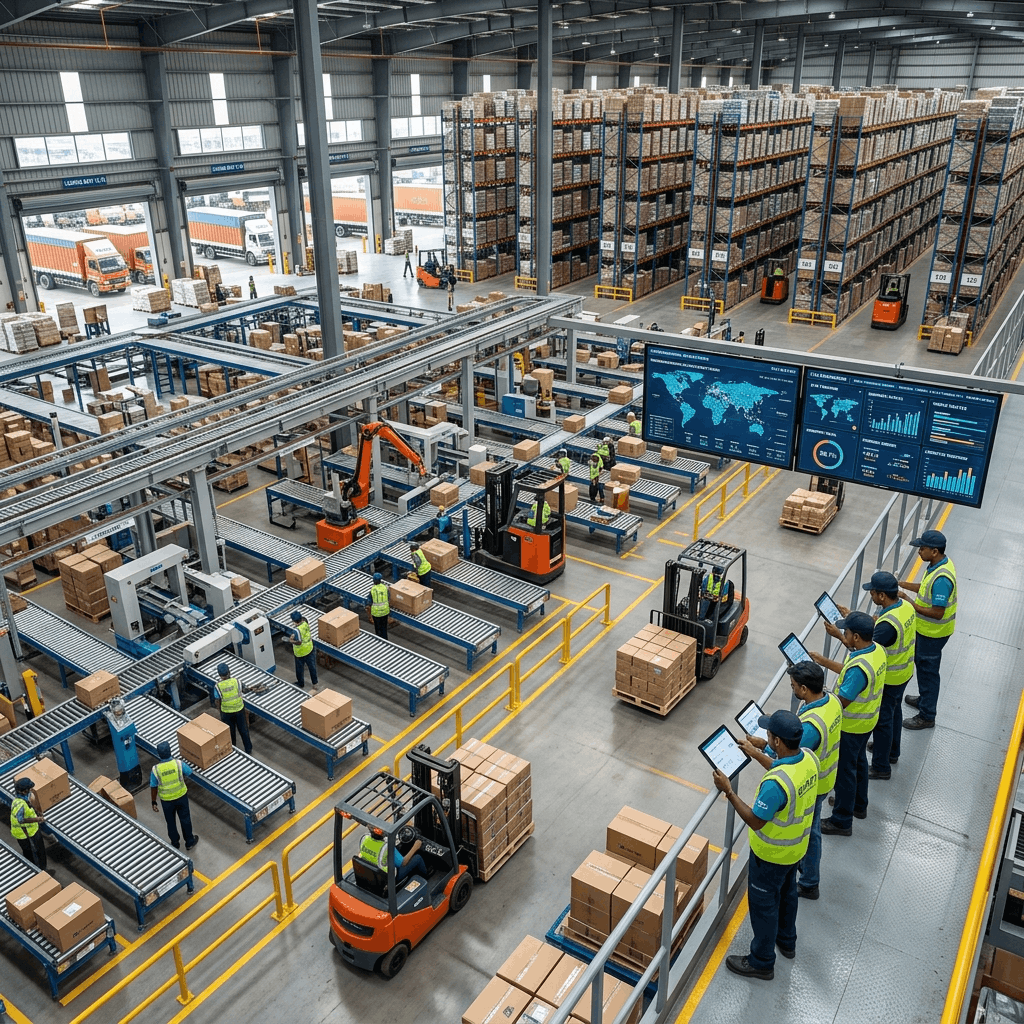
In today's hyper-competitive global market, a slow and opaque supply chain is not just an operational inconvenience — it is a strategic liability that costs businesses customers, margins, and market position every single day. For Indian manufacturers and distributors, supply chain inefficiencies manifest as chronic stockouts, late deliveries, bloated inventory, and poor supplier relationships that collectively drain profitability.
The solution is not working harder within broken manual processes. The solution is a fundamental technological transformation — moving from fragmented spreadsheets, phone calls, and WhatsApp groups to an integrated, real-time Supply Chain Management ERP platform. This comprehensive guide explores exactly how Delight ERP accelerates every facet of your supply chain — and what measurable results Indian businesses are achieving.
Why Indian Supply Chains Need Urgent Modernisation
The typical Indian mid-sized manufacturer or distributor manages their supply chain through a patchwork of tools: Tally for accounting, Excel sheets for inventory, WhatsApp for supplier communication, and verbal instructions for warehouse operations. This approach worked adequately when business was simpler and competition was local. In 2026, it is catastrophically inadequate.
Consider the operational reality: a sales order is received. Someone manually checks a spreadsheet (which may or may not be current) to confirm stock. The purchase team calls the supplier. The supplier says they can deliver in 10 days. Nobody informs the customer. The delivery happens 15 days later. The customer is frustrated. Meanwhile, two other customers placed similar orders and received no stock because nobody updated the inventory spreadsheet after the first commitment. This scenario — repeated hundreds of times daily across thousands of Indian businesses — represents billions in lost revenue and customer relationships.
The Three Root Causes of Supply Chain Failure
- Information silos: Different departments (purchase, stores, production, sales) have different, inconsistent views of inventory, orders, and commitments — leading to systematic errors and delays.
- Reactive management: Problems are only visible after they occur — stockouts are discovered when orders can't be fulfilled, supplier issues surface when deliveries are late, quality problems emerge during final inspection. Proactive intervention is impossible without real-time data.
- Manual processes: Every transaction — purchase orders, goods receipts, stock transfers, dispatch documents, invoices — requires manual data entry, creating bottlenecks, errors, and delays throughout the supply chain.
Delight ERP addresses all three root causes simultaneously — replacing silos with integration, reactive management with real-time intelligence, and manual processes with automation.
End-to-End Visibility: The Foundation of Fast Supply Chains
The cornerstone of modern supply chain management is complete, real-time visibility across the entire supply chain — from supplier to customer. Without visibility, every decision is a guess. With visibility, every decision is informed.
What Real Supply Chain Visibility Looks Like
- Live inventory across all locations: Real-time stock levels at every warehouse, godown, in-transit location, and production floor — accessible by any authorised user from any device. No more "let me check and call you back" delays.
- Purchase order tracking: Every purchase order is tracked from creation through supplier acknowledgment, dispatch, transit, and goods receipt — with automatic alerts when expected deliveries are delayed or quantities are short-shipped.
- Production-supply linkage: Production planning and supply chain are connected — so when a production plan is created, the system automatically calculates material requirements and highlights gaps between planned needs and available stock.
- Sales order to delivery tracking: Every customer order is tracked from receipt through production scheduling, inventory allocation, dispatch, and delivery confirmation — giving sales teams accurate ETAs to communicate to customers.
- Supplier performance visibility: Historical supplier data — on-time delivery rate, quality rejection rate, lead time accuracy, price variance — is visible at a glance, enabling informed sourcing decisions.
Automated Procurement & Vendor Management
Manual procurement — telephone quotes, paper purchase orders, manual approvals, physical filing — is slow, error-prone, and provides zero visibility. Delight ERP transforms procurement from a reactive, manual function into an automated, strategic operation.
Procurement Automation That Delivers Results
- Automatic reorder triggering: The system continuously monitors inventory levels and automatically generates purchase requisitions when stock falls below reorder points — accounting for supplier lead times to ensure materials arrive before production needs them.
- Material Requirements Planning (MRP): The MRP engine calculates precise material requirements based on confirmed sales orders and production schedules — generating purchase needs by item, quantity, and required date. No more manual BOM explosion by production planners.
- Request for Quotation (RFQ) management: Send RFQs to multiple suppliers simultaneously from within the ERP — with structured response templates that capture pricing, delivery commitment, and terms in a comparable format for easy decision-making.
- Comparative quotation analysis: The system generates automatic comparative statements showing quoted prices against historical purchase prices, enabling buyers to identify the best value option quickly and document their decision rationale.
- Purchase order workflow: Configurable approval workflows route POs through the right approvers based on amount, category, or supplier — with mobile approval capabilities so managers can approve from anywhere.
- Three-way matching: Automatic matching of Purchase Order, Goods Receipt Note, and Supplier Invoice — preventing payment on items not ordered, not received, or priced incorrectly.
Comprehensive Vendor Management
A supply chain is only as strong as its supplier relationships. Delight ERP provides a complete Vendor Management System that enables strategic supplier management:
- Supplier master database: Centralised repository of all supplier information — contact details, payment terms, GST details, quality certifications, bank accounts, approved items — maintained in one place and accessible to all authorised teams.
- Supplier performance scoring: Automatic calculation of supplier KPIs: on-time delivery rate, acceptance rate (goods not rejected), price variance, and responsiveness — enabling data-driven vendor rationalisation and preferred vendor strategies.
- Quality inspection integration: Incoming goods inspections are recorded in the ERP against specific purchase orders — with quality acceptance, partial acceptance, or rejection decisions tracked against each supplier and reflected in their performance scores.
- Supplier-wise profitability analysis: Compare the true cost of procurement from different suppliers — including purchase price, inspection rejection rate, freight, and payment terms impact — to identify the genuinely best-value supplier for each item.
| Procurement Activity | Manual Process Time | With Delight ERP | Time Saving |
|---|---|---|---|
| Purchase requisition creation | 30–60 minutes | Automated / 5 minutes | 85%+ |
| Supplier quotation comparison | 2–4 hours | Automated comparison: 15 min | 80%+ |
| Purchase order creation | 20–45 minutes | 5–10 minutes | 75%+ |
| Invoice matching and payment | 1–2 days | 3-way auto-match: 30 min | 90%+ |
| Supplier performance review | Weekly manual report: 4 hours | Real-time dashboard | 100% |
Dynamic Inventory Optimisation with MRP
Inventory is simultaneously one of the largest assets and one of the biggest cost centres for manufacturing and distribution businesses. Too much inventory ties up working capital and generates carrying costs (typically 18–25% of inventory value per year when you include financing, storage, insurance, obsolescence, and handling). Too little inventory causes stockouts, production stoppages, and lost customer orders. The goal is the optimal middle ground — and only data-driven inventory management achieves it.
How Delight ERP Optimises Inventory
- ABC-XYZ analysis: Automatic classification of items by value (A/B/C) and demand variability (X/Y/Z) — enabling targeted inventory management strategies: tight control for high-value items, safety stock for variable-demand items, and min-max reordering for stable, low-value items.
- Demand forecasting: Statistical forecasting algorithms analyse historical sales data, seasonal patterns, and trend information to project future demand — reducing forecast error by 20–30% compared to manual judgement.
- Safety stock calculation: The system calculates safety stock requirements based on demand variability and supplier lead time variability — ensuring that normal variation is covered without excessive stockpiling.
- Economic Order Quantity (EOQ): Automatic EOQ calculations balance the cost of ordering (setup costs, procurement costs) against the cost of holding inventory — identifying the optimal order quantity for each item.
- Slow-moving and obsolete stock alerts: Items that haven't moved in 60, 90, or 180 days are flagged automatically — enabling proactive action (promotion, liquidation, return to vendor) before dead stock value deteriorates further.
- Lot and batch tracking: FIFO/FEFO inventory management with batch tracking ensures older stock is used first and provides complete traceability for quality or recall purposes.
Streamlined Warehouse Operations
The warehouse is where supply chain plans meet physical reality — and where many businesses experience their highest levels of error, waste, and inefficiency. A fast supply chain requires a highly efficient warehouse operation, and that requires digital tools.
Warehouse Management with Delight ERP
- Barcode and QR code scanning: Eliminate manual data entry errors in goods receipt, putaway, picking, and dispatch. Every transaction is captured at the point of action with a scan — ensuring the inventory database reflects reality, not memory.
- Location management: Define warehouse locations down to aisle-rack-bin level. The system directs workers to exact locations for putaway and picking — eliminating search time and supporting FIFO discipline automatically.
- Mobile warehouse operations: Warehouse staff use mobile devices (smartphones, tablets, or rugged handheld terminals) to receive dispatch orders, scan confirmations, and record transactions — replacing paper pick lists that are error-prone and create data-entry delays.
- Goods Receipt Note (GRN) processing: When a supplier truck arrives, the warehouse team processes the GRN on a mobile device — scanning items, confirming quantities, recording quality inspection results, and triggering automatic inventory and financial updates simultaneously.
- Dispatch and delivery documentation: Generate delivery challans, e-way bills, and customer invoices directly from the ERP at the point of dispatch — ensuring paperwork is accurate and complete without back-office delays.
- Physical stock verification: Cycle count and full stock take features enable regular inventory verification without halting warehouse operations — maintaining inventory accuracy throughout the year rather than discovering discrepancies in annual stock takes.
B2B Customer & Dealer Portal
Supply chains are ecosystems — they include not just your internal operations but also your dealer network, distributors, and B2B customers. Delight ERP's B2B Customer Portal extends supply chain visibility and self-service capabilities to your external partners.
What the B2B Portal Delivers
- 24×7 order placement: Dealers and distributors place orders directly through the portal — eliminating phone calls, WhatsApp messages, and email orders that create bottleneck at your customer service team.
- Live stock visibility: Partners see real-time stock availability for all items — making informed orders without calling your team. Out-of-stock items show expected availability dates based on open purchase orders.
- Order tracking: Partners track their orders from placement through dispatch confirmation and delivery — without calling your logistics team for status updates.
- Invoice and payment history: Dealers access their complete order history, invoices, credit notes, and payment records — reducing billing queries and outstanding disputes.
- Scheme and pricing transparency: Current pricing, trade discounts, promotional schemes, and credit limits are visible to each dealer based on their tier — eliminating confusion and pricing disputes.
- Complaint and service requests: Dealers log product complaints and service requests directly through the portal — integrated with the Service CRM for seamless handling.
Advanced Logistics & Route Optimisation
For businesses managing their own delivery fleet, logistics is often the highest-cost and lowest-visibility component of the supply chain. Delight ERP's logistics management capabilities transform delivery operations from a cost centre into a competitive advantage.
Logistics Capabilities in Delight ERP
- Delivery route planning: Group multiple delivery destinations by geography, vehicle capacity, and delivery time windows — generating optimised routes that maximise the number of deliveries per vehicle per day while minimising fuel consumption.
- Vehicle and driver management: Maintain complete vehicle records — registration, insurance, PUC, maintenance history, and fuel consumption — alongside driver performance tracking including on-time delivery rate and customer satisfaction scores.
- GPS tracking integration: Real-time GPS tracking of delivery vehicles provides dispatch teams with live visibility — enabling accurate ETAs for customer queries and immediate response to route deviations or vehicle breakdowns.
- Proof of delivery (POD): Drivers capture customer signatures, photos of delivered goods, and delivery confirmation on their smartphones — instantly updating the ERP and generating billing triggers without paperwork delays.
- E-way bill generation: Automatic GST-compliant e-way bill generation for all inter-state and qualifying intra-state shipments — integrated with the GST portal for direct submission without manual re-entry.
Risk Mitigation with Real-Time Analytics
Supply chain risk — whether from supplier failure, demand spikes, quality issues, or logistical disruptions — cannot be eliminated. But it can be identified early and managed proactively. Delight ERP's analytics and alerting capabilities transform supply chain risk management from reactive firefighting to proactive risk mitigation.
Supply Chain Risk Intelligence
- Critical material alerts: Automatic alerts when stock levels of production-critical materials approach minimum thresholds — giving procurement teams lead time to source alternatives before production is impacted.
- Supplier concentration risk: The system highlights where single-supplier dependency creates business risk — enabling category managers to qualify alternative suppliers before a crisis occurs.
- Demand deviation monitoring: Alerts when actual sales orders significantly exceed or fall below forecasted demand — enabling rapid inventory and procurement adjustments before imbalances become crises.
- Quality trend analysis: Track quality rejection rates by supplier, material category, and time period. Identify suppliers whose quality is deteriorating before it creates a production stoppage.
- Cash flow impact analysis: Integrate supply chain decisions with financial planning — show the working capital impact of planned purchases and help finance teams anticipate cash flow requirements accurately.
Compliance, Traceability & GST Integration
Indian supply chain compliance requirements have increased dramatically in recent years — GST, e-way bills, e-invoicing (IRN), TDS/TCS on purchases, and sector-specific regulations. Delight ERP is built with Indian compliance requirements as a native capability — not an add-on.
Compliance Built into Every Transaction
- GST-compliant purchase orders and invoices: Every transaction automatically applies correct GST rates (CGST/SGST/IGST), HSN codes, and generates GST-compliant documents — eliminating manual tax calculation errors.
- E-way bill automation: E-way bills are generated automatically during dispatch document creation and submitted directly to the GST portal — without any manual data re-entry.
- E-invoicing (IRN): For applicable taxpayers, purchase invoices received from vendors and sales invoices issued are processed through the Invoice Reference Number (IRN) system — maintaining full compliance with e-invoicing mandates.
- Lot and serial number traceability: Complete forward and backward traceability — trace any finished product back to the raw material batch, or trace any raw material batch forward to all finished products it was used in. Essential for quality recalls and regulatory audits.
- FSSAI, BIS, and sector compliance: Industry-specific compliance requirements (food safety lot tracking, BIS certification records, pharmaceutical batch records) are supported within the ERP's traceability framework.
Measuring Supply Chain Performance: KPIs That Matter
You cannot manage what you cannot measure. Delight ERP provides pre-built and customisable dashboards for all critical supply chain KPIs — enabling leadership to track performance, identify trends, and make data-driven decisions.
| KPI | Definition | Industry Benchmark |
|---|---|---|
| Order Fill Rate | % of orders fulfilled completely from stock | > 95% |
| On-Time Delivery Rate | % of orders delivered by committed date | > 92% |
| Inventory Turnover Ratio | Annual sales / Average inventory value | 8–12x (manufacturing) |
| Days Inventory Outstanding (DIO) | Average days inventory is held | < 30 days |
| Purchase Order Cycle Time | Days from PR to PO issued | < 2 days |
| Supplier On-Time Delivery | % of supplier deliveries arriving on committed date | > 90% |
| Goods Receipt Rejection Rate | % of received goods rejected for quality | < 2% |
Delight ERP's business intelligence module generates these metrics automatically from transactional data — eliminating the hours your team spends manually compiling reports from spreadsheets and providing leadership with real-time performance visibility through mobile-accessible dashboards.
Conclusion: Transform Your Supply Chain with Delight ERP
A supply chain is not just a logistics function — it is the operational backbone of your business. Every day your supply chain operates with fragmented information, manual processes, and reactive management, your business is leaving money on the table: in excess inventory, lost sales, customer attrition, and procurement overpayment.
Delight ERP provides the integrated, real-time, automation-driven supply chain management platform that Indian businesses need to compete effectively in 2026 and beyond. From automated procurement and intelligent inventory optimisation to dealer portals and logistics tracking — every capability is designed for the specific operational reality of Indian manufacturing and distribution businesses.
The combination of Supply Chain Management, Manufacturing ERP, and CRM within Delight's integrated platform creates a single source of truth that connects customer demand to supply chain response — ensuring your business delivers on its commitments, every time.
Streamline operations, reduce costs, and scale faster with Delight ERP.