
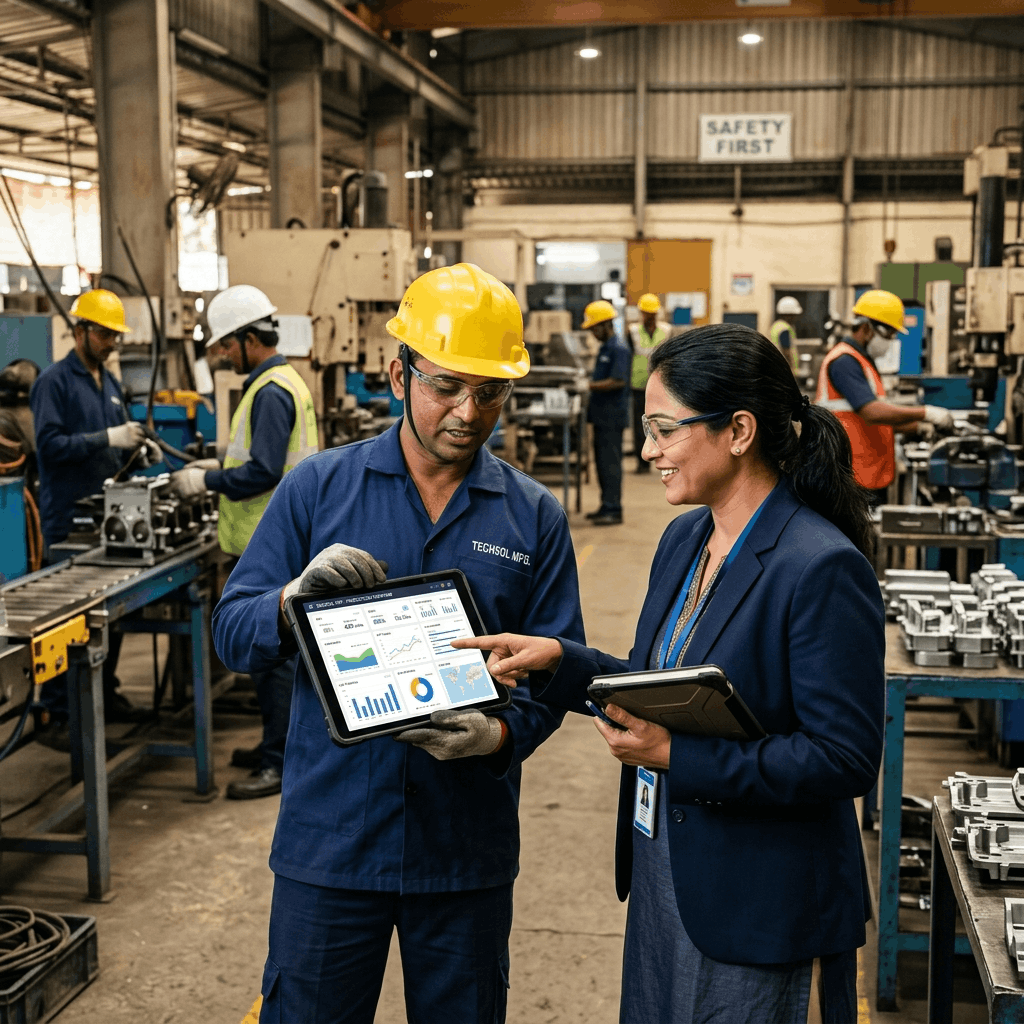
The modern Indian business workforce is no longer tethered to a desk. From sales representatives visiting factories across three states to warehouse managers coordinating shipments across multiple godowns, and field service technicians repairing equipment at customer sites — business happens on the move, every minute of every working day.
Yet most Indian businesses still run their ERP systems as desktop-only tools — requiring employees to physically return to the office to enter data, check information, or get approvals. Every journey back to the desk represents lost time, delayed decisions, data entered hours after the fact, and opportunities missed. This is why Mobile ERP has transitioned from a luxury feature to an operational necessity for competitive Indian businesses in 2026.
This comprehensive guide explores the transformative benefits of Mobile ERP, with specific focus on how it impacts field sales, service operations, warehouse management, and production — and how Delight ERP's mobile capabilities are built for the specific needs of Indian businesses.
Why Mobile ERP Is Now Essential for Indian Business
India's smartphone penetration exceeded 750 million users in 2025, with affordable 4G and 5G connectivity reaching even tier-3 cities and industrial areas. The technological infrastructure for Mobile ERP is now ubiquitous across Indian business environments. The question is no longer whether mobile access is possible — it is why your business isn't using it yet.
The economic case for Mobile ERP is straightforward. Consider a field sales representative who visits 8 customer sites per day. Under a desktop ERP model, they carry a notebook, write down customer orders and feedback, and spend 2 hours each evening entering data into the ERP back at the office — hours that could be spent on additional customer visits. With Mobile ERP, the same data is entered on-site immediately after each customer interaction, taking 5 minutes rather than 15. The sales rep gains 2 hours of additional customer-facing time per day — a 25% increase in productive selling time with zero additional headcount.
Real-Time Data Access: Anywhere, Anytime
The most fundamental benefit of Mobile ERP is the democratisation of information — putting accurate, real-time business data in the hands of everyone who needs it, wherever they are, the moment they need it.
The Business Impact of Universal Data Access
- Eliminate "I'll check and call you back": When a dealer asks a sales rep whether a specific item is in stock, the sales rep checks the live ERP database on their smartphone and gives an accurate answer immediately — instead of promising to call back after checking with the office. This one capability accelerates the sales cycle and builds customer confidence.
- Live pricing and scheme information: Sales teams always have access to current pricing, active promotional schemes, customer-specific discounts, and credit limits — preventing the embarrassing situation of quoting incorrect prices or offering schemes that have ended.
- Customer account visibility: Before a customer visit, a sales rep reviews the customer's complete account — outstanding invoices, order history, purchase trends, service tickets, and any notes from previous interactions — arriving prepared for a more productive conversation.
- Production status for customer communication: Sales executives can see live production status for specific customer orders — giving accurate, credible delivery estimates rather than generic commitments that damage credibility when they're missed.
- Financial metrics for management: Directors and owners see live P&L, cash position, and key KPIs on their phones — enabling informed business discussions and faster responses to financial challenges.
Empowering the Field Sales Team
The field sales team is the revenue engine of any manufacturing or distribution business. The difference between a good and great sales team is often not talent or customer relationships — it is the tools they have access to. Mobile ERP transforms field sales productivity in measurable ways.
Mobile ERP Capabilities for Field Sales
- On-site order creation: Sales reps create sales orders directly on their tablets while sitting with the customer — with item selection, quantity entry, price confirmation, and credit limit check happening in real time. Orders enter the system instantly, triggering production planning and inventory reservation without any office intermediary.
- GPS visit tracking: Sales managers see the real-time location of every sales rep, daily visit records, time spent at each customer, and geographic coverage — enabling better route planning, territory management, and activity coaching without invasive micro-management.
- Lead and follow-up management: All prospect interactions, quotations, follow-up commitments, and pipeline stages are captured through the mobile CRM — ensuring no opportunity falls through the cracks due to forgotten follow-ups.
- Beat planning and journey optimisation: The system suggests optimal daily visit routes based on pending customer follow-ups, overdue outstanding collections, and new prospect visits — maximising the productive customer-facing hours of each sales rep.
- Collection management: Sales reps collect outstanding payments, record cheque details, and issue digital receipts on the spot — with immediate ERP updates that the accounts team can see in real time, without a physical cheque reaching the office first.
- Competitor intelligence capture: Structured forms allow sales reps to log competitor product presence, pricing, and customer feedback during visits — feeding market intelligence into the business for product and strategy decisions.
Revolutionising Field Service & Maintenance
For companies with after-sales service operations — equipment manufacturers, HVAC companies, industrial machinery suppliers, home appliance service networks — field service is often the most operationally complex and customer-facing function in the business. Mobile ERP is transformational for field service management.
Complete Mobile Service Management
- Real-time job assignments: Service coordinators assign jobs to technicians from the desktop — technicians receive instant push notifications on their smartphones with full job details: customer name, location, contact, equipment details, and service history.
- GPS navigation to customer site: One-tap integration with mapping apps navigates technicians to the customer location — eliminating the time wasted on phone calls asking for directions.
- Complete service history on mobile: Before arriving at the customer site, technicians review the equipment's complete service history — previous repairs, parts replaced, recurring issues, and any customer notes — arriving prepared to diagnose and resolve efficiently.
- Digital job sheets: Technicians record service activities on their mobile — diagnosis findings, actions taken, parts used, time spent, and travel — replacing paper job sheets that were lost, illegible, or delayed billing by days.
- Photo documentation: Before-and-after photos of service work are captured and attached to the service ticket — providing evidence of work quality and protecting against customer disputes.
- Customer signature capture: Digital customer signature on job completion confirms service delivery and automatically triggers invoice generation — reducing billing disputes and accelerating cash collection.
- Spare parts management: Technicians request spare parts from the field — the system checks inventory availability and triggers dispatch to the service location, with real-time tracking of parts in transit.
- Warranty and AMC validation: The mobile app automatically checks whether the equipment is under warranty or AMC and displays coverage terms — ensuring technicians know whether the service is chargeable before beginning work.
| Field Service Metric | Paper-Based Operations | Mobile ERP |
|---|---|---|
| Job assignment communication | Phone call: 5–10 min delay | Instant push notification |
| Service history access | Call office: 15–30 min delay | Instant on mobile |
| Job completion documentation | Paper form, office entry next day | Digital, real-time |
| Invoice generation after service | 2–5 days | Same day (automatic trigger) |
| Customer satisfaction survey | Manual call or form | Automated SMS/WhatsApp |
Transforming Warehouse & Logistics Operations
The warehouse is where supply chain theory meets physical reality. Inaccurate inventory records, picking errors, and slow receiving processes all trace back to one root cause: data is not captured at the point of action. Mobile ERP with barcode scanning capabilities solves this permanently.
Warehouse Digitalisation with Mobile ERP
- Barcode-driven goods receipt: When a supplier truck arrives, the warehouse team scans item barcodes on the incoming goods using mobile devices — instantly matching against the purchase order, recording quantities, and flagging discrepancies without manual data entry.
- Guided picking with optimal routes: Pickers receive digital pick lists on their mobile devices with items ordered by warehouse location sequence — reducing travel distance and picking time by 20–35% compared to paper pick lists.
- Real-time inventory updates: Every scan — receipt, transfer, pick, dispatch — instantly updates the central inventory database. At any moment, the system reflects the true physical state of the warehouse, not a stale approximation from last night's batch update.
- Bin-level location management: Mobile scanning supports precise bin-level inventory management — directing workers to exact rack-row-bin locations and confirming the correct item is picked through scan verification.
- Proof of delivery capture: Delivery drivers capture customer signatures and delivery photos on their mobile devices at the point of delivery — creating an auditable POD record that triggers billing and eliminates delivery disputes.
- Stock transfer between locations: Internal stock transfers between warehouses, production locations, or retail outlets are processed through mobile scanning — with automatic in-transit stock tracking and receiving confirmation.
Production Floor Digitalisation
The production floor has traditionally been the most paper-intensive area of manufacturing operations — paper work orders, paper job cards, paper quality checklists. Mobile ERP brings digital efficiency to production without requiring workers to leave the floor to enter data.
Mobile ERP on the Factory Floor
- Digital work orders: Operators receive work order assignments on floor-mounted tablets or handheld devices — with complete instructions, quantities, specifications, and BOM details. No more waiting for the production planning team to print and distribute work orders.
- Production progress reporting: Operators log production quantities — good output, rework, scrap — directly on the production floor as they work. Production managers see live production progress in real time, without waiting for end-of-shift manual tallies.
- Machine downtime recording: When a machine stops, operators log the downtime reason on a mobile device immediately — enabling accurate downtime analysis and maintenance scheduling based on real data rather than supervisor estimates.
- Quality inspection logging: Quality inspectors perform in-process inspections and record results on tablets at the inspection station — triggering hold notifications for non-conforming materials and automatic escalations for critical defects.
- Material issuance confirmation: Store keepers confirm raw material issuance to production jobs using mobile scanning — ensuring BOM-accurate material consumption is recorded and inventory is updated without delays.
Delight ERP's Production Management module supports floor-level mobile integration, enabling manufacturers to achieve real-time production visibility without expensive proprietary hardware.
Faster Decision-Making & Mobile Approvals
Business bottlenecks frequently occur at approval points — where processes pause waiting for a manager's sign-off. When managers are travelling, in meetings, or at customer sites, these pauses can stretch from hours to days, creating costly delays across the business.
Mobile Approval Workflows
- Purchase order approvals: Procurement teams submit POs for approval — managers receive push notifications and approve or reject with one tap from their smartphone, with the system tracking approval time and escalating if unanswered within the configured SLA.
- Sales order confirmation: Large orders requiring special pricing or credit limit exceptions are routed to sales managers for approval — eliminating the scenario where orders sit waiting for a manager to return to the office.
- Leave and expense approvals: HR workflows — leave requests, travel expense approvals, advance payments — are processed through mobile notifications, keeping employees informed and processes moving regardless of manager location.
- Production plan approvals: Production supervisors confirm shift completion and production quantity totals through mobile — with immediate visibility to planning teams for next-day scheduling decisions.
- Credit limit overrides: When a sales rep requests a credit exception for a valuable customer, the request reaches the finance manager's smartphone immediately — with complete customer credit history — enabling real-time decisions rather than day-long waits.
Improving Data Accuracy at the Source
One of the most significant but least discussed benefits of Mobile ERP is its dramatic impact on data quality. In paper-based and desktop ERP environments, data is captured in two stages: first on paper or in memory, then transferred into the computer. This double-handling introduces transcription errors, missing information, and timing delays that compound into significant business intelligence failures.
Point-of-Activity Data Capture
- Eliminating transcription errors: When data is entered into a mobile device at the point of the transaction, there is no paper intermediary to misread or lose. Barcode scanning eliminates item code errors entirely — the most common source of inventory discrepancies.
- Timestamp accuracy: Mobile ERP captures the exact time of each transaction — when goods were received, when a service was completed, when a payment was collected — rather than the time the office data entry happened. This improves accuracy of performance analytics and compliance documentation.
- Mandatory field enforcement: Mobile app forms enforce mandatory data fields at the point of capture — preventing incomplete records that create data gaps requiring costly follow-up investigation.
- Photo evidence: Mobile devices capture photographic evidence of goods conditions, service work performed, and delivery states — creating irrefutable records that resolve customer disputes and insurance claims efficiently.
- GPS coordinates: Transactions captured on mobile devices record GPS coordinates automatically — providing location proof for service visits, delivery confirmations, and sales meetings that supports accountability and eliminates falsification.
Executive Mobility & Real-Time Business Intelligence
For business owners and senior executives, Mobile ERP transforms how they stay informed and in control of their business — whether they're at a trade show in Mumbai, visiting a major customer in Delhi, or at a board meeting in Bengaluru.
Executive Dashboard Capabilities
- Live P&L and cash position: Real-time profitability metrics — revenue, gross margin, operating expenses, EBITDA — updated continuously as transactions are processed. No more waiting for the weekly finance report to know how the business is performing.
- Sales performance by rep and region: Daily, weekly, and MTD sales performance by individual, team, territory, and product category — with drill-down capability to understand what's driving variances from target.
- Production status dashboard: Live production output vs. plan, quality metrics, machine OEE, and pending order status — giving operations directors complete factory visibility from their smartphone.
- Inventory and cash flow alerts: Automated alerts for critical situations — stock below safety level, customer credit limit exceeded, outstanding payments overdue — reaching the right executive's phone before problems become crises.
- Comparative performance analytics: Month-over-month and year-over-year performance comparisons with trend lines — enabling strategic business conversations backed by accurate, current data.
Choosing the Right Mobile ERP for Indian Business
Not all Mobile ERP solutions are created equal. When evaluating Mobile ERP for your Indian business, prioritise these capabilities:
- Native Android and iOS apps: Purpose-built mobile apps provide better performance, offline capabilities, and user experience compared to mobile-responsive web interfaces. Ensure the ERP vendor offers dedicated apps, not just a mobile browser version.
- Offline mode support: Indian business environments include factory floors, remote customer sites, and rural areas where connectivity is inconsistent. Offline mode — allowing data capture without live internet — is essential, not optional.
- Role-based mobile access: Different users need different mobile capabilities. A sales rep needs CRM and order functions; a warehouse worker needs scanning and stock functions; an executive needs dashboards. The Mobile ERP must support role-based configurations without requiring custom development.
- Indian language support: For floor-level workers, ERP interfaces available in local languages (Hindi, Gujarati, Marathi, Tamil) dramatically improve adoption and data accuracy.
- GST compliance on mobile: The ability to generate GST-compliant invoices, e-way bills, and receipts from mobile devices — without returning to the office — is essential for Indian business compliance.
- Integration with WhatsApp and communication tools: The ability to share quotations, invoices, and service updates directly from the ERP to WhatsApp — the primary business communication tool in India — significantly improves adoption and customer experience.
Delight ERP's mobile capabilities are built specifically for Indian business requirements — with dedicated Android and iOS apps, offline mode, GST compliance on mobile, WhatsApp integration, and role-based configurations across sales, service, warehouse, and production functions. The Field Sales Tracking and Service CRM modules provide the most comprehensive mobile functionality in the Indian mid-market ERP category.
Conclusion: Mobile ERP Is Not a Feature — It's a Foundation
Mobile ERP has crossed from innovation to necessity. In an environment where business happens on factory floors, at customer sites, in warehouses, and on roads — restricting your ERP to a desktop is like restricting your telephone to your office desk. The business world has moved; your business tools must move with it.
The benefits are not incremental — they are transformative. Sales teams sell more and sell faster. Service teams resolve issues on first visits. Warehouse operations achieve higher accuracy with less labour. Executives make informed decisions from anywhere. And the entire business operates with real-time data rather than yesterday's approximations.
For Indian manufacturers and distributors ready to move from desktop to mobile ERP, Delight ERP provides the complete, integrated platform — connecting field operations, production, supply chain, sales, and finance in one mobile-first system designed for the specific needs of Indian business.
Streamline operations, reduce costs, and scale faster with Delight ERP.