
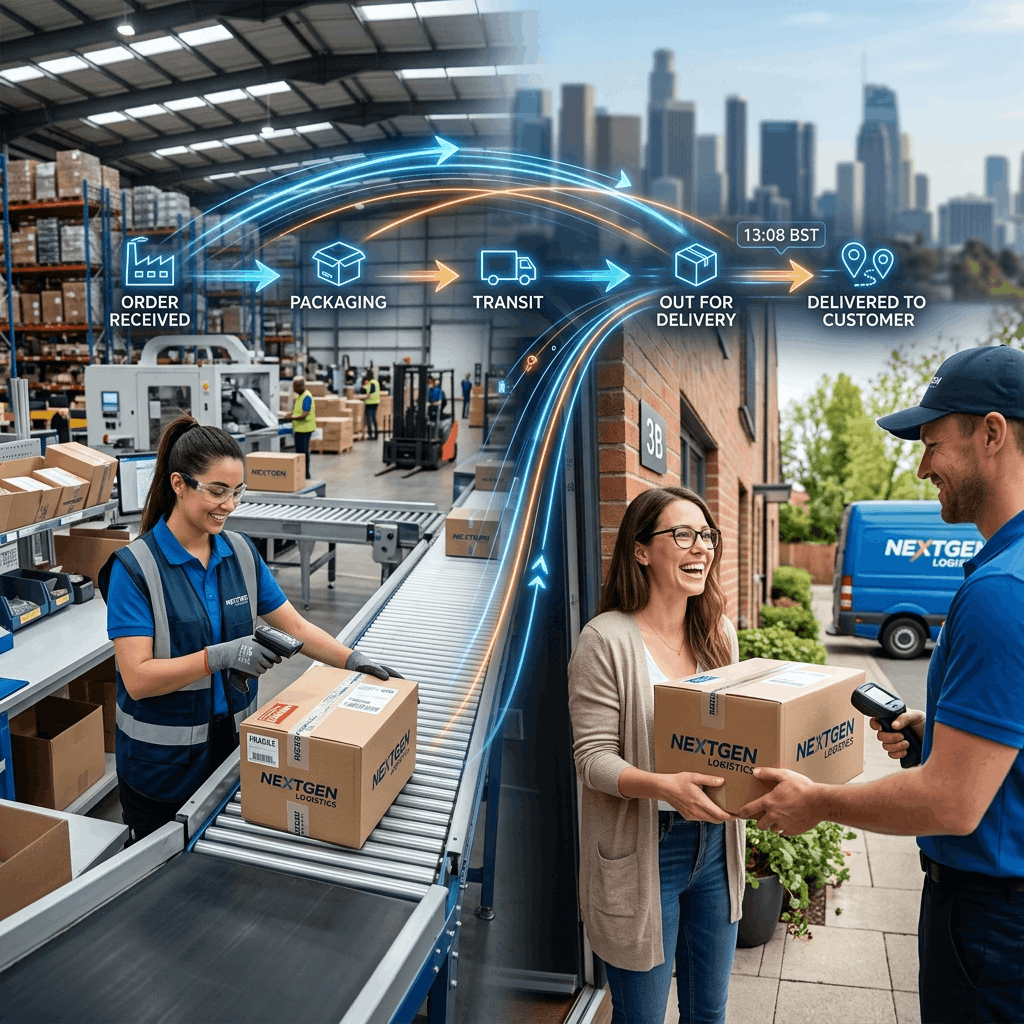
In traditional distribution and retail, the business model is straightforward but capital-intensive: purchase goods from suppliers, store them in a warehouse, and ship to customers when orders arrive. The warehouse is the business — and it consumes capital in rent, staff, insurance, and carrying costs every single day, regardless of whether goods are moving or gathering dust.
Progressive Indian distributors, manufacturers, and retailers are increasingly embracing a more capital-efficient model: direct vendor-to-customer product transfers — commonly called drop shipping. In this model, when a customer places an order, you create a purchase order to your supplier who ships directly to the customer. You never touch the goods, yet you maintain the complete commercial relationship, pricing control, and customer relationship.
When managed through a robust Supply Chain Management ERP system like Delight ERP, this model delivers powerful competitive advantages — freeing working capital, eliminating warehouse overhead, and enabling rapid product range expansion without the risk of unsold inventory. This guide explores all the benefits and the critical role ERP plays in making the model work reliably at scale.
Understanding Vendor-to-Customer Product Transfers
To appreciate the benefits, it's important to understand exactly how vendor-to-customer transfers work — and the key difference from traditional distribution.
Traditional Distribution Model (Multi-Stage)
Customer order → Distributor receives → Distributor picks from warehouse → Distributor packs → Distributor ships to customer
Each stage adds time, cost, and handling risk. The goods travel from supplier warehouse to your warehouse to customer — two legs of physical movement, two sets of handling, two sets of documentation.
Vendor-to-Customer Transfer Model (Direct)
Customer order → ERP generates purchase order to vendor → Vendor ships directly to customer → Distributor invoices customer
The goods travel directly from vendor to customer — one leg of movement, one set of handling, dramatically faster delivery and lower logistics cost.
When Vendor-to-Customer Transfer Makes Strategic Sense
- Large, heavy, or bulky items where double-handling significantly increases logistics costs
- Low-volume, high-value items with unpredictable demand that would generate high carrying costs
- New product trials where you want to test market demand without committing to inventory investment
- Geographic expansion where you want to serve new regions without building local warehouse infrastructure
- Specialty or customised items that require manufacturer-to-customer direct service and installation
- Items with short shelf life or high obsolescence risk in a rapidly evolving product category
Benefit 1: Massive Reduction in Inventory Carrying Costs
The most immediate and quantifiable benefit of vendor-to-customer transfers is the elimination of inventory carrying costs. For Indian businesses, inventory carrying costs typically total 18–25% of inventory value per year — a significant burden on working capital and profitability.
What Inventory Carrying Costs Include
- Capital cost: At typical Indian bank lending rates of 10–14%, money tied up in inventory costs your business 10–14% per year in financing cost alone. This is the largest component of carrying cost and is entirely eliminated for drop-shipped items.
- Warehouse space: Commercial storage space in Indian industrial areas costs ₹15–40 per sq ft per month depending on location. A business holding ₹5 crore in inventory might occupy 5,000–10,000 sq ft — a rental cost of ₹9–48 lakhs annually.
- Labour: Receiving, quality inspection, putaway, picking, packing, and dispatch all require labour. For a mid-sized distributor, warehouse labour might represent ₹20–40 lakhs annually.
- Insurance: Stock insurance typically costs 0.5–1% of inventory value annually — ₹2.5–5 lakhs per ₹5 crore of inventory.
- Obsolescence and damage: Goods that become obsolete or are damaged in storage represent a direct write-off — typically 3–8% of slow-moving inventory value annually for industries with evolving product ranges.
- Utility costs: Warehouse lighting, cooling (for climate-sensitive products), security, and maintenance.
Benefit 2: Expand Product Range Without Risk
One of the most powerful strategic advantages of vendor-to-customer transfers is the ability to dramatically expand your addressable market without bearing the financial risk of unsold inventory.
In a traditional inventory model, adding a new product line requires a financial commitment — you purchase minimum order quantities, stock them in your warehouse, and bear the risk that they don't sell as expected. This financial barrier limits product range expansion and encourages businesses to stay within their established categories.
Risk-Free Product Expansion Through Drop Shipping
- Zero inventory commitment: List a new product in your catalogue and begin marketing it to customers before purchasing a single unit. When the first order arrives, purchase it from your vendor and ship directly. If the product doesn't gain traction, you have zero unsold inventory to write off.
- Market testing at scale: Test new product categories, brands, or price points with real customers and real sales data — without the capital risk that traditionally makes product range decisions conservative and slow.
- Long-tail product catalogue: Offer thousands of low-volume, speciality items that would be impractical to stock — serving niche customer needs that competitors ignore because traditional inventory economics make them unviable.
- Complementary product cross-selling: Expand into complementary product categories to increase revenue per customer without warehouse investment. A machinery distributor can add tooling, consumables, and maintenance supplies from specialist vendors.
Delight ERP's Distribution Management Software supports managing a hybrid catalogue — showing customers your complete product range (including vendor-fulfilled items) with accurate availability and pricing, while routing orders automatically to the correct fulfilment source.
Benefit 3: Faster Order Fulfilment & Customer Delivery
Every additional handling stage in a supply chain adds transit time, cost, and risk. By eliminating the intermediate warehouse leg — products coming to your facility before being re-dispatched to the customer — direct vendor transfers can significantly accelerate delivery times.
Where Time Is Saved in Direct Transfer
- Elimination of inbound logistics: No waiting for goods to arrive at your warehouse before dispatching to the customer. The vendor ships directly — saving typically 1–4 days of inbound transit and receiving time.
- No receiving and putaway delay: Goods received at your warehouse must be inspected, counted, labelled, and stored before they're available for customer orders — a process that takes 1–2 days even in efficient operations. This delay is completely eliminated.
- Vendor proximity advantage: Your vendor may be geographically closer to your customer than your warehouse is. A vendor in Chennai shipping to a customer in Bengaluru is faster and cheaper than routing through your Mumbai warehouse.
- Specialist vendor packaging: Manufacturers often have superior packaging capabilities for their specific products — especially for fragile or heavy items — resulting in fewer transit damages and re-deliveries.
| Fulfilment Stage | Traditional Warehouse Model | Vendor-to-Customer Transfer |
|---|---|---|
| Vendor to warehouse | 2–4 days transit | Eliminated |
| Receiving & inspection | 1–2 days | Eliminated |
| Putaway to shelf | 0.5–1 day | Eliminated |
| Pick, pack, dispatch | 1–2 days | Vendor handles directly |
| Vendor to customer | Not applicable | 2–3 days transit |
| Total delivery time | 7–12 days from order | 3–5 days from order |
Benefit 4: Full Automation Through ERP Integration
Managing drop shipping without ERP automation is operationally fragile. Orders need to be forwarded to vendors promptly, tracking information received and relayed to customers, and billing triggered accurately — all with perfect information flow. Without ERP, this requires constant manual coordination that creates errors, delays, and staff burnout. With ERP, the entire process is automated.
How Delight ERP Automates Vendor Transfers
- Automatic purchase order generation: When a customer sales order is created for a drop-ship item, Delight ERP automatically generates the corresponding vendor purchase order — with the customer's delivery address populated as the shipping address, eliminating manual re-entry and the address errors it causes.
- Vendor portal notification: The purchase order is sent electronically to the vendor through Delight's B2B Vendor Portal — where the vendor can view the order, confirm acceptance, update expected shipping date, and provide tracking information without requiring email or phone communication.
- Real-time vendor stock integration: For vendors with API-enabled systems, Delight ERP syncs vendor stock availability in real time — preventing sales orders for items the vendor is out of stock on, and displaying accurate availability information to your sales team and customers.
- Shipment tracking relay: When the vendor marks an order as shipped with a tracking number, the ERP automatically sends a shipment confirmation notification to the customer — maintaining customer communication without any manual effort.
- Automated billing trigger: Upon vendor confirmation of dispatch (or customer confirmation of receipt, depending on your business terms), the ERP automatically generates the GST-compliant customer invoice — including correct HSN codes, tax rates, and e-invoicing IRN submission for eligible transactions.
- Financial reconciliation: The ERP automatically matches the vendor invoice against the purchase order and goods receipt, and the customer invoice against the sales order — maintaining accurate accounts payable and receivable without manual matching.
Benefit 5: Geographical Independence & Infinite Scalability
Perhaps the most strategically powerful benefit of vendor-to-customer transfers — when combined with ERP automation — is the ability to serve any geography without physical infrastructure. Your business becomes location-agnostic: you can serve customers in Kochi, Kolkata, and Kashmir equally effectively from a single office location.
Geographic Expansion Without Infrastructure Investment
- National coverage without regional warehouses: Serve customers across India through vendor networks without the capital investment of regional distribution centres in each geography. Your vendors' locations become your de facto distribution network.
- Market entry testing: Enter new regional markets with zero fixed cost — list products, generate leads, accept orders, and have vendors ship locally. If the market develops, you have the data to justify a physical presence. If it doesn't, you exit without write-offs.
- Scalability without proportional cost increase: A traditional distributor adding 1,000 orders per day needs more warehouse space, more staff, and more trucks. A drop-ship model scales volume 10x with minimal additional internal cost — the vendor handles the physical fulfilment scaling.
- Time zone and coverage flexibility: With ERP automation handling order routing, vendor communication, and customer updates, your business can effectively process international or overnight orders without corresponding staff coverage.
Benefit 6: Reduced Handling Damage & Returns
Every time a product is handled — unloaded from a truck, moved through a warehouse, picked, repacked, and dispatched — there is risk of damage. Fragile items, precision equipment, and perishable goods are particularly vulnerable to handling damage that triggers costly returns, replacements, and customer complaints.
Direct vendor-to-customer transfers eliminate multiple handling touchpoints. The product is packed once by the manufacturer in purpose-built packaging, and ships directly to the customer without intermediate repackaging. This reduction in handling touchpoints translates directly into lower damage rates, fewer customer returns, and improved customer satisfaction.
Benefit 7: Focus Your Team on Sales & Customer Value
Running a warehouse requires significant management attention — from staff scheduling and picking efficiency to inventory accuracy, space utilisation, and safety compliance. This operational complexity diverts your management team's attention from higher-value activities: building customer relationships, developing new markets, and improving your commercial proposition.
The vendor-to-customer model allows your organisation to focus its human capital on what directly generates revenue and customer loyalty:
- Sales and business development: More time building customer relationships, identifying new opportunities, and deepening commercial partnerships — with field sales productivity enhanced by Mobile CRM tools.
- Customer experience management: When you're not managing warehouse operations, you can invest in better customer communication, faster complaint resolution, and proactive service — building the loyalty that drives repeat business and referrals.
- Vendor relationship management: Strong vendor relationships are the foundation of successful drop shipping. Your team can invest in vendor performance monitoring, qualification, and collaborative planning — building a vendor network that is a genuine competitive advantage.
- Product and market development: Freed from warehouse management overhead, your leadership team can focus on product portfolio strategy, market expansion, and commercial innovation that drives long-term growth.
Managing the Risks: Quality, Branding & Vendor Reliability
Vendor-to-customer transfers offer substantial advantages, but they come with risks that must be actively managed. Businesses that succeed with this model invest seriously in risk mitigation through ERP-enabled vendor management and structured process design.
Key Risks and ERP-Enabled Mitigation
- Quality control gap: You never inspect goods before they reach the customer. Mitigation: Implement rigorous vendor qualification (quality certifications, initial sample inspection, ongoing defect rate tracking in ERP), and create a rapid-response returns process for customer quality complaints.
- Overselling risk: Selling items the vendor is currently out of stock on. Mitigation: Real-time vendor stock API integration in the ERP, with products showing "available" only when vendor stock is confirmed; safety buffer settings that flag low vendor stock before stockout.
- Delivery timeline risk: Vendor ships late, damaging customer relationships. Mitigation: ERP tracks vendor shipping SLAs, sends automated reminders before committed ship dates, and escalates delays to vendor management contacts automatically.
- Branding inconsistency: Goods arrive in vendor packaging without your brand identity. Mitigation: Negotiate branded packaging or "blind shipping" (vendor packaging without vendor branding) as a contract requirement; document and track compliance through vendor performance metrics.
- Vendor dependency: Business disruption if a key vendor stops supplying. Mitigation: Maintain at least two qualified vendors for all critical drop-ship items; vendor performance monitoring helps identify deteriorating relationships before they become supply failures.
Building a Hybrid Model: Direct Transfer + Own Inventory
The most sophisticated supply chain strategy is not a binary choice between warehouse inventory and drop shipping — it is a hybrid model that strategically assigns each product to the most appropriate fulfilment method based on demand patterns, margins, handling requirements, and vendor capabilities.
Hybrid Model Decision Framework
| Product Characteristic | Recommended Fulfilment |
|---|---|
| High volume, predictable demand, good margins | Own inventory (optimise carrying cost vs. service level) |
| Low volume, unpredictable demand | Direct vendor transfer (eliminate carrying cost risk) |
| New product being tested | Direct vendor transfer (zero inventory commitment) |
| Large/heavy items (high handling cost) | Direct vendor transfer (eliminate double-handling cost) |
| Short shelf life or high obsolescence risk | Direct vendor transfer (eliminate write-off risk) |
| Differentiated or branded items (your brand) | Own inventory (control over quality and presentation) |
Delight ERP enables sophisticated hybrid model management — allowing you to designate specific items or specific orders for direct vendor fulfilment while maintaining your own inventory for other products. The ERP intelligently routes each order line to the correct fulfilment method and manages the corresponding procurement, documentation, and billing workflows automatically.
The Supply Chain Management module within Delight ERP provides the complete platform for hybrid fulfilment strategy — combining distribution management, vendor portal collaboration, inventory optimisation, and automated order routing in one integrated system.
Conclusion: Transform Your Distribution Model with Delight ERP
Direct vendor-to-customer product transfers represent one of the most powerful tools available to Indian distributors and traders for improving capital efficiency, expanding product range, and accelerating customer delivery — simultaneously. The model is not new, but its potential has been radically expanded by ERP automation that makes it operationally manageable at scale.
The businesses succeeding with vendor-to-customer transfers share one common capability: a robust, integrated ERP system that automates the entire workflow from customer order to vendor dispatch to customer delivery and billing — without requiring manual coordination at every step. Without ERP, drop shipping is operationally fragile. With Delight ERP, it becomes a scalable, reliable fulfilment strategy that frees your capital and focuses your team on growth.
Whether you're a manufacturer looking to serve distributors more directly, a distributor looking to expand your product range without warehouse investment, or a trader exploring capital-efficient growth — the combination of the direct transfer model and Delight ERP's supply chain automation provides the blueprint for profitable expansion.
Streamline operations, reduce costs, and scale faster with Delight ERP.