
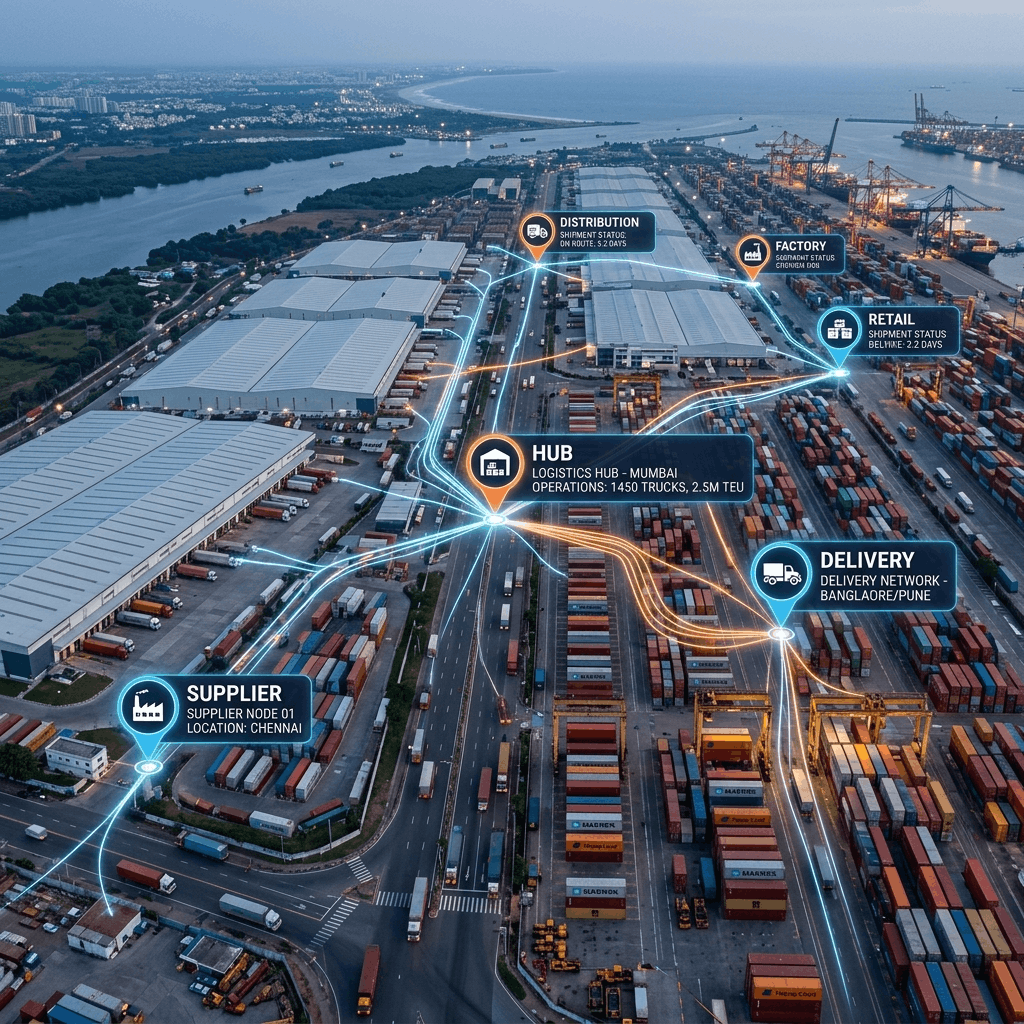
The Hidden Costs of Transportation
The logistics and transportation industry operates on incredibly razor-thin margins. Fuel prices fluctuate wildly, vehicle maintenance costs are skyrocketing, and driver shortages are a global crisis. In this environment, a logistics company cannot afford inefficiency.
If you are running a fleet of 50 trucks using whiteboards, Excel spreadsheets, and a disconnected GPS tracking app, you are bleeding money. A truck that leaves your depot half-empty, or a driver that takes an inefficient route, directly destroys your profit margin.
To survive, Third-Party Logistics (3PL) providers and transportation companies must adopt specialized Logistics Enterprise Resource Planning (ERP) software. Let's look at exactly how modern ERP systems squeeze every drop of efficiency out of a supply chain.
Phase 1: Dynamic Route Optimization
In traditional logistics operations, a human dispatcher looks at a map and manually guesses the best route for a driver to take to hit their 15 delivery stops. This is incredibly inefficient. A human cannot calculate live traffic data, toll road costs, and vehicle weight restrictions simultaneously.
A Logistics ERP features an automated Route Optimization engine. The dispatcher simply inputs the 15 delivery addresses. The ERP analyzes thousands of data points—including historical traffic patterns, current road closures, and weather data—to calculate the mathematically perfect route.
The system then sends turn-by-turn navigation directly to a tablet mounted in the driver's cab. This dynamic routing reduces total fuel consumption by an average of 15% and ensures the driver hits their delivery windows on time.
Phase 2: Intelligent Load Planning
Air inside a trailer is the enemy of profit. If you send a massive 53-foot semi-truck on a 500-mile journey, and that truck is only 40% full, you have lost money on that trip.
A Logistics ERP features Cargo Consolidation and Load Planning. When an order enters the system, the ERP calculates the dimensional weight (length x width x height) of the cargo. The software then acts like a game of 3D Tetris. It analyzes all pending orders going to a specific region and perfectly consolidates them.
The ERP generates a 3D diagram showing the warehouse workers exactly how to pack the pallets into the trailer to maximize cubic volume while distributing the axle weight legally. Every truck leaves the depot 100% optimized.
Phase 3: Fleet Management and Maintenance
If a delivery truck breaks down on the highway, the costs are catastrophic. You have to pay for an emergency tow, you miss the delivery deadline (angering the client), and the driver is sitting idle on the payroll.
A Logistics ERP includes a proactive Fleet Management module. The system tracks the exact mileage and engine hours of every single vehicle in your fleet. Instead of waiting for a truck to break down, the ERP schedules preventative maintenance.
When a truck hits 50,000 miles, the ERP automatically blocks the dispatcher from routing that truck and generates a work order for the mechanic to change the brake pads. Proactive maintenance extends the lifespan of your expensive capital assets and eliminates unpredictable downtime.
Phase 4: Real-Time Telematics and GPS
When a high-value client calls the logistics office asking, "Where is my shipment?", the dispatcher should not have to call the driver's cell phone to ask where they are. That is unprofessional and dangerous for the driving operator.
A Logistics ERP provides real-time Telematics. The ERP is hardwired into the vehicle's onboard diagnostics (OBD) port. The dispatcher can look at a digital map and see exactly where every truck is, exactly how fast they are driving, and exactly how much fuel is in the tank.
The ERP can even detect "harsh braking" or "rapid acceleration," allowing management to identify aggressive drivers and retrain them before they cause a liability-inducing accident.
Phase 5: Automated Proof of Delivery and Billing
In the old days, a driver would get a paper document signed by the client, stuff it in their glovebox, and turn it into the accounting department three days later. The accounting department would then manually type the invoice, resulting in a 30-day delay in cash flow.
A Logistics ERP automates the entire billing cycle. When the driver arrives at the destination, they hand their tablet to the client. The client signs the glass for an electronic Proof of Delivery (ePOD). The driver can also use the tablet's camera to take a photo of the undamaged cargo.
The instant that signature is captured, the tablet syncs with the central ERP over the cellular network. The accounting module automatically generates the final freight invoice and emails it to the client's Accounts Payable department before the truck even drives away. You get paid weeks faster.
Conclusion: Driving Profitability
In the logistics industry, you cannot control the price of diesel fuel, and you cannot control the weather. The only thing you can control is your own internal efficiency. If you are operating without a centralized digital brain, you are losing money on every mile driven.
An ERP system replaces the chaos of dispatch whiteboards and paper invoices with a highly optimized, data-driven machine. It allows you to move more cargo with fewer trucks and less fuel.
At Delight ERP, our Logistics and Transportation module is designed to provide total visibility over your fleet. From dynamic route optimization to automated electronic billing, we give you the tools you need to dominate the supply chain.
Streamline operations, reduce costs, and scale faster with Delight ERP.