
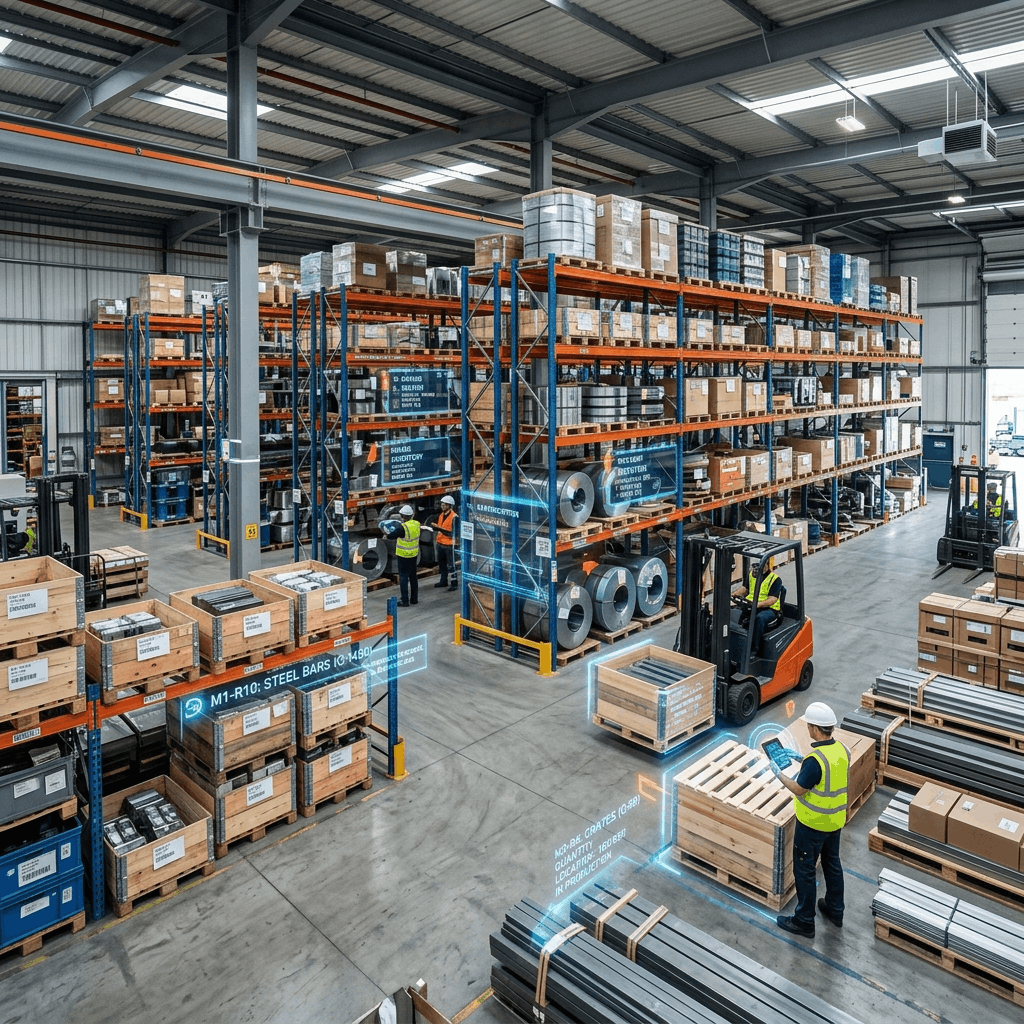
Manufacturing is Not Retail
One of the most common—and devastating—mistakes a manufacturing business can make is purchasing "generic" inventory software. They buy software designed for a retail clothing store or an e-commerce drop-shipper, and they try to force their factory to use it.
This fails because a retailer's inventory model is flat. They buy a finished shirt, put it on a shelf, and sell a finished shirt. A manufacturer's inventory model is incredibly deep. A manufacturer buys raw aluminum, tracks it as it sits on the shelf, tracks it again as a machine cuts it (Work-in-Progress), tracks the scrap metal that falls on the floor, and finally tracks the finished industrial valve that emerges at the end of the assembly line.
To run a factory effectively, you need an Enterprise Resource Planning (ERP) system specifically architected for manufacturing. Here are the five critical features that separate true manufacturing inventory software from generic retail apps.
Feature 1: Multi-Level BOM Management
The foundation of any manufacturing process is the Bill of Materials (BOM). This is the "recipe" for your product. Generic software can usually handle a simple, single-level BOM (e.g., mixing flour, sugar, and eggs to make a cake).
Industrial manufacturers, however, require Multi-Level BOM capabilities. Imagine building a bicycle. The top-level BOM requires a Frame, two Wheels, and a Drivetrain. But the "Drivetrain" isn't a raw material; it is a sub-assembly with its own BOM (chains, gears, pedals).
The best manufacturing software can nest these BOMs infinitely. When an engineer updates the specification for the gear inside the Drivetrain BOM, the software automatically updates the cost and inventory requirements for every top-level bicycle model that uses that specific drivetrain.
Feature 2: Work-in-Progress (WIP) Traceability
If you ask a manager using generic software, "Where is our inventory?" they can tell you what is in the receiving dock, and what is in the shipping dock. But they are completely blind to the "black box" in the middle: the factory floor.
Manufacturing ERP systems track Work-in-Progress (WIP) in real-time. As raw materials move from the cutting station, to the welding station, to the painting station, workers scan barcodes to track the exact location of the WIP.
This prevents bottlenecks. If a production manager looks at the dashboard and sees $50,000 worth of WIP piled up at the painting station, they instantly know they need to redirect labor to that area to clear the bottleneck before it impacts the final delivery date.
Feature 3: The MRP (Material Requirements Planning) Engine
In a factory, you do not just order materials when the shelf looks empty. You order materials based on the future production schedule. Doing this manually using Excel spreadsheets is impossible once a factory scales past a few million dollars in revenue.
The MRP Engine is the brain of a manufacturing ERP. It looks at the master production schedule for the next three months. It breaks down the multi-level BOMs for all the products you need to build. It checks your current warehouse stock. It calculates the lead times for your overseas suppliers.
Then, the MRP engine automatically tells the purchasing manager exactly what to order, how much to order, and on what exact date the Purchase Order needs to be sent to ensure the raw materials arrive precisely one day before the assembly line needs them.
Feature 4: Strict Lot and Serial Tracking
For manufacturers in highly regulated industries—such as aerospace, pharmaceuticals, food/beverage, or automotive components—inventory tracking is not just about efficiency; it is a legal requirement. Generic software cannot handle this level of compliance.
Advanced inventory software enforces strict Lot and Serial Number traceability. When a shipment of steel arrives from a vendor, the system assigns it a unique Lot Number. As that steel is machined into thousands of individual parts, the software records which specific parts came from that specific Lot of steel.
If the supplier calls three months later and says that steel was metallurgically defective, the manufacturer can open the ERP, type in the Lot Number, and instantly generate a list of the exact 50 customers who bought the affected parts, allowing for a precise, surgical recall rather than a catastrophic global recall.
Feature 5: Automated Scrap and Rework Costing
In retail, if a shirt is ripped, you throw it away. In manufacturing, if an expensive brass casting has a minor defect, you do not throw it away; you send it back to the machining station for "rework."
Generic inventory software has no idea how to financially account for rework. It simply writes the item off.
Manufacturing ERP systems handle both Scrap and Rework seamlessly. If an item is truly ruined, a worker scans it as scrap. The system removes the raw material from inventory and instantly updates the Job Costing module, applying the financial loss to that specific production run. If an item is sent for rework, the system tracks the additional labor hours spent fixing the part, ensuring the CEO has a 100% accurate view of the true, final profit margin of that product.
Conclusion: Software Built for the Factory Floor
Trying to run a modern factory with retail-focused inventory software is like trying to win a Formula 1 race in a golf cart. You lack the horsepower, the precision, and the specialized engineering required to compete at the highest level.
To maximize your margins, prevent assembly line halts, and ensure strict compliance, you must deploy software that speaks the language of manufacturing—BOMs, WIP, Routing, and MRP.
At Delight ERP, we have spent years engineering our software alongside actual factory floor managers. Our platform provides the deep inventory visibility and automated material planning you need to run your production lines flawlessly.
Streamline operations, reduce costs, and scale faster with Delight ERP.