
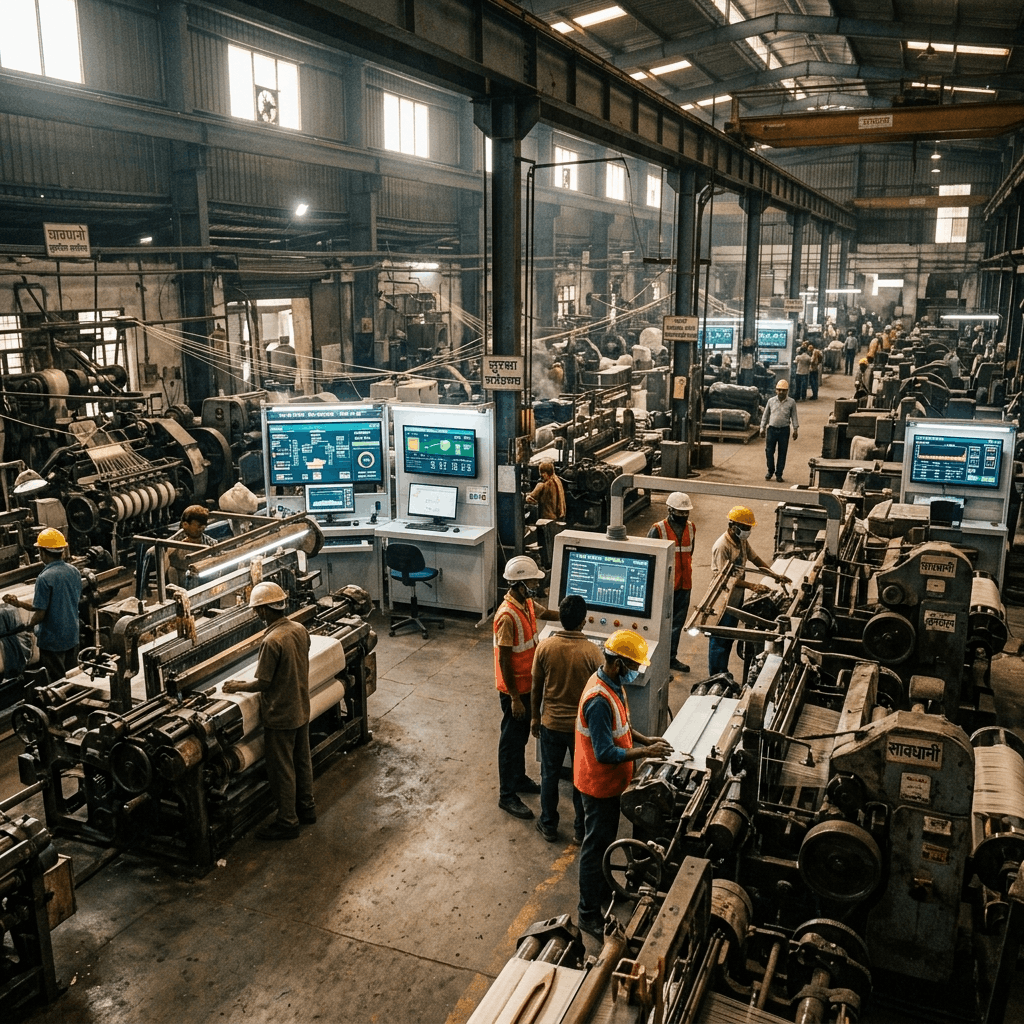
The Chaos of Modern Manufacturing
Manufacturing is inherently one of the most difficult business models to execute. You are combining volatile global supply chains, heavy industrial machinery, unpredictable human labor, and strict customer deadlines into a single, highly pressurized environment.
Historically, a good plant manager could manage this chaos with a clipboard and decades of gut intuition. Today, the sheer speed of global commerce makes that impossible. If a factory relies on manual processes, the complexity will eventually crush its profit margins.
To survive and scale, executives must confront the operational friction holding their factories back. Here are the top five most severe challenges faced by the modern manufacturing industry, and how digital transformation solves them.
Challenge 1: Supply Chain Volatility and Shortages
In the past, supply chains were relatively stable. You ordered raw materials, and they arrived three weeks later. Today, global supply chains are incredibly fragile. A shipping bottleneck in one hemisphere can instantly halt an assembly line in another.
When manufacturers rely on manual purchasing, they cannot react fast enough. A purchasing agent might not realize a supplier is going to be late until the factory workers are literally standing around waiting for parts.
The Solution: Automated Vendor Management. Modern ERP systems feature intelligent supply chain modules. They track historical lead times dynamically. If a vendor historically promises 3-week delivery but averages 5 weeks, the ERP's MRP engine automatically accounts for the real-world delay and drafts the Purchase Order two weeks earlier, buffering your factory against the volatility.
Challenge 2: Inaccurate Data and "Ghost Inventory"
One of the most terrifying things a production manager can hear is: "The computer says we have the parts, but the shelf is empty." This is known as Ghost Inventory.
Ghost inventory occurs when workers fail to manually record scrapped parts, or when they accidentally pull the wrong SKU from a shelf. Because the software thinks the materials exist, the procurement team does not order replacements. The factory floor discovers the shortage at the exact moment they need the part, forcing a massive, expensive halt to production.
The Solution: Barcode Scanning and Real-Time WMS. Implementing a Warehouse Management System (WMS) eliminates Ghost Inventory. Workers use ruggedized handheld barcode scanners. When they pull a box of screws for an assembly job, they scan the bin. The inventory is instantly decremented from the master database. If a part is dropped and broken, they scan it as "Scrap," ensuring the database perfectly mirrors physical reality 100% of the time.
Challenge 3: Unplanned Machine Downtime
Industrial machinery is expensive to run, but it is infinitely more expensive when it unexpectedly stops. Unplanned downtime destroys profitability. You are still paying hourly wages to idle workers, your delivery dates are slipping, and the emergency repair costs are astronomical.
Many factories still operate on a "Run to Failure" model. They push the CNC machine until it breaks, and then they panic.
The Solution: Preventative Maintenance Modules. Modern manufacturing software tracks machine utilization in real-time. Just like your car's dashboard alerts you to change the oil every 5,000 miles, the ERP tracks how many hours a specific spindle has been cutting metal. The system automatically generates a Preventative Maintenance work order before the spindle snaps, allowing the engineering team to swap the part during a planned weekend shift without impacting production.
Challenge 4: Rigid Production Scheduling
Most manufacturers still use Microsoft Excel to plan their production schedules. A planner creates a massive, color-coded spreadsheet on a Friday afternoon dictating what every machine will do next week.
By Monday at 10:00 AM, that spreadsheet is useless. A key worker called in sick, a rush order came in from a VIP customer, and a machine needs emergency maintenance. Spreadsheets are rigid; they cannot recalculate hundreds of cascading dependencies dynamically.
The Solution: Advanced Planning and Scheduling (APS). An ERP system features an APS engine. When a rush order is injected into the system, the APS automatically recalculates the entire factory floor. It shifts lower-priority jobs to different machines, identifies the new bottlenecks, and ensures the VIP customer receives their order on time without requiring a human to manually redraw the master schedule.
Challenge 5: Siloed Data and Financial Blind Spots
The greatest overarching challenge in manufacturing is departmental silos. The Sales team uses Salesforce. The Warehouse uses a custom Access database. The Accounting team uses QuickBooks. The Factory Floor uses paper.
Because these systems do not talk to each other, the CEO never has a clear picture of profitability. A product might look profitable on the original sales quote, but due to massive scrap rates on the factory floor and expedited shipping costs, the company actually lost money on the order. Without integrated data, the company will blindly continue to sell unprofitable products.
The Solution: The Unified Database. An Enterprise Resource Planning system destroys these silos. It connects the sales quote directly to the factory floor routing, the warehouse inventory, and the general ledger. The CEO can open a dashboard and see real-time, penny-accurate Job Costing, revealing exactly where the company is making money and where it is bleeding cash.
Conclusion: Implementing Digital Resilience
You cannot control global supply chain shocks. You cannot completely eliminate machine wear and tear. However, you can control how quickly and effectively your organization responds to these challenges.
Relying on spreadsheets and fragmented software creates a fragile factory. Implementing a centralized digital nervous system creates a resilient one.
At Delight ERP, we engineer software specifically designed to solve the hardest problems in manufacturing. From real-time barcode inventory to advanced production scheduling, we provide the tools you need to tame the chaos and scale your profitability.
Streamline operations, reduce costs, and scale faster with Delight ERP.