
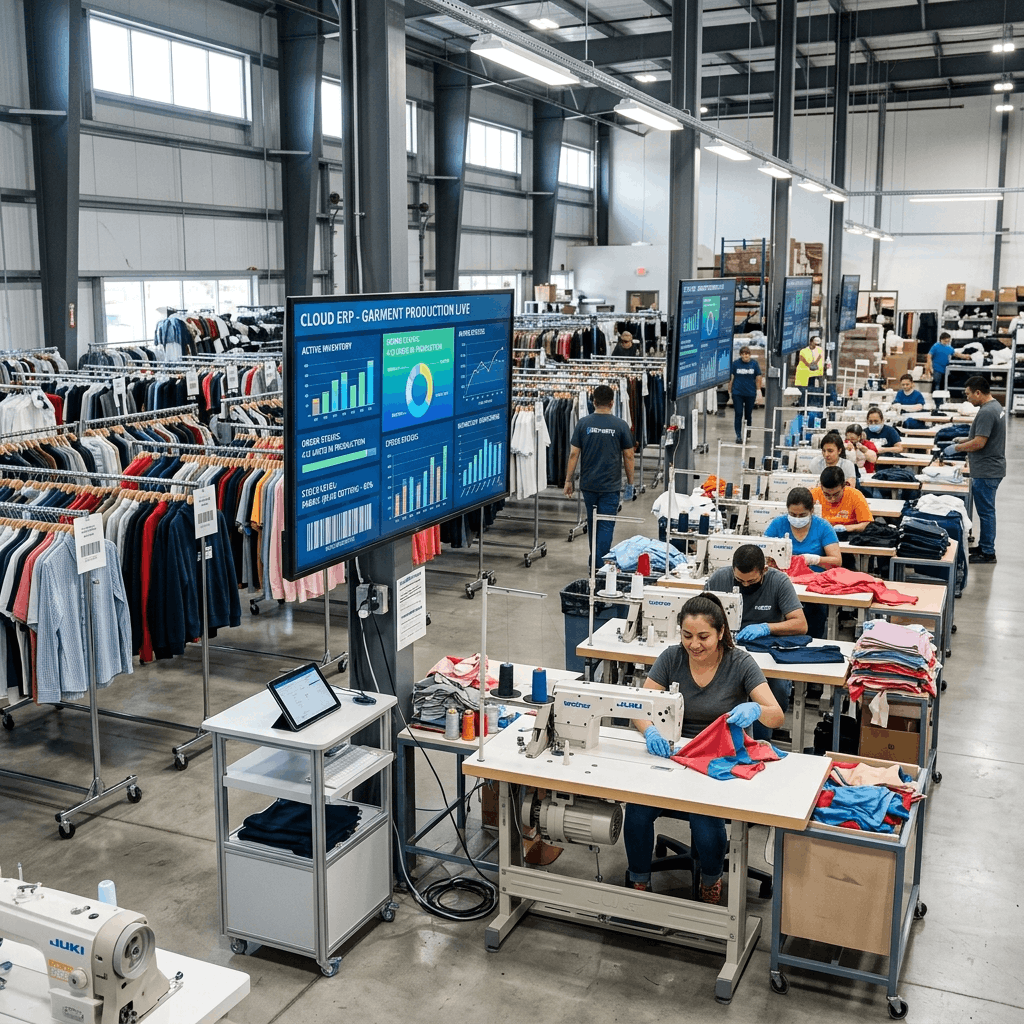
The Great Migration in Apparel Manufacturing
For decades, large garment manufacturers relied on massive, clunky, on-premise servers hidden away in cold IT closets to run their businesses. These legacy systems were incredibly expensive to maintain, painfully slow to update, and restricted access to employees physically sitting in the main office.
However, the modern apparel industry has evolved. Today's garment businesses are highly decentralized. The design team might sit in New York, the raw cotton is sourced from India, the fabric is dyed in Vietnam, and the garments are sewn in Bangladesh before being shipped globally.
Attempting to manage this sprawling, global network on an old, localized server is an operational nightmare. This is why the entire garment industry is experiencing a massive migration to Cloud Enterprise Resource Planning (ERP) software. Hosted securely on the internet, Cloud ERP provides the speed, agility, and connectivity required to survive in the modern fashion ecosystem.
Benefit 1: Unifying Global Supply Chains in Real-Time
The defining characteristic of the modern garment industry is its reliance on global outsourcing. Very few apparel brands own their own sewing factories. Instead, they contract with massive assembly hubs across Asia and South America.
When you rely on a legacy on-premise system, collaborating with these overseas partners usually involves sending huge Excel spreadsheets back and forth via email. By the time a spreadsheet detailing the "Required Bill of Materials" is opened by the factory manager in Bangladesh, the data is already 12 hours out of date.
Cloud ERP shatters these geographical barriers. Because the software is hosted in the cloud, an authorized factory manager in Dhaka can log into the exact same database as the CEO in London via a standard web browser.
If the design team updates the size specifications for a new jacket, the overseas factory sees that update instantly. The factory can also log their daily production numbers directly into the Cloud ERP, giving the central headquarters real-time visibility into exactly how many garments were produced that day. This total global unity prevents costly miscommunications and delays.
Benefit 2: Flawless Scalability for Seasonal Spikes
The apparel industry is violently seasonal. A garment retailer might do 40% of its entire annual sales volume during a frantic six-week window between Black Friday and Christmas. Furthermore, a sudden viral trend on TikTok can cause demand for a specific style of jeans to spike by 10,000% overnight.
An on-premise server is static. It has a fixed amount of processing power. If an apparel company suddenly gets slammed with 50,000 online orders in one hour, the physical server will crash, taking the website and the warehouse down with it.
Cloud ERP offers infinite scalability. Cloud providers (like AWS or Azure) operate massive server farms. If the ERP software detects a sudden, massive surge in web traffic and transaction volume, it automatically "spins up" additional server resources to handle the load. The system stays blazingly fast during the holiday rush, and then automatically scales back down in January, meaning you only pay for the computing power you actually use.
Benefit 3: Mobile Agility for the Modern Sales Force
Garment sales reps do not sit at desks. They travel to global fashion trade shows, they visit boutique retail clients, and they walk the floors of massive wholesale distribution centers.
In the past, a sales rep at a trade show would take wholesale orders on a paper notepad, fly back to the office three days later, and manually type those orders into the computer. By that time, the warehouse might have already sold out of the requested garments.
Cloud ERP enables true mobility. The software can be accessed securely via a dedicated iPad or smartphone app. When a sales rep is meeting with a major department store buyer, they can open the Cloud ERP on their tablet, view live inventory levels across all global warehouses, and input a massive purchase order on the spot. The warehouse can literally begin packing the order while the sales rep is still shaking the buyer's hand.
Benefit 4: Automatic Updates in a Fast-Fashion World
The software industry moves just as fast as the fashion industry. Every year, new capabilities are invented: advanced AI demand forecasting, better integrations with Shopify, and new tools for tracking carbon footprints.
If a garment company uses an on-premise ERP, upgrading the software requires shutting down the factory for an entire weekend while high-priced IT consultants manually install the new version. Because this is painful, companies often wait 5-10 years to upgrade, leaving them stuck with obsolete technology.
Cloud ERP is updated automatically by the vendor. Much like how the apps on your iPhone silently update while you sleep, a Cloud ERP provider continuously pushes new features, security patches, and performance enhancements to the software in the background. The garment manufacturer always has access to the absolute latest, bleeding-edge technology without any effort.
Benefit 5: Drastically Reduced IT Overhead
Garment companies are in the business of making clothes, not managing server infrastructure. Running an on-premise system requires buying physical servers ($50,000+), paying for the electricity to cool them, and hiring a team of expensive IT engineers to maintain them and manage backups.
Cloud ERP operates on a SaaS (Software as a Service) model. The apparel brand simply pays a predictable monthly subscription fee. The ERP vendor takes on the entire burden of buying servers, maintaining 99.9% uptime, executing hourly data backups, and defending against ransomware attacks using enterprise-grade cybersecurity teams.
This allows the garment company to drastically cut its IT overhead and redirect that capital into hiring better designers, launching new marketing campaigns, or expanding into new global markets.
Conclusion: Built for the Speed of Fashion
The modern garment industry waits for no one. If your business software restricts your employees to physical desks, limits your visibility into overseas factories, or crashes during a massive sales event, your competitors will leave you behind.
Cloud ERP is not just a technological upgrade; it is a fundamental shift in business agility. By embracing the cloud, apparel manufacturers unlock the speed, global connectivity, and scalability required to dominate the modern, omni-channel retail landscape.
At Delight ERP, we provide a state-of-the-art Cloud architecture tailored specifically for the complexities of the garment industry. Our platform ensures your global operations are always connected, always secure, and always ready to scale.
Streamline operations, reduce costs, and scale faster with Delight ERP.