
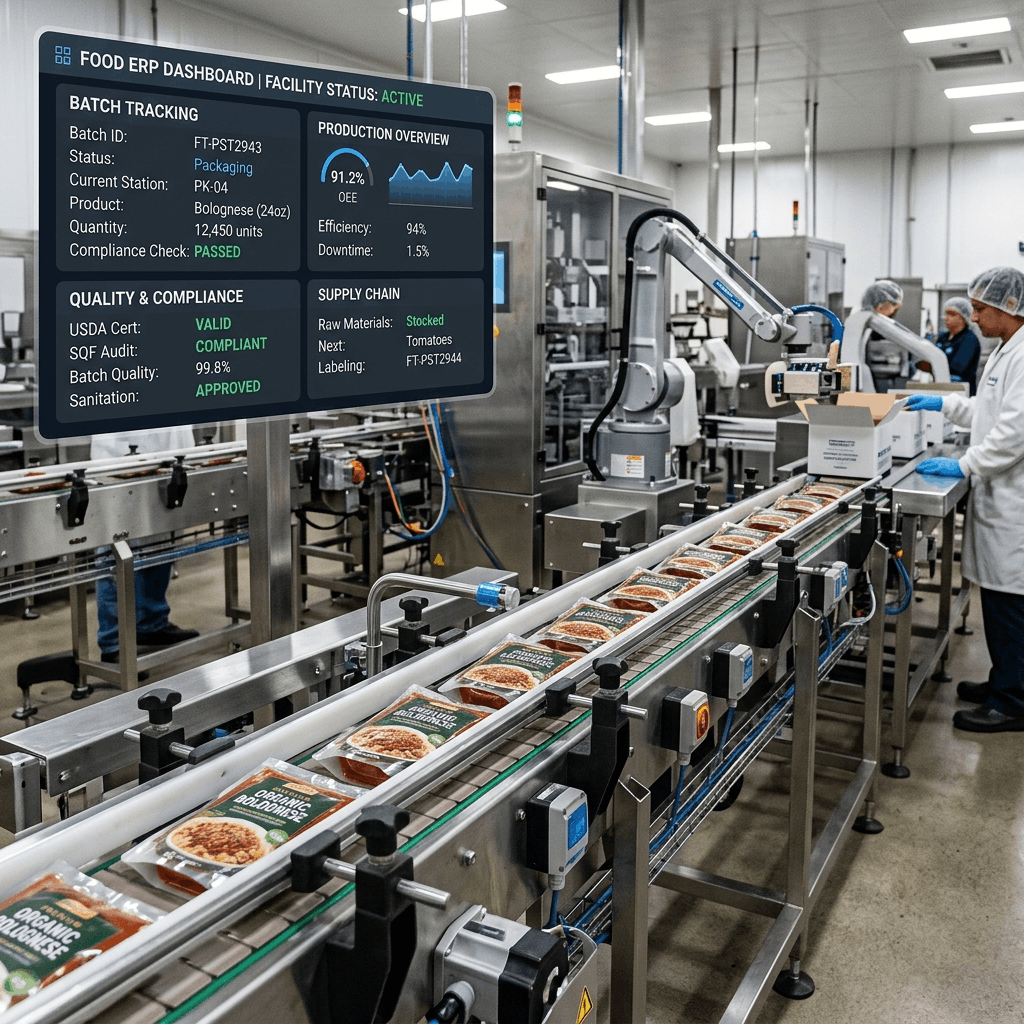
The Engine Behind the Food Industry
Manufacturing food is arguably the most highly regulated, closely scrutinized industry on the planet. From the moment a raw ingredient enters the receiving dock to the moment the finished product is scanned at a grocery store checkout, it must be tracked, tested, and verified for safety.
Attempting to manage this massive volume of critical data using paper logs and spreadsheets is not just an administrative burden; it is a profound risk. A single lost piece of paper during a safety audit can result in massive fines or forced factory closures.
This is why the core capabilities of a specialized Food Enterprise Resource Planning (ERP) software are so vital. It is the digital engine that ensures safety, enforces compliance, and drives profitability. Let's explore the absolute core capabilities a Food ERP must possess.
Capability 1: Advanced Quality Management Systems (QMS)
In standard manufacturing, Quality Control (QC) might involve measuring a part with calipers at the end of the line. In the Food and Beverage (F&B) industry, Quality Control must happen continuously throughout the entire production cycle.
A core capability of a Food ERP is its embedded Quality Management System (QMS). This system replaces paper QC logs with strict digital checkpoints. For example, if a factory is pasteurizing milk, the ERP will physically lock the production sequence. The operator is required to take a temperature reading and input it into the ERP tablet.
If the operator inputs a temperature of 140°F, but the safety threshold requires 161°F, the ERP immediately flags a critical failure. It halts the line, quarantines the batch digitally so it cannot be shipped, and sends an urgent alert to the QA Manager. This systemic enforcement guarantees that unsafe food can never accidentally leave the facility.
Capability 2: Instant Compliance and Audit Reporting
Food manufacturers are subject to grueling audits from organizations like the FDA, USDA, and various global standards like SQF, BRC, and FSMA. When an auditor walks through the door and demands a "Mock Recall," the factory has a very short window of time to prove they can trace a specific ingredient forward and backward through their entire supply chain.
If a factory uses paper records, employees will spend hours frantically digging through filing cabinets, praying the paperwork wasn't lost.
A core capability of a Food ERP is Instant Audit Reporting. Because every ingredient, lot number, and QC check is logged digitally into the central database in real-time, executing a mock recall takes seconds. The QA manager simply types the lot number into the ERP, clicks a button, and the system instantly generates a comprehensive, perfectly formatted compliance report detailing the exact whereabouts of every ounce of that specific ingredient.
Capability 3: Procurement Based on Shelf-Life
Automated procurement in standard manufacturing is simple: if you need 5,000 screws for next month's production, you buy 5,000 screws. Food procurement is drastically more complex because of Shelf Life.
If you need 5,000 gallons of milk for next month's production, you cannot just buy it all today, because it will spoil before you use it.
A core capability of a Food ERP is Shelf-Life Aware Procurement. The ERP's Material Requirements Planning (MRP) engine analyzes the production schedule and cross-references it with the known shelf life of the raw ingredients. It will automatically generate staggered, perfectly timed Purchase Orders. It might order 1,000 gallons of milk to arrive every Monday for five weeks, ensuring the factory always has exactly enough fresh inventory without ever risking spoilage.
Capability 4: Optimizing Production Changeovers
A "Changeover" is the time it takes to stop a production line, clean it, and set it up to run a different product. In the F&B industry, changeovers are incredibly expensive due to mandatory sanitation washes (especially when dealing with allergens).
If a factory makes vanilla ice cream, then chocolate ice cream, then strawberry ice cream, the changeover is relatively simple. If they make chocolate, then vanilla, they have to execute a massive, deep sanitation wash so the chocolate doesn't stain the vanilla.
The ERP's Advanced Planning and Scheduling (APS) engine handles this automatically. It analyzes the incoming sales orders and groups similar recipes together. It will intelligently schedule the factory to run from "Light to Dark" or "Allergen-Free to Allergen," minimizing the number of deep sanitation washes required and drastically increasing the total uptime of the machinery.
Capability 5: Omni-Channel Logistics and Distribution
Once the food is manufactured and safely packaged, it must be distributed. Food distribution is a logistical nightmare involving "Cold Chain" requirements (refrigerated trucks) and strict delivery windows for large grocery chains.
A core capability of the ERP is managing Distribution Logistics. The ERP ensures that the FEFO (First Expired, First Out) logic extends to the loading dock. It directs warehouse workers to load the oldest pallets onto the trucks first.
Furthermore, the ERP integrates natively via EDI (Electronic Data Interchange) with major distributors and retailers. When the truck leaves the dock, the ERP automatically sends an Advanced Shipping Notice (ASN) to the grocery store and instantly generates the customer invoice, automating the entire order-to-cash cycle.
Conclusion: A Platform Built for Safety
The Food and Beverage industry is an environment where inefficiency leads to spoilage, and non-compliance leads to disaster. You cannot rely on fragmented software tools to protect your customers and your profit margins.
The core capabilities of a Food ERP—Advanced QMS, instant audit reporting, shelf-life procurement, and optimized changeovers—provide the digital armor your company needs. It transforms compliance from a terrifying burden into a seamless, automated daily process.
At Delight ERP, we build software designed for the high-stakes reality of food manufacturing. Our platform delivers the core capabilities you need to enforce absolute quality control, pass every audit effortlessly, and scale your F&B business with total confidence.
Streamline operations, reduce costs, and scale faster with Delight ERP.