
In This Article
- 1. What Is a Smart Manufacturing System?
- 2. Component 1: Industrial Internet of Things (IIoT)
- 3. Component 2: Artificial Intelligence & Machine Learning
- 4. Component 3: Cyber-Physical Systems (CPS)
- 5. Component 4: Digital Twin Technology
- 6. Component 5: Cloud ERP as the Data Backbone
- 7. Component 6: Advanced Robotics & Collaborative Automation
- 8. Component 7: Augmented Reality & Digital Workforce Tools
- 9. Component 8: Cybersecurity for Smart Factories
- 10. How All 8 Components Work Together: The Smart Factory Ecosystem
- 11. Building Your Smart Manufacturing Roadmap with Delight ERP
- Frequently Asked Questions
1. What Is a Smart Manufacturing System?
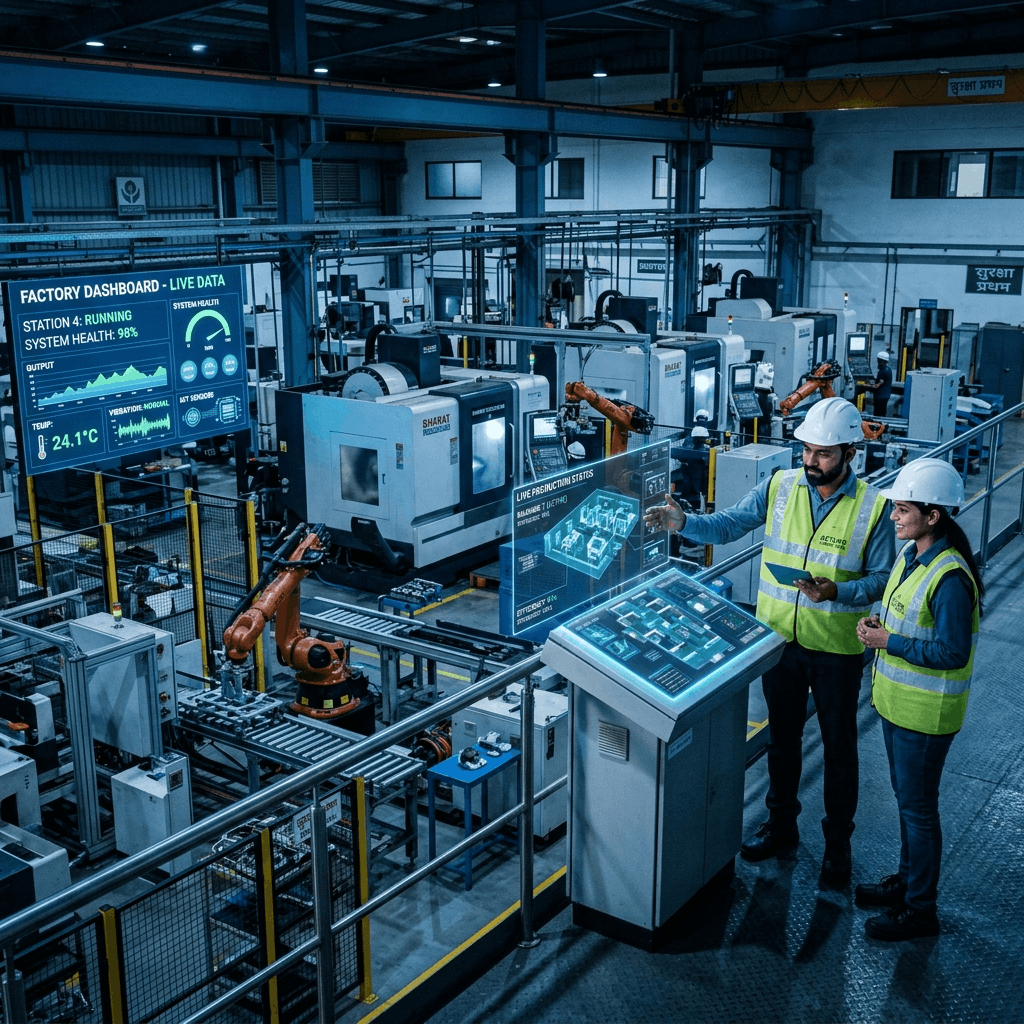
Smart manufacturing is not merely a buzzword; it represents the fourth industrial revolution (Industry 4.0). At its core, a smart manufacturing system is a fully integrated, collaborative manufacturing system that responds in real-time to meet changing demands and conditions in the factory, in the supply network, and in customer needs. Unlike traditional manufacturing, which relies heavily on human intervention and isolated silos of information, smart manufacturing creates an interconnected digital ecosystem.
For Indian manufacturers aiming to compete on a global scale, adopting these digital manufacturing systems is shifting from a luxury to an absolute necessity. By combining physical production processes with advanced digital technologies, factories become intelligent, predictive, and incredibly efficient, drastically reducing waste and maximizing productivity.
2. Component 1: Industrial Internet of Things (IIoT)
The Industrial Internet of Things (IIoT) acts as the sensory network of the smart factory. It involves equipping physical machines, production lines, and even raw materials with internet-connected sensors and actuators. These devices continuously collect vast amounts of granular data regarding machine performance, temperature, vibration, energy consumption, and output rates.
This raw data is the fuel that powers all other smart manufacturing capabilities. By providing real-time visibility into the exact physical state of the shop floor without requiring human data entry, IIoT eliminates blind spots. When this data flows seamlessly into a central Manufacturing ERP system, floor managers can monitor operations remotely and react to anomalies instantly.
3. Component 2: Artificial Intelligence & Machine Learning
While IIoT collects the data, Artificial Intelligence (AI) and Machine Learning (ML) act as the brain of the smart factory, making sense of the massive datasets. In a manufacturing context, AI algorithms can analyze historical production data to identify complex patterns that humans would miss. This leads to predictive capabilities that define Industry 4.0.
For example, ML algorithms can predict precisely when a critical machine component is likely to fail based on subtle vibration changes detected by IIoT sensors. This enables predictive maintenance—fixing the machine just before it breaks, rather than suffering unplanned downtime or wasting money on unnecessary routine maintenance.
4. Component 3: Cyber-Physical Systems (CPS)
Cyber-Physical Systems (CPS) represent the deep integration of computation, networking, and physical processes. In a CPS, embedded computers and networks monitor and control the physical processes of manufacturing, usually with feedback loops where physical processes affect computations and vice versa.
This means the physical machinery and the software controlling it operate in tandem. If an ERP system dictates a change in the production schedule due to an urgent customer order, a true CPS allows that digital command to automatically adjust the physical parameters of the CNC machines on the floor without requiring manual reprogramming.
5. Component 4: Digital Twin Technology
A Digital Twin is a highly complex virtual model that exactly reflects a physical object or process. In smart manufacturing, you might have a digital twin of a specific machine, an entire production line, or even the whole factory. This virtual model is continuously updated with real-time data from IIoT sensors attached to its physical counterpart.
This technology allows Indian manufacturers to run extensive "what-if" simulations in a risk-free digital environment. You can test how a new product design will affect the assembly line speed, or simulate the impact of using a different raw material, all without risking actual physical capital or disrupting current production.
💡 Case Study: Indian Auto Components Manufacturer
A tier-1 automotive components supplier in Pune integrated IIoT sensors with their Delight ERP system. By feeding machine health data directly into the ERP's maintenance module, they shifted from preventive to predictive maintenance. The result was a dramatic 50% reduction in unplanned machine downtime, saving lakhs of rupees annually and ensuring uninterrupted supply to their OEM partners.
6. Component 5: Cloud ERP as the Data Backbone
You cannot have a smart factory without a central repository to process and act upon the data. Cloud ERP software serves as the central nervous system or data backbone of the entire smart manufacturing ecosystem. It integrates the shop floor (OT - Operational Technology) with the top floor (IT - Information Technology).
When an IIoT sensor detects that a raw material bin is empty, it communicates this to the ERP. The ERP then automatically checks inventory, generates a purchase order for the vendor, updates the production schedule to account for the delay, and notifies the floor manager via their mobile device. Delight ERP is designed precisely to facilitate this seamless orchestration.
7. Component 6: Advanced Robotics & Collaborative Automation
Industry 4.0 moves beyond traditional, rigid robotic arms confined to safety cages. The new era features Advanced Robotics, including Collaborative Robots (Cobots) and Autonomous Mobile Robots (AMRs). These machines are designed to work safely alongside human workers, handling dangerous, repetitive, or heavy lifting tasks.
Integrated with the factory's manufacturing software, these robots receive dynamic instructions. AMRs can navigate the warehouse autonomously to fetch raw materials precisely when the ERP system calculates they are needed on the assembly line, creating a fluid, highly responsive internal logistics system.
8. Component 7: Augmented Reality & Digital Workforce Tools
Smart manufacturing also involves empowering the human workforce with digital tools. Augmented Reality (AR) overlays digital information onto the physical world. For a factory worker, this might mean wearing AR glasses that display complex assembly instructions, safety warnings, or quality checklists directly in their field of vision as they look at a part.
Even without AR glasses, providing workers with rugged tablets running mobile ERP interfaces allows them to receive digital work orders, report scrap, and access standard operating procedures (SOPs) instantly at their workstations, eliminating paper trails and reducing human error.
⚠️ The Critical Need for Factory Cybersecurity
As factories become hyper-connected via IIoT and cloud systems, the "attack surface" for hackers expands significantly. An unsecured smart factory is vulnerable to ransomware attacks that can physically halt production lines. Robust cybersecurity protocols, secure cloud infrastructure (like that provided by modern Cloud ERPs), and encrypted OT/IT networks are not optional—they are mandatory.
9. Component 8: Cybersecurity for Smart Factories
As highlighted above, Cybersecurity is the vital shield protecting the smart manufacturing system. Traditional factories were "air-gapped," meaning their operational technology was physically disconnected from the internet. Industry 4.0 demands connectivity, which inherently introduces cyber risks.
A comprehensive smart factory architecture requires end-to-end encryption, strict identity and access management (ensuring only authorized personnel can alter machine parameters), and continuous network monitoring to detect and neutralize threats before they can disrupt the supply chain or compromise proprietary product designs.
10. How All 8 Components Work Together: The Smart Factory Ecosystem
The true power of Industry 4.0 is realized only when these components operate in harmony. Let's look at a practical example:
| Smart Component | Function / Description | ERP Integration Point |
|---|---|---|
| IIoT Sensors | Collect real-time machine data (speed, temp) | Feeds raw production data to ERP |
| AI / Machine Learning | Predicts machine failures before they happen | Triggers predictive maintenance work orders in ERP |
| Cloud ERP | The central brain processing all business data | Central Hub (BOM, MRP, Inventory, Finance) |
| Digital Twin | Virtual simulation of physical processes | Tests ERP production schedules virtually first |
| Cobots & AMRs | Automated material handling and assembly | ERP directs AMRs to move inventory based on MRP |
| Cybersecurity | Protects the connected factory from attacks | Secures ERP database and cloud infrastructure |
📌 Pro Tip: Start Incrementally
Don't try to build a fully autonomous smart factory overnight. The key to success for Indian MSMEs is incremental adoption. Start by digitizing your core operations with a robust Cloud ERP system like Delight ERP. Once your data is centralized and accurate, you can gradually add IIoT sensors to critical machines, building out your smart factory capabilities step-by-step.
11. Building Your Smart Manufacturing Roadmap with Delight ERP
Transitioning to a smart manufacturing model may seem daunting, but it is achievable with the right technology partner. Delight ERP provides the scalable, cloud-based foundation required to orchestrate these advanced Industry 4.0 components. Our platform is designed to break down information silos, providing the real-time visibility and control necessary to thrive in the modern industrial landscape.
Whether you are looking to automate your Bill of Materials, implement strict quality control workflows, or prepare your factory for IIoT integration, Delight ERP offers the tools and expertise to guide your digital transformation journey. Embrace the future of manufacturing today and ensure your business remains competitive, agile, and highly profitable for decades to come.
Frequently Asked Questions
What are the core components of a smart manufacturing system?
The core components include the Industrial Internet of Things (IIoT), Artificial Intelligence (AI), Cyber-Physical Systems (CPS), Digital Twins, Cloud ERP software, Advanced Robotics, Augmented Reality (AR), and robust Cybersecurity protocols.
How does IIoT connect to ERP in a smart factory?
IIoT sensors collect real-time data from factory machines (like temperature, speed, or output) and feed this raw data directly into the Cloud ERP system. The ERP then analyzes this data to update inventory, trigger maintenance alerts, and calculate OEE instantly.
What is a digital twin and how does it benefit Indian manufacturers?
A digital twin is a virtual replica of a physical asset or process. It allows Indian manufacturers to simulate production changes, test new product designs, and predict machine failures in a risk-free virtual environment before applying them to the real factory floor.
How much does it cost to implement smart manufacturing in India?
Costs vary widely based on scale. However, Indian MSMEs do not need to invest millions upfront. By starting incrementally with a foundational Cloud ERP system like Delight ERP and adding IIoT sensors gradually, the initial investment is highly manageable with rapid ROI.
How does Delight ERP support smart manufacturing adoption?
Delight ERP acts as the central data backbone for smart manufacturing. It integrates with IIoT devices, automates complex manufacturing BOMs, provides real-time production analytics, and offers mobile accessibility, making Industry 4.0 achievable for Indian manufacturers.
Frequently Asked Questions
IIoT integration · AI production scheduling · Real-time OEE · Digital work orders · Quality management · Mobile floor access — Industry 4.0 ready.