
The Imperative of "Make in India"
The Indian manufacturing sector stands at a critical historical juncture. Propelled by the government's aggressive "Make in India" initiative, massive infrastructure investments, and a global desire to diversify supply chains away from total reliance on China, India has a unique opportunity to become the world's premier manufacturing hub.
However, an abundance of raw materials and a massive workforce are no longer sufficient to guarantee success in the global market. Global buyers demand unprecedented speed, flawless quality control, strict environmental compliance, and complete supply chain transparency. A manufacturing plant running on physical paper ledgers, fragmented Excel sheets, and intuition cannot meet these demands.
To capture this global opportunity, Indian manufacturers—from automotive parts suppliers in Pune to textile giants in Tiruppur—must undergo rapid Digital Transformation. At the core of this transformation is the adoption of localized, highly advanced Enterprise Resource Planning (ERP) systems. Let's explore how Cloud ERP is fundamentally rewiring the Indian manufacturing landscape.
Catalyst 1: Abandoning the Red Ledger (Paper to Cloud)
For decades, a significant portion of Indian mid-market manufacturing has relied on the traditional "bahi-khata" (red ledger) or disconnected tally systems. Inventory counts are written on clipboards. Machine operators manually fill out daily production logbooks. These physical records are then slowly typed into a computer by a clerk days later.
This reliance on paper creates massive data latency and guarantees human error. By the time a factory owner realizes they are out of a critical raw material, the production line has already stopped.
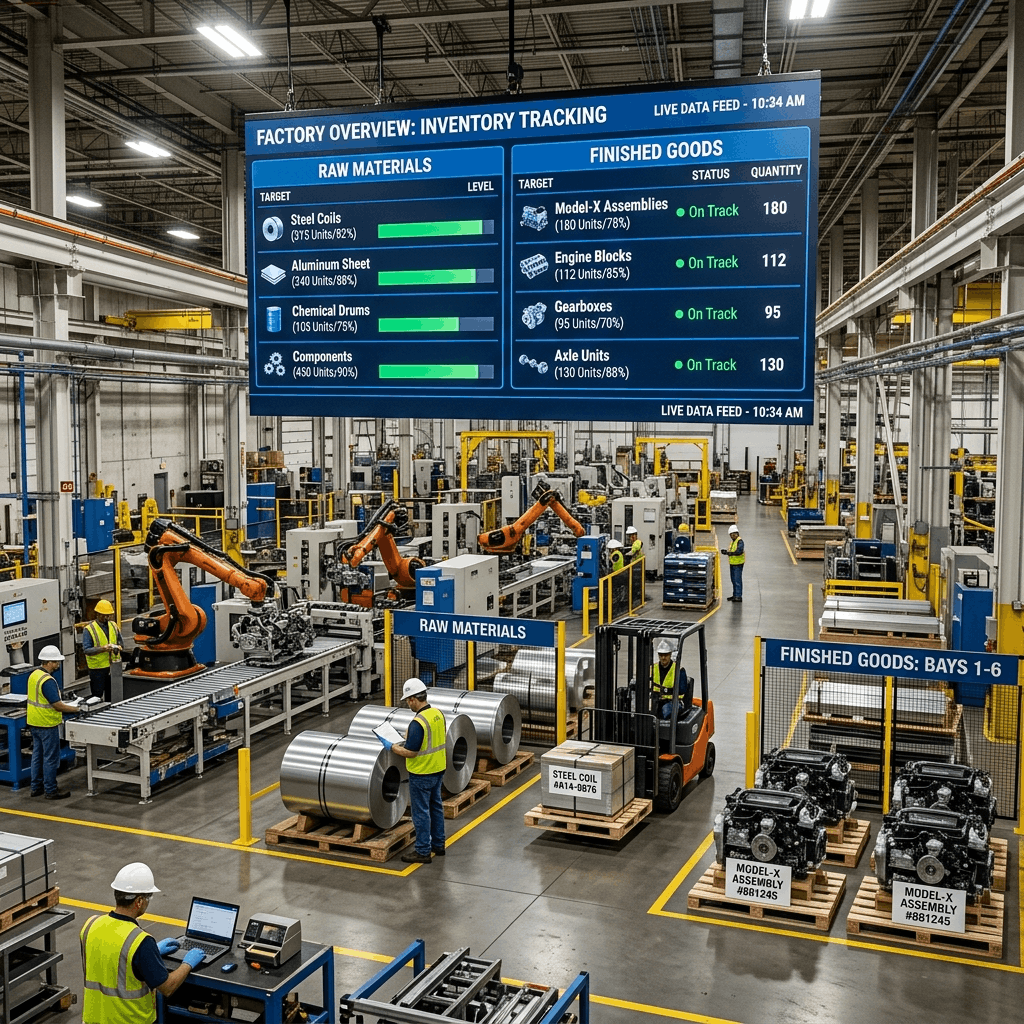
Digital transformation via ERP completely eliminates paper from the shop floor. Machine operators use rugged tablets or smartphones to input production numbers in real-time. Storekeepers use barcode scanners to log material movements instantly. This provides the factory owner with a live, second-by-second dashboard of the entire operation, allowing for aggressive, data-driven decision making.
Catalyst 2: Mastering GST and Regulatory Compliance
The introduction of the Goods and Services Tax (GST) revolutionized the Indian economy, unifying a complex web of state taxes into a single system. However, GST compliance is incredibly rigorous. Generating accurate e-Way bills, managing precise Input Tax Credit (ITC) reconciliation, and filing flawless monthly returns is a monumental task for a growing business.
Attempting to manage GST compliance across multiple factory locations using disjointed accounting software is a recipe for severe financial penalties.
A modern Indian ERP system has GST compliance built directly into its core architecture. When a sales order is created, the ERP automatically determines the correct HSN/SAC codes and calculates the precise CGST, SGST, or IGST. When a shipment leaves the loading dock, the ERP automatically communicates with the government portal via API to instantly generate the required e-Way bill. This automation ensures 100% compliance and saves the accounting department thousands of hours.
Catalyst 3: Integrating the Unorganized Supply Chain
A unique challenge in Indian manufacturing is the heavy reliance on a massive, highly fragmented, and often "unorganized" supply chain. A large automotive manufacturer might rely on hundreds of tiny "Tier 3" workshops spread across a state for small metal stampings or plastic moldings.
Historically, coordinating with these small vendors via phone calls and WhatsApp messages resulted in massive supply chain chaos and delayed deliveries.
Digital transformation solves this by extending the ERP to the supplier. Modern ERP systems offer lightweight, mobile-friendly Vendor Portals. Even a small workshop owner with a basic smartphone can log into the portal to receive digital Purchase Orders, accept delivery schedules, and notify the primary manufacturer the exact moment a shipment is dispatched. This brings visibility and discipline to previously opaque supply networks.
Catalyst 4: Bridging the Skilled Labor Gap via Automation
While India has a massive demographic dividend, there is a persistent shortage of highly skilled, specialized technical labor required to operate complex modern machinery or manage intricate quality control procedures.
ERP and digital transformation act as a bridge for this skills gap. By standardizing processes within the software, the reliance on tribal knowledge is reduced. For example, instead of relying on a veteran worker's memory to assemble a complex product, the ERP delivers a digital, step-by-step visual instruction manual (complete with video) directly to a tablet at the workstation.
The software also enforces strict quality control checkpoints; the worker cannot proceed to the next step until the ERP verifies the previous step was completed correctly. This "poka-yoke" (mistake-proofing) via software allows manufacturers to scale their operations quickly using a less experienced workforce without sacrificing product quality.
Catalyst 5: IoT and Predictive Maintenance in Harsh Environments
Indian factories often operate in harsh environmental conditions—extreme heat, high humidity, and fluctuating power grids. This places immense stress on expensive manufacturing machinery, leading to frequent breakdowns. Traditional maintenance is "reactive"—you fix the machine when it breaks and production stops.
The pinnacle of digital transformation is integrating the ERP with the Internet of Things (IoT). Cheap, rugged sensors can be attached to legacy machinery to monitor vibration, motor temperature, and power draw.
This data feeds continuously into the Cloud ERP. The system's AI analyzes the data and predicts exactly when a motor is likely to fail, automatically scheduling "predictive maintenance" during an off-shift. Fixing a machine before it breaks eliminates catastrophic unplanned downtime, massively increasing the overall factory output.
Catalyst 6: Scaling for Global Export Standards
If an Indian manufacturer wants to export their products to lucrative markets in Europe or North America, they must adhere to incredibly strict international standards (ISO certifications, FDA regulations for pharmaceuticals, strict material traceability for aerospace).
Global buyers require undeniable proof of quality. An ERP system provides complete, end-to-end digital traceability. If a defective product is found in Germany, the Indian manufacturer can use their ERP to trace that exact product back to the specific batch of raw materials received from a vendor three months ago, and instantly identify every other product manufactured from that same batch.
This level of digital accountability is not just a nice-to-have; it is a mandatory prerequisite for entering the global supply chain.
Conclusion: The Digital Factory of the Future
The modernization of the Indian manufacturing sector is accelerating. The narrative has shifted from "cheap labor" to "high-tech, high-quality, agile production." The companies that embrace this shift will become global titans; those who cling to their paper ledgers will be rapidly outpaced.
Digital transformation through a robust, localized Cloud ERP is the engine of this revolution. It provides the visibility, the compliance, the automation, and the global standards required to turn the "Make in India" vision into an undeniable reality.
At Delight ERP, we are deeply committed to powering this transformation. Our platform is built specifically for the realities of the Indian market, providing world-class technology designed to scale your operations from a single local plant to a global manufacturing powerhouse.
Streamline operations, reduce costs, and scale faster with Delight ERP.