
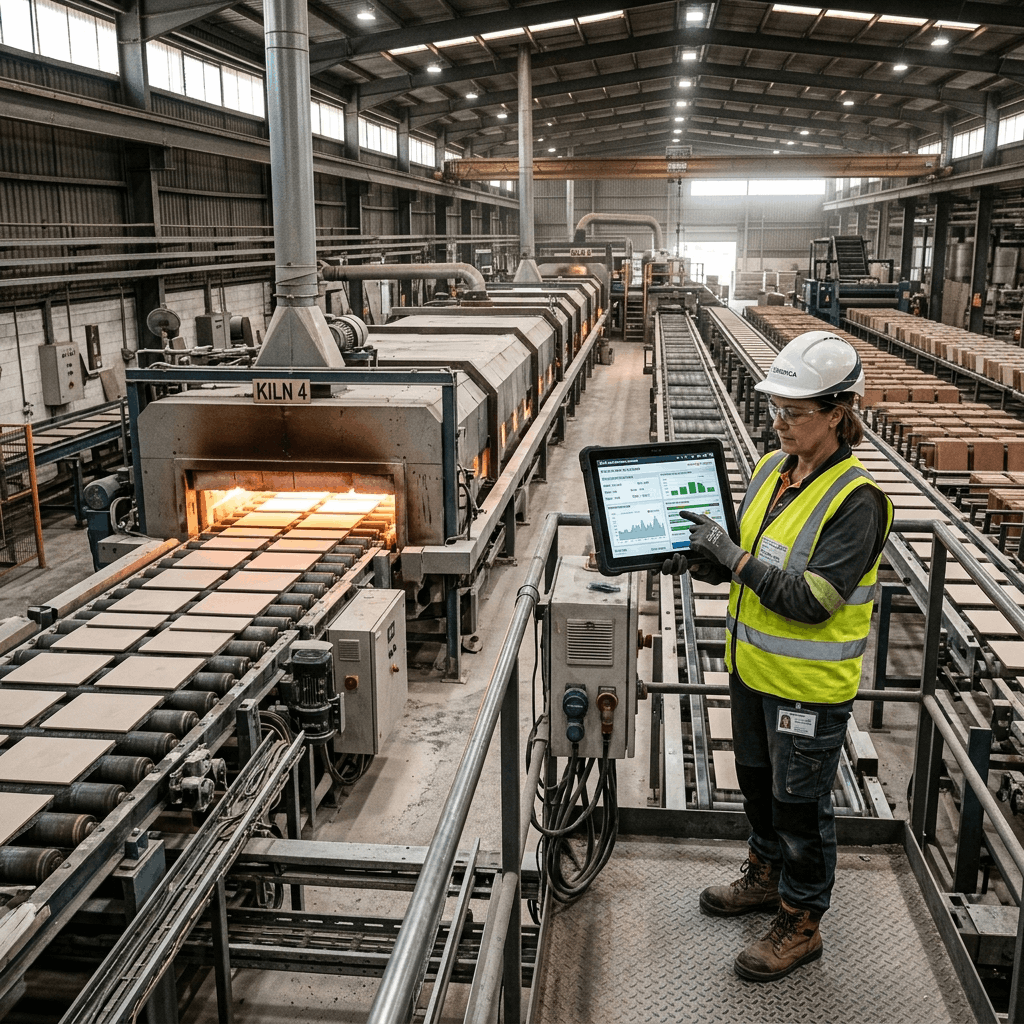
The Heavy Reality of Ceramic Manufacturing
When people think of manufacturing software, they often picture clean rooms assembling electronics or automotive lines bolting cars together. The ceramic industry is entirely different. Whether a factory is producing delicate dinnerware, massive porcelain floor tiles, or heavy industrial sanitaryware (toilets and sinks), the process is heavy, hot, and highly variable.
Ceramic manufacturing is fundamentally a chemical and thermal process. It involves mining raw earth, mixing precise chemical glazes, pressing shapes under immense pressure, and firing them in massive kilns at extreme temperatures.
Because of this intense variability, a simple accounting software package is utterly useless on a ceramic factory floor. The answer to the question, "Does the ceramic industry implement ERP software?" is a resounding Yes. In fact, a specialized Enterprise Resource Planning (ERP) system is the only way a modern ceramic manufacturer can maintain profitability. Here is how they use it.
Point 1: Complex Raw Material Formulas (Clays & Glazes)
In discrete manufacturing, a Bill of Materials (BOM) consists of solid parts (e.g., 4 screws). In ceramics, the BOM is a highly sensitive chemical recipe known as a "Formulation."
A ceramic manufacturer must mix specific ratios of ball clay, feldspar, silica, and water to create the "slip" (the liquid clay body). More importantly, the glazes that give the ceramic its color and shine require incredibly precise chemical mixtures. A variation of a single ounce of cobalt oxide in a massive vat of glaze can completely ruin the color of 10,000 floor tiles.
A Ceramic ERP handles Formula Management. The engineering team locks the chemical recipes into the ERP. When the production manager initiates a work order for a batch of tiles, the ERP automatically calculates the exact tonnage and poundage of every raw material required, preventing human math errors that lead to catastrophic color variations.
Point 2: Energy Tracking and Kiln Optimization
The single highest variable cost in the ceramic industry is energy. Firing a massive industrial kiln requires burning enormous amounts of natural gas or electricity to sustain temperatures exceeding 2,000°F (1,100°C) for hours or even days at a time.
If the cost of natural gas spikes, a manufacturer's profit margin can evaporate overnight. Furthermore, if a kiln is run half-empty, the company is literally burning money.
An ERP optimizes energy consumption in two ways. First, its Advanced Planning engine schedules production to ensure that kilns are always loaded to maximum capacity before firing. Second, the ERP integrates with factory sensors to track the exact amount of energy consumed during a specific firing cycle. It then uses "Granular Job Costing" to allocate that energy expense directly to the tiles produced in that cycle, providing the CFO with a hyper-accurate, real-time Cost of Goods Sold (COGS).
Point 3: Grading, Sorting, and Quality Control
When you manufacture a metal desk, it is either perfect or it is scrapped. Ceramics is much more nuanced. Because firing clay in a massive kiln creates unpredictable thermal reactions, not every tile or sink that comes out of the kiln will be identical.
A ceramic factory relies on "Grading and Sorting." At the end of the line, inspectors examine the tiles. Some are perfect ("Premium Grade"). Some have minor visual imperfections but are still structurally sound ("Standard Grade"). Some are cracked and must be crushed ("Reject/Scrap").
A specialized ERP manages these Grades seamlessly. As the tiles are sorted, the worker scans them into the ERP. The software automatically splits the finished goods inventory into different SKU grades and dynamically assigns different retail pricing rules to them (e.g., selling the Premium grade to luxury showrooms, and the Standard grade to discount hardware chains). This maximizes the revenue extracted from a single production run.
Point 4: Dealing with Breakage and Yield Loss
Ceramics, especially before they are fired (in the "green" state), are incredibly fragile. Breakage is an unavoidable reality of the industry. If a customer orders 1,000 sinks, and the factory only initiates a work order to build exactly 1,000 sinks, they will inevitably end up short because 50 sinks might crack in the kiln.
An ERP automatically manages Yield Loss. The system tracks historical breakage data over time. The engineering team might determine the historical yield loss for a specific sink design is 5%.
When the sales team inputs an order for 1,000 sinks, the ERP automatically inflates the production Work Order to 1,053 sinks. It automatically orders the extra raw clay required, ensuring that even after the expected breakage occurs in the kiln, the factory produces enough flawless finished goods to fulfill the customer's order perfectly on time.
Point 5: Multi-UOM and Batch Management
The units of measure in a ceramic factory are incredibly diverse. A factory purchases raw silica by the Railcar (Tons). It mixes glaze recipes by the Pound or Kilogram. It stores finished floor tiles in the warehouse by the Pallet, but sells them to the customer by the Square Foot or Square Meter.
Expecting employees to manually calculate these conversions using calculators leads to massive inventory discrepancies. A Ceramic ERP provides automated Multi-UOM (Unit of Measure) functionality.
Furthermore, because the exact shade of a fired tile can vary from batch to batch, the ERP enforces strict Batch Tracking. If a customer needs 500 square feet of tile to finish a massive lobby, the ERP ensures that all 500 square feet are pulled from the exact same firing batch, guaranteeing absolute color uniformity for the end user.
Conclusion: Firing Up Profitability
The ceramic industry is an ancient art form that has scaled to massive industrial proportions. However, the fundamental challenges of the medium—fragility, chemical variability, and immense thermal requirements—remain the same.
To operate profitably in the modern global market, a ceramic manufacturer must embrace digital transformation. A specialized Enterprise Resource Planning system removes the guesswork from glaze formulas, protects margins from fluctuating energy costs, and extracts maximum value from every single tile that emerges from the kiln.
At Delight ERP, we provide the industrial-strength software architecture required by heavy manufacturers. Our platform handles complex chemical formulations, tracks energy costs in real-time, and scales your ceramic production with absolute precision.
Streamline operations, reduce costs, and scale faster with Delight ERP.