
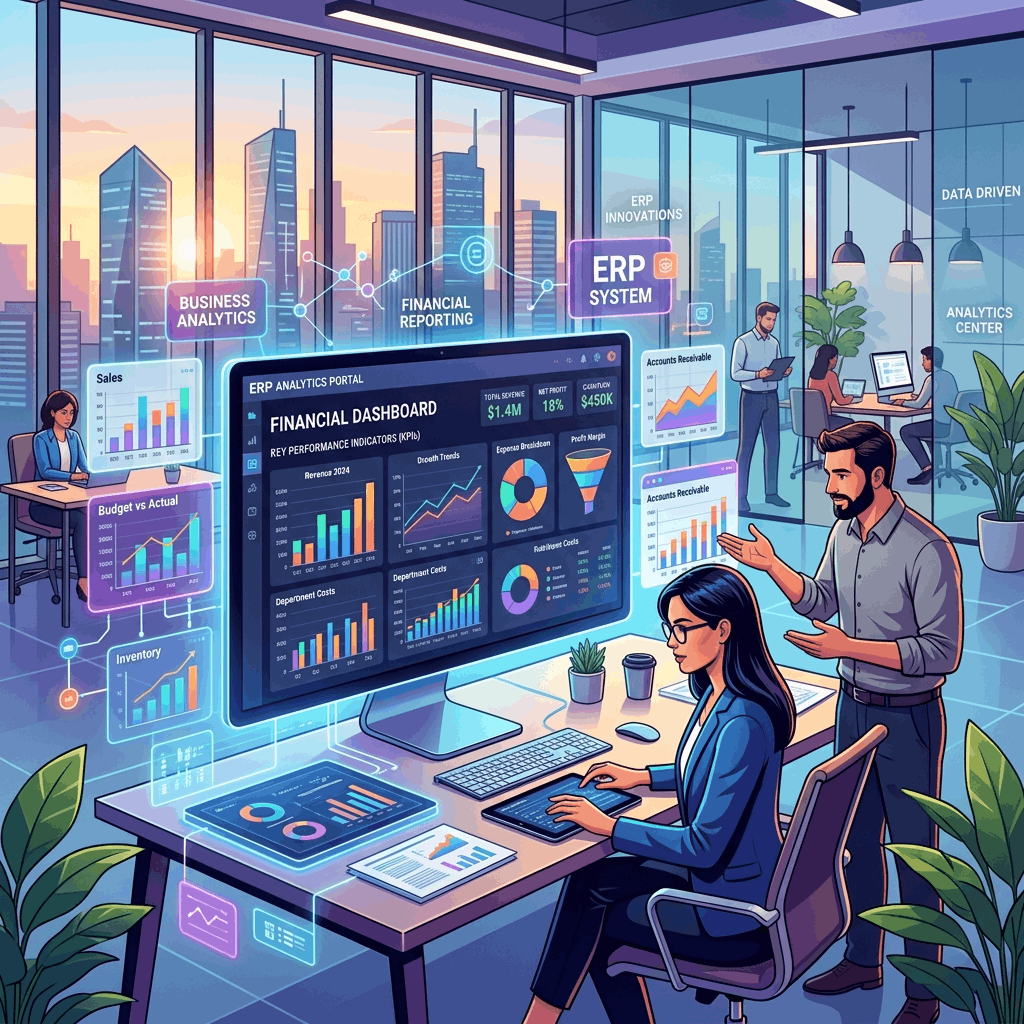
The Failure of Standalone Accounting
Most small businesses start their financial journey using basic, standalone software like entry-level QuickBooks or Xero. For a company doing $500,000 in revenue with a handful of employees, this is perfectly adequate.
However, when a company scales to $5 million, $20 million, or $100 million in revenue, standalone accounting software becomes a massive bottleneck. The software doesn't "talk" to the warehouse management system, the manufacturing floor, or the sales CRM. As a result, the accounting department is forced to manually re-type thousands of invoices, receipts, and payroll hours into the ledger every single month.
This manual data entry leads to errors, delays, and a complete lack of financial visibility. A CEO should not have to wait until the 15th of the month to know if they made a profit last month. The solution is Enterprise Resource Planning (ERP) Accounting Software. Here is everything you need to know about how an ERP transforms corporate finance.
Feature 1: The Unified General Ledger
In a siloed business, data exists in vacuums. The warehouse team knows exactly how many units of a product were shipped, but the accounting team doesn't find out until three days later when someone drops a physical piece of paper on their desk to generate the invoice.
An ERP operates on a Unified General Ledger. The entire company uses the exact same database. When a warehouse worker scans a barcode to ship a product out the door, the ERP instantly and automatically generates the customer invoice, updates the Accounts Receivable (AR) ledger, and recognizes the revenue based on GAAP or IFRS standards.
By eliminating data silos, the accounting team transitions from being "data typists" to being "data analysts," capable of providing the executive team with real-time strategic advice.
Feature 2: Automated 3-Way Matching (Accounts Payable)
One of the largest sources of financial leakage in a growing company is a disorganized Accounts Payable (AP) department. If a supplier sends an invoice for 500 widgets, how does the AP clerk know that the warehouse actually received 500 widgets? Often, they just blindly pay the invoice, leading to massive overpayments.
ERP software enforces Automated 3-Way Matching. Before the system will allow a check to be cut, the software automatically cross-references three digital documents:
- 1. The Purchase Order: Did we actually order 500 widgets at $1.00 each?
- 2. The Receiving Receipt: Did the warehouse worker scan exactly 500 widgets into the building?
- 3. The Supplier Invoice: Is the supplier charging us for 500 widgets at $1.00 each?
If there is a discrepancy—for example, the warehouse only received 480 widgets—the ERP automatically flags the invoice, freezes the payment, and alerts a manager to dispute the charge with the vendor.
Feature 3: Real-Time Job Costing
If you manufacture custom products or run large-scale service projects, determining your exact profit margin is incredibly difficult. The cost of raw materials fluctuates daily, and workers spend different amounts of time on different tasks.
If a company relies on estimates, they might be selling their best products at a loss without even realizing it.
An ERP provides penny-accurate Job Costing. Because the ERP tracks everything, it knows exactly how much you paid for the steel last Tuesday. It knows exactly which worker operated the CNC machine, and it knows that worker makes $28 an hour. The ERP automatically aggregates the real-time material costs, direct labor costs, and indirect factory overhead into a live dashboard. The CEO can instantly see the exact profit margin of every single job before the product even leaves the building.
Feature 4: Multi-Entity and Multi-Currency Consolidation
As businesses grow, they often spin off new legal entities or expand internationally. A CEO might own "Company A" in the United States, "Company B" in Canada, and a manufacturing subsidiary in Mexico.
With basic software, the accounting team has to log into three different databases, export everything to Excel, manually convert the currencies, and attempt to stitch together a consolidated financial report. This process takes weeks.
Enterprise-grade ERPs handle Multi-Entity Consolidation effortlessly. The CEO can open a dashboard and view the individual performance of the Mexican subsidiary in Pesos. With one click, the ERP automatically converts all currencies using real-time exchange rates, eliminates inter-company transactions, and generates a unified, consolidated Profit & Loss statement for the entire corporate umbrella instantly.
Feature 5: Automated Tax Compliance and Audit Trails
Handling taxation across different states, provinces, or countries is a legal minefield. Furthermore, if a government auditor knocks on your door, handing them a disorganized box of physical receipts is a guaranteed way to trigger massive fines.
An ERP acts as a digital fortress for compliance. The software integrates with live tax engines to automatically calculate the correct regional tax (like GST, VAT, or State Sales Tax) based on the exact shipping destination.
More importantly, the ERP maintains an immutable Audit Trail. If a journal entry is modified, the system records exactly which user made the change, at what exact millisecond, and from which IP address. When an auditor arrives, you simply grant them "Read-Only" access to the ERP, allowing them to verify your absolute digital compliance in hours instead of weeks.
Conclusion: Financial Clarity as a Weapon
In modern business, financial clarity is a competitive weapon. If your competitor knows their exact profit margins in real-time, they can confidently lower their prices to win a massive contract. If you are operating on month-old data, you are forced to guess.
You cannot scale a complex business on a foundation of disconnected spreadsheets and manual data entry. You need a centralized financial nervous system.
At Delight ERP, our advanced accounting modules are built to handle the complexities of multi-entity, high-volume organizations. We provide the automation, the security, and the real-time visibility you need to drive your profitability to the next level.
Streamline operations, reduce costs, and scale faster with Delight ERP.