
A Website is Not a Business
In the early days of a business, launching a Shopify or WooCommerce website feels like a massive accomplishment. But as sales volume grows from 10 orders a day to 500 orders a day, the cracks begin to show.
A beautiful website is just a digital storefront. It doesn't pack boxes, it doesn't order raw materials, and it doesn't file taxes. If your E-commerce website is disconnected from your backend operations, your employees are forced to act as the "human middleware." They spend all day manually copying data from the website into your accounting software and your warehouse shipping software.
This manual process simply does not scale. To build a multi-million dollar online business, you must eliminate the human middleware. You must integrate your storefront with an Enterprise Resource Planning (ERP) system. Here is why ERP integration is the ultimate growth hack for E-commerce.
Phase 1: Eliminating Manual Data Entry
If you are running a disconnected system, the lifecycle of an order looks like this: A customer places an order on Shopify. An employee prints the order. They manually type the customer's name, address, and credit card info into QuickBooks. They then walk the paper ticket to the warehouse.
When you are processing 500 orders a day, this manual data entry requires a massive, expensive administrative team. Furthermore, human beings make typos. If a data-entry clerk accidentally types "Avenue" instead of "Street," the package gets lost in the mail.
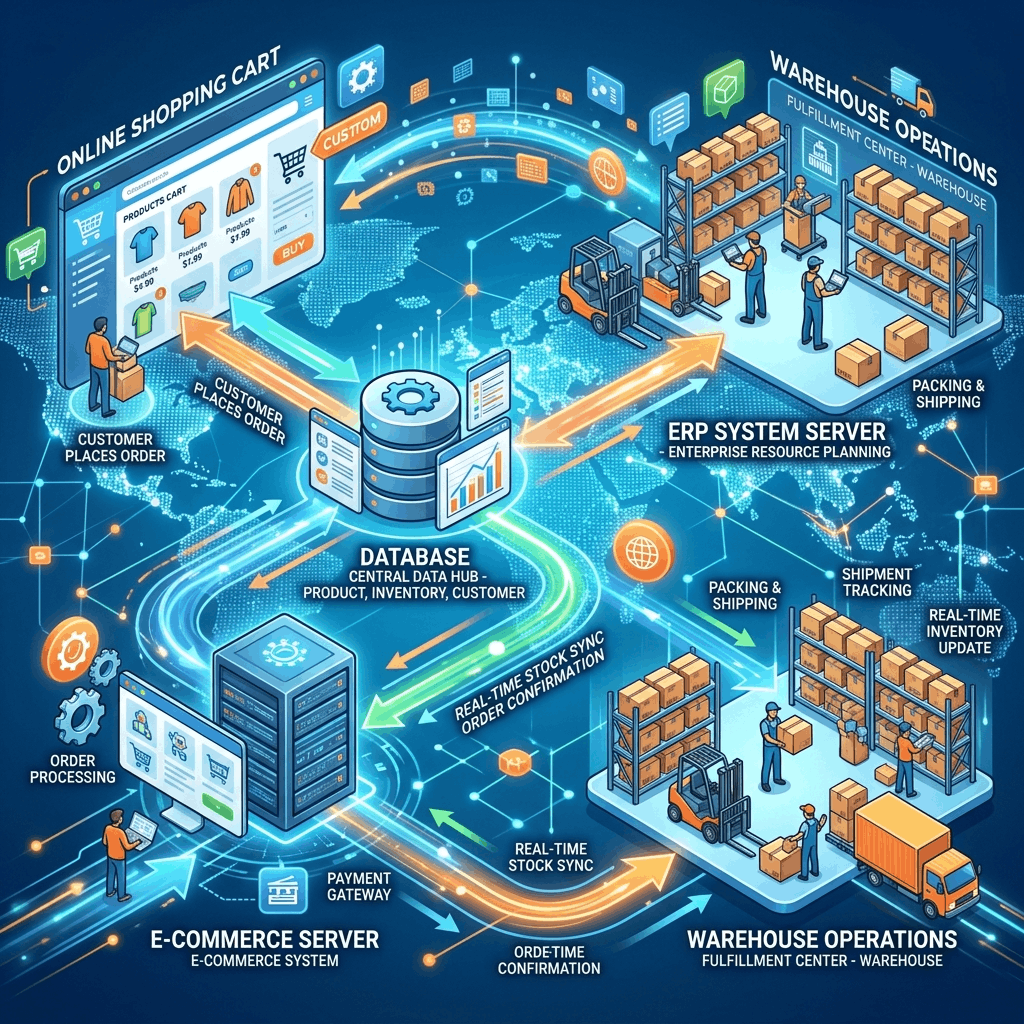
ERP integration automates the data flow. Using advanced APIs (Application Programming Interfaces), the ERP and the E-commerce platform talk to each other directly. The instant an order is placed online, the data flows perfectly into the ERP database. Zero human keystrokes required. Zero typos. Infinite scalability.
Phase 2: Total Inventory Synchronization
Perhaps the fastest way to destroy an online brand's reputation is by overselling inventory. If a customer pays for an item, receives an order confirmation, and then gets an email three days later saying, "Sorry, we are actually out of stock," they will never buy from you again. They will also leave a scathing 1-star review.
Overselling happens when you have multiple sales channels (e.g., a physical store, an Amazon store, and a Shopify store) that do not share a single brain. A customer buys the last jacket in your physical store, but your Shopify site still thinks you have one left.
An integrated ERP acts as the "Single Source of Truth." The ERP is the master record of your inventory. If that last jacket is scanned at your physical cash register, the ERP instantly sends an API ping to Shopify and Amazon, marking the item as "Out of Stock" globally within milliseconds. You will never oversell an item again.
Phase 3: Automated Fulfillment and Shipping
Amazon has trained consumers to expect their orders to be shipped almost immediately. If your warehouse takes three days just to put a product in a cardboard box, you will lose to the competition.
ERP integration hyper-accelerates fulfillment. When the online order flows into the ERP, it skips the administrative desk entirely and pops up instantly on a tablet in the warehouse. The warehouse worker picks the item, scans the barcode, and packs it.
The ERP then automatically calculates the dimensional weight, interfaces with the UPS/FedEx servers, selects the cheapest shipping method, prints the shipping label, and instantly pushes the tracking number back up to the E-commerce website, which emails the customer. The entire process takes minutes, not days.
Phase 4: Flawless Financial Reconciliation
Accounting for E-commerce is notoriously complex. You have to account for the revenue, the Cost of Goods Sold (COGS), the credit card processing fees (like Stripe or PayPal), and complex multi-state or international sales taxes.
If an accountant tries to do this manually by downloading CSV files from Shopify at the end of the month, they will pull their hair out. The numbers will never match the bank statements perfectly.
An integrated ERP automates the accounting. Every time an order is placed, the ERP generates the correct journal entries. It logs the revenue, subtracts the precise COGS to calculate live profit margins, and deposits the exact sales tax into a separate liability account. When tax season arrives, your books are already perfectly balanced and ready to file.
Phase 5: B2B Wholesale Functionality
Standard E-commerce platforms are built for B2C (Business-to-Consumer) transactions, where every customer sees the exact same retail price. But what if you run a B2B wholesale business? Client A might get a 20% discount because they buy in bulk, while Client B gets a 10% discount.
A B2B integrated ERP enables Custom Pricing Portals. Because all your complex pricing matrices live inside the ERP, the ERP can control the website. When Client A logs into your website, the ERP tells the website to display Client A's specific, negotiated prices. They can place a bulk order, and the ERP will automatically deduct the total from their pre-approved line of credit.
Conclusion: Built for Scale
A standalone E-commerce website is a great way to start a business. An integrated ERP-E-commerce ecosystem is the only way to scale one. By automating the flow of data between your customers, your warehouse, and your bank account, you unlock massive operational leverage.
You can process 10,000 orders a day with the exact same administrative headcount it took to process 100 orders a day.
At Delight ERP, we provide seamless, bi-directional integration with the world's most popular E-commerce platforms. We ensure that your storefront and your backend are operating in perfect, highly profitable harmony.
Streamline operations, reduce costs, and scale faster with Delight ERP.