
In This Article
- 1. Why ERP Myths Are Costing Indian Businesses Crores
- 2. Myth 1: ERP Is Only for Large Enterprises
- 3. Myth 2: ERP Implementation Is Too Expensive for MSMEs
- 4. Myth 3: ERP Takes 2-3 Years to Implement
- 5. Myth 4: ERP Will Disrupt Daily Business Operations
- 6. Myth 5: Our Business Is Too Unique for a Standard ERP
- 7. Myth 6: ERP Is Just Accounting Software
- 8. Myth 7: Cloud ERP Is Not Secure for Business Data
- 9. Myth 8: ERP Is Too Complex — Our Team Won't Adopt It
- 10. Myth 9: We Can Wait — Our Current System Is Good Enough
- 11. Myth 10: ERP ROI Takes Too Long to Materialise
- 12. The Truth: How to Start Your ERP Journey Without Fear
- Frequently Asked Questions
1. Why ERP Myths Are Costing Indian Businesses Crores
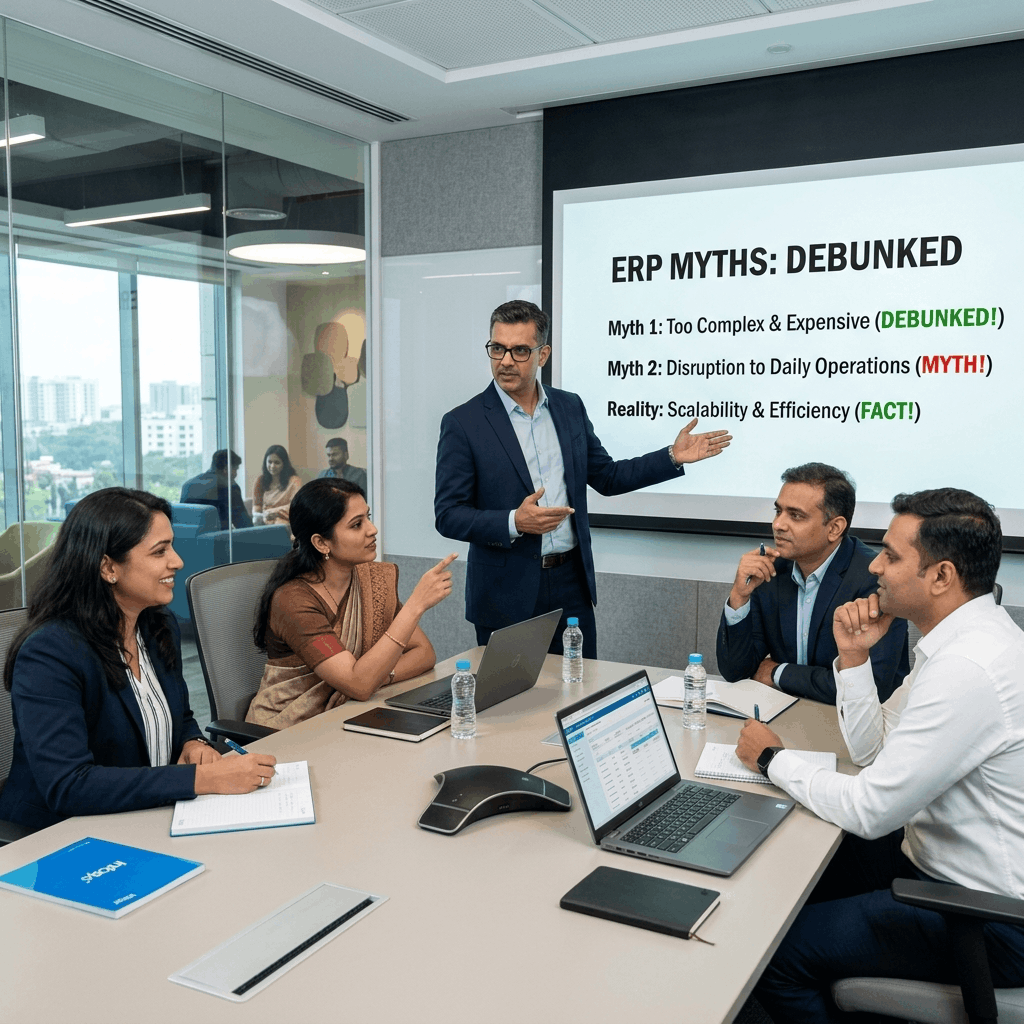
Digital transformation is no longer optional for Indian businesses aiming to remain competitive; it is a fundamental requirement for survival. Yet, a surprising number of Micro, Small, and Medium Enterprises (MSMEs) hesitate to adopt Enterprise Resource Planning (ERP) software. This hesitation is rarely due to a lack of ambition. Instead, it is almost entirely driven by pervasive, outdated myths surrounding what ERP is, what it costs, and how it is implemented.
These myths act as a psychological barrier, paralyzing decision-makers and causing them to stick with inefficient manual processes, disjointed spreadsheets, and legacy accounting software. The cost of believing these myths is immense: lost productivity, uncontrolled inventory costs, poor customer service, and an inability to scale. It is time to debunk the top 10 ERP myths holding Indian businesses back and reveal the empowering truth.
⚠️ The Real Cost of Doing Nothing
The myth that "our current system is fine" is the most dangerous of all. As your competitors automate their supply chains and gain real-time visibility into their costs, relying on manual data entry means your business is slowly bleeding margins. The longer you wait to implement an ERP, the wider the competitive gap becomes, and the harder it will be to catch up.
2. Myth 1: ERP Is Only for Large Enterprises
The Myth: Only massive multi-national corporations with thousands of employees and multi-million-dollar IT budgets need, or can afford, ERP systems.
The Truth: This was true in the 1990s, but it is entirely false today. The advent of Cloud ERP has democratized enterprise software. Solutions like Delight ERP are built specifically with the Indian MSME in mind. Whether you are a small trading firm with 10 employees or a mid-sized manufacturer, an ERP provides the structured processes and visibility necessary to manage growth and prevent operational chaos.
3. Myth 2: ERP Implementation Is Too Expensive for MSMEs
The Myth: Implementing an ERP will drain our working capital and require us to hire an expensive, dedicated IT team.
The Truth: Legacy, on-premise ERPs required massive upfront capital expenditure (CapEx) for physical servers, software licenses, and IT staff. Cloud ERP, however, operates on a Software as a Service (SaaS) model. It is an operational expense (OpEx) where you pay a predictable, highly affordable subscription fee. The vendor handles all the server maintenance, security, and updates, eliminating the need for an in-house IT department.
4. Myth 3: ERP Takes 2-3 Years to Implement
The Myth: We will be stuck in a never-ending IT project that will drain our resources and distract us from our core business for years.
The Truth: While deploying a highly customized legacy system across a global corporation can take years, implementing a modern Cloud ERP for an SME is remarkably swift. Delight ERP uses agile implementation methodologies. For most Indian MSMEs, a complete rollout—including data migration and user training—takes just 2 to 4 weeks. The focus is on rapid deployment to deliver quick time-to-value.
💡 Success Story: Speedy Implementation in Rajkot
A 15-person industrial pump manufacturer in Rajkot believed ERP was too big a project for them. After consulting with Delight ERP, they opted for a cloud-based manufacturing module. The entire system was configured, old data imported, and staff fully trained and live within just 3 weeks, immediately solving their chronic inventory tracking issues without disrupting production.
5. Myth 4: ERP Will Disrupt Daily Business Operations
The Myth: Implementing a new system will bring our business to a standstill. We can't afford to stop production or halt sales while the software is installed.
The Truth: A professional implementation partner ensures zero disruption. Implementations are carefully planned. Often, a "phased approach" is used, where one module (e.g., CRM software) goes live first, followed by others. Alternatively, the new ERP is run in parallel with the old system for a brief period to ensure everything functions perfectly before the final switch is flipped, safeguarding your daily operations.
📌 Pro Tip: Phased Implementation
To entirely mitigate operational risk, ask your ERP vendor for a phased rollout. Start by digitizing your most painful bottleneck first—such as inventory or billing. Once your team is comfortable and that specific problem is solved, gradually introduce production planning, HR, and CRM modules.
6. Myth 5: Our Business Is Too Unique for a Standard ERP
The Myth: Our workflows are so special and complex that no off-the-shelf software could possibly handle them. We need to build our own software from scratch.
The Truth: While every business has unique traits, core business processes—procurement, accounting, inventory management—follow established best practices. Modern ERPs like Delight ERP are highly configurable. Instead of rewriting code, the software's settings, workflows, and reports are adapted to fit your specific needs. Building custom software from scratch is notoriously risky, expensive, and difficult to maintain long-term.
7. Myth 6: ERP Is Just Accounting Software
The Myth: We already have basic accounting software (like Tally), so we don't need an ERP. It's basically the same thing.
The Truth: Accounting software looks in the rear-view mirror—it records financial transactions after they happen. An ERP system looks forward and manages the entire operational engine. While it includes GST billing and financial modules, an ERP also manages production floors, tracks supply chains, handles customer relationships, and automates procurement. ERP connects the physical operations of your business directly to the financial outcomes.
8. Myth 7: Cloud ERP Is Not Secure for Business Data
The Myth: Keeping our data on a server in our office is safer than putting it "in the cloud" where hackers can get it.
The Truth: The opposite is true. An on-premise server sitting in a local office is highly vulnerable to physical theft, fire, flooding, hardware failure, and ransomware attacks. Cloud ERP providers host data in highly secure, enterprise-grade data centers (like AWS or Azure) with military-grade encryption, continuous monitoring, and automated redundant backups. Your data is far safer in the cloud than on a local hard drive.
9. Myth 8: ERP Is Too Complex — Our Team Won't Adopt It
The Myth: Our staff are not "tech-savvy." They will resist the change, find the software too hard to use, and eventually abandon it.
The Truth: Early ERP systems were notoriously clunky. However, modern systems like Delight ERP feature intuitive, user-friendly interfaces similar to the apps people use on their smartphones every day. Furthermore, successful adoption is driven by professional training. A good implementation partner spends significant time training your team, ensuring they understand how the software actually makes their daily jobs easier, not harder.
10. Myth 9: We Can Wait — Our Current System Is Good Enough
The Myth: We are profitable now using spreadsheets and manual workarounds. We can delay this investment until we are much bigger.
The Truth: "Good enough" is the enemy of growth. Manual processes don't scale. If you wait until your business is breaking at the seams to implement an ERP, the implementation process will be significantly harder because you will be dealing with ingrained bad habits and a massive volume of disorganized data. Implementing ERP early creates a scalable foundation that facilitates and accelerates growth, rather than bottlenecking it.
11. Myth 10: ERP ROI Takes Too Long to Materialise
The Myth: ERP is a sunk cost. We won't see a financial return on this investment for many years, if ever.
The Truth: Cloud ERP delivers rapid ROI, typically within 12 to 18 months for Indian MSMEs. The return is generated through multiple channels: dramatic reductions in excess inventory holding costs, elimination of costly production errors due to accurate BOM management, optimized supply chain purchasing, and a significant increase in overall employee productivity. It pays for itself quickly and then continues to generate ongoing value.
| The Myth | The Truth (Reality) |
|---|---|
| Only for large enterprises | Cloud ERP is scalable and explicitly designed for MSMEs. |
| Too expensive | SaaS models mean low, predictable monthly operational costs. |
| Takes years to implement | Typically 2-4 weeks for an SME with Delight ERP. |
| Disrupts business | Phased rollouts ensure zero disruption to daily operations. |
| Just accounting software | Manages the entire business: production, CRM, inventory, HR. |
| Cloud is insecure | Cloud data centers have military-grade security and backups. |
| Employees won't use it | Modern UI and proper training ensure high adoption rates (95%+). |
| ROI takes too long | Average payback period is 12-18 months through major efficiency gains. |
12. The Truth: How to Start Your ERP Journey Without Fear
The myths surrounding ERP software are relics of the past. Today, modern Cloud ERP is the most powerful tool an Indian business can deploy to organize its operations, ensure strict tax compliance, and accelerate profitable growth. The key to a successful transition is choosing a partner who understands the realities of your specific industry and the scale of your business.
Delight ERP is committed to debunking these myths through practical, affordable, and highly effective software solutions tailored for Indian MSMEs. Don't let unfounded fears hold your business back from its true potential. Take the first step towards digital transformation today by scheduling a demo, and discover how seamless and rewarding the ERP journey can actually be.
Frequently Asked Questions
Is ERP software only suitable for large manufacturing companies in India?
No, this is a major myth. Modern cloud ERP systems are specifically designed to scale down for Small and Medium Enterprises (SMEs). Whether you have 10 employees or 1,000, ERP provides vital operational control and efficiency.
How long does it actually take to implement ERP for a small Indian business?
While massive global enterprises might take years, a typical MSME in India implementing a cloud-based solution like Delight ERP can usually go live within 2 to 4 weeks, depending on the complexity of their specific requirements.
How much does cloud ERP software really cost for an Indian MSME?
Cloud ERP is highly affordable due to the SaaS (Software as a Service) subscription model. Instead of massive upfront capital expenditure on servers and licenses, MSMEs pay a predictable monthly or annual fee based on the number of users.
Will ERP implementation disrupt our current business operations?
With proper planning and a phased implementation approach, disruption is minimal. Experienced vendors like Delight ERP run parallel systems or phase in modules gradually to ensure daily business continues smoothly during the transition.
How long does it take to see ROI from ERP implementation in India?
The average Return on Investment (ROI) period for Indian SMEs implementing Cloud ERP is generally around 12 to 18 months. Savings are quickly realized through reduced inventory holding costs, eliminated manual data entry, and increased sales efficiency.
Frequently Asked Questions
Fast implementation · Affordable for MSMEs · Easy to use · Fully customisable · 100% GST compliant · Dedicated support — no myths, just results.