
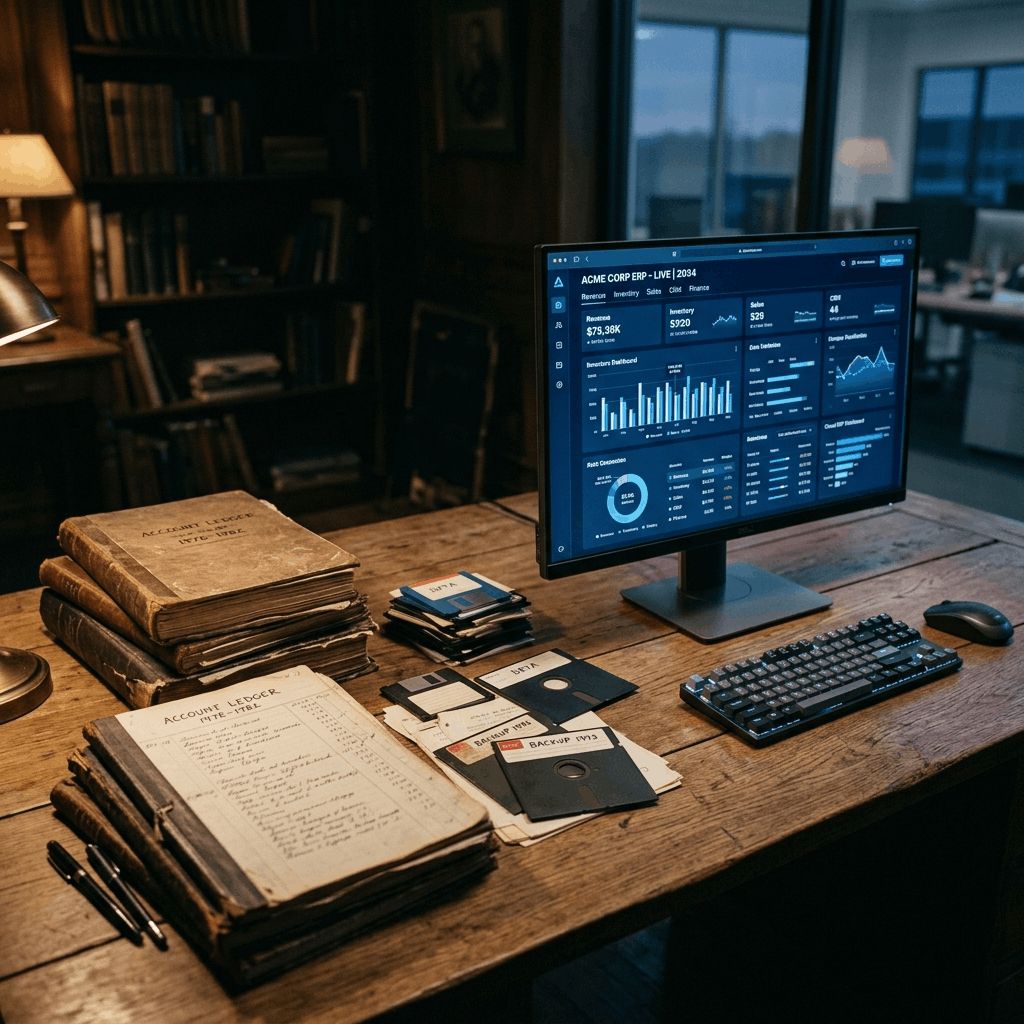
From Mainframes to the Cloud: A Brief History
To understand where Enterprise Resource Planning (ERP) software is going, you must understand where it came from. The concept of ERP was born in the 1960s, though it was originally called Material Requirements Planning (MRP). These early systems were essentially massive calculators running on room-sized mainframe computers, used exclusively by giant manufacturing companies to calculate how much raw steel or plastic they needed to order.
In the 1990s, the term "ERP" was coined as the software expanded beyond the factory floor to include finance, human resources, and sales. However, these systems were "On-Premise"—meaning they required massive upfront capital to buy physical servers and took years to implement.
Today, the landscape has completely transformed. Driven by the internet, mobile technology, and the relentless demand for speed, modern ERP systems bear almost no resemblance to their 1990s ancestors. Let's dive into the top five current trends that are actively shaping the future of enterprise software.
Trend 1: The Unquestioned Dominance of Cloud-Native Architectures
The debate between On-Premise and Cloud computing is over; the Cloud has won decisively. Historically, companies were hesitant to put their financial data in the cloud due to perceived security risks. Today, they realize that multi-billion dollar cloud providers (like AWS or Azure) have exponentially better cybersecurity than a mid-sized company's internal IT department.
The current trend is the shift toward "Cloud-Native" ERP. This means the software isn't just an old program hosted on a web server; it was built from the ground up for the internet.
Cloud-native architecture provides elastic scalability. If your e-commerce business goes viral on social media and order volume spikes 1,000% overnight, a cloud-native ERP instantly provisions more server power to handle the traffic, preventing your systems from crashing. Furthermore, cloud ERPs offer "continuous delivery," meaning software updates and new features are pushed to your system automatically over the weekend, eliminating the nightmare of manual software upgrades.
Trend 2: The Infusion of Artificial Intelligence (AI)
Artificial Intelligence (AI) and Machine Learning (ML) are no longer sci-fi concepts; they are actively embedded into the core modules of modern ERP systems, fundamentally changing how businesses operate.
Currently, AI in ERP is primarily focused on two areas: Automation and Predictive Analytics.
For automation, AI algorithms can "read" incoming vendor invoices via Optical Character Recognition (OCR), extract the relevant financial data, match it against the original purchase order, and route it for payment without a human ever typing a single number. This drastically reduces administrative overhead.
For predictive analytics, AI analyzes years of your historical sales data, factors in external variables (like weather patterns or global shipping delays), and generates highly accurate demand forecasts. Instead of a procurement manager guessing how much inventory to order, the AI prescribes exactly what to buy and when, optimizing cash flow and preventing stockouts.
Trend 3: The Rise of the Mobile Workforce
The days of enterprise software being locked to a desktop computer in a cubicle are over. The modern workforce is dynamic, remote, and constantly moving. ERP vendors have responded by developing highly robust, native mobile applications.
Mobile ERP is not just a condensed version of the desktop site; it leverages the unique hardware of the smartphone. A warehouse worker can use their phone's camera to scan barcodes and update live inventory. A field service technician can use GPS to route to a client, fix a broken machine, capture the client's signature on the touch screen, and instantly generate an invoice from the driveway.
This mobility ensures that data is captured at the exact source of the action, reducing data latency to zero and empowering employees to execute their jobs from anywhere in the world.
Trend 4: Deep Integration with the Internet of Things (IoT)
The Internet of Things (IoT) involves attaching internet-connected sensors to physical objects. When IoT is integrated with an ERP, the physical world begins communicating directly with your software.
This is particularly revolutionary in manufacturing and logistics. Instead of a worker manually typing in the temperature of a cold-storage warehouse, an IoT sensor constantly streams that data to the ERP. If the temperature spikes, the ERP automatically alerts the manager before the perishable inventory is destroyed.
In manufacturing, IoT sensors monitor the vibration and heat of expensive machinery. The ERP's AI analyzes this data stream to predict exactly when a machine component will fail. The ERP then automatically orders a replacement part and schedules "predictive maintenance" during an off-shift, entirely preventing catastrophic factory downtime.
Trend 5: Composable ERP and Hyper-Personalization
In the past, ERP systems were massive, monolithic blocks of code. You bought the entire suite, even if you only needed 20% of the features, and customizing it was a notoriously expensive nightmare.
The current trend is "Composable ERP." Modern systems are built on microservices architectures and utilize extensive APIs (Application Programming Interfaces). This allows a business to treat their software like Lego blocks. You can implement the core financial module from your ERP vendor, but seamlessly plug in a specialized third-party HR app or a custom-built e-commerce frontend.
Furthermore, modern ERPs feature "low-code/no-code" interfaces. This allows business users—not just IT programmers—to build custom dashboards, design automated workflows, and personalize their user interface via simple drag-and-drop tools. This hyper-personalization ensures the software adapts to the business, rather than forcing the business to adapt to the software.
Conclusion: Adapting to the Velocity of Change
The evolution of ERP software reflects the broader evolution of the global economy: it is moving faster, becoming more intelligent, and becoming deeply interconnected.
Companies running on outdated, rigid legacy systems will simply not be able to keep pace. They will be outmaneuvered by competitors utilizing AI to predict demand and IoT to automate production. Upgrading to a modern, cloud-native ERP is no longer just an IT upgrade; it is a strategic necessity to remain relevant in the next decade of business.
At Delight ERP, we are obsessed with the future of enterprise technology. Our cloud-native platform is constantly evolving, ensuring our clients always have access to the cutting-edge tools they need to dominate their respective industries.
Streamline operations, reduce costs, and scale faster with Delight ERP.