
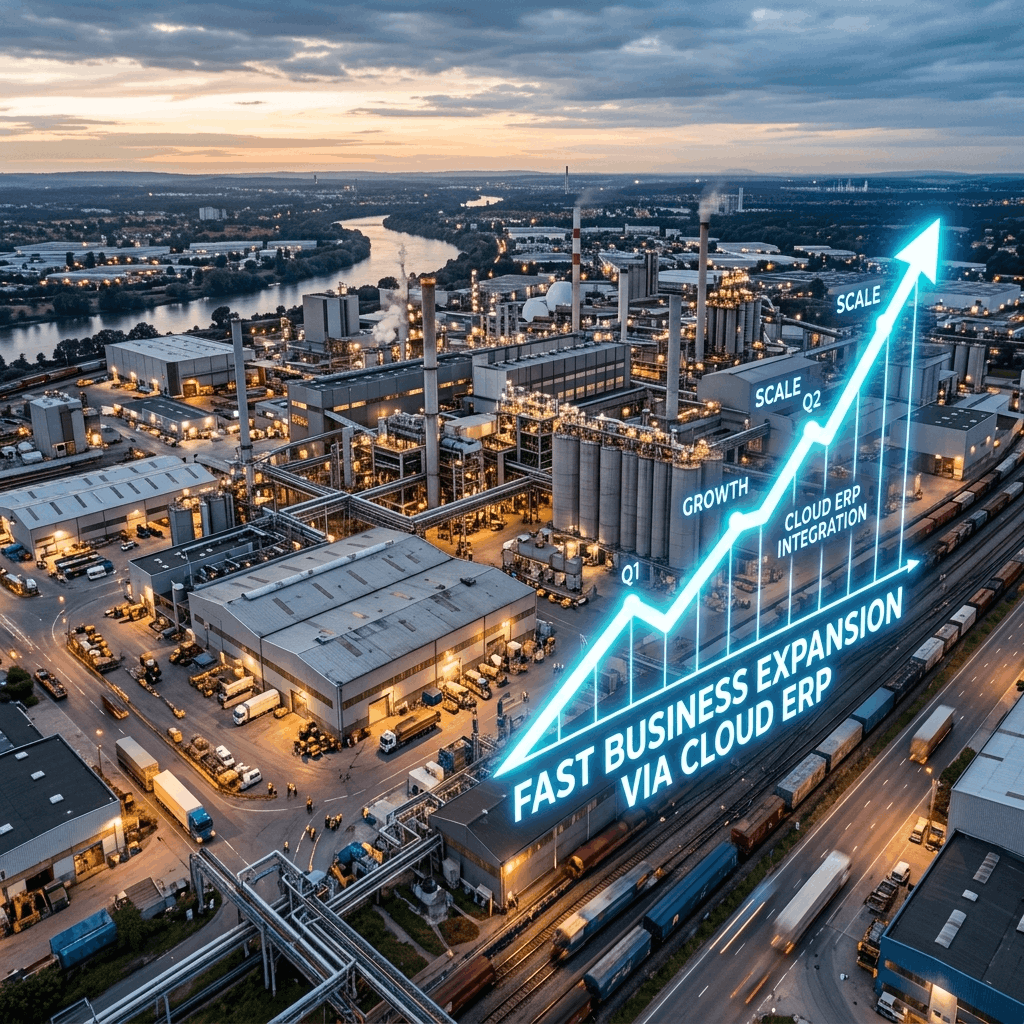
The Era of Agile Manufacturing
The manufacturing sector has historically been viewed as slow-moving and highly traditional. For decades, massive factories operated on rigid, multi-year plans. However, in the 2020s, the global market demands unprecedented speed. Customer preferences shift overnight, supply chains are volatile, and product lifecycles are shorter than ever before. To survive and grow, a modern manufacturing business must be incredibly agile.
Agility is impossible when your factory is running on a patchwork of disconnected spreadsheets, whiteboards, and a legacy on-premise software system that was installed fifteen years ago. When a business relies on outdated infrastructure, every attempt to scale production results in increased chaos, higher scrap rates, and squeezed profit margins.
This is why high-growth manufacturing firms are abandoning their server rooms and aggressively migrating to Cloud ERP (Enterprise Resource Planning) systems. Cloud ERP is not just a place to store data; it is a dynamic, infinitely scalable operational engine. Let's break down exactly how Cloud ERP enables explosive, sustainable growth for manufacturing businesses.
Enabler 1: Real-Time Shop Floor Visibility
You cannot optimize what you cannot see. In traditional manufacturing setups, plant managers only discover production bottlenecks at the end of the day or the end of the week, when physical paperwork is finally handed to the accounting office. By that time, thousands of dollars have already been lost to idle labor or machine downtime.
A Cloud ERP provides absolute, real-time visibility into the shop floor. Modern cloud systems integrate directly with IoT (Internet of Things) sensors attached to the manufacturing equipment. They also allow workers to use ruggedized tablets directly on the assembly line.
When a machine's output drops below optimal levels, or when a specific workstation begins producing defective units, the Cloud ERP instantly flags the anomaly on the manager's live digital dashboard. This allows management to intervene immediately, pivoting production schedules or deploying maintenance teams before a minor issue spirals into a massive delay. This level of real-time control is critical when ramping up production volume.
Enabler 2: Scalable Bill of Materials (BOM) Management
The Bill of Materials (BOM) is the fundamental recipe for any manufactured product. When a business is small and only manufactures five simple products, managing the BOM in an Excel spreadsheet is difficult, but possible. When a business scales to manufacturing 500 complex products, each with multi-level BOMs containing thousands of sub-components, using spreadsheets guarantees catastrophic failure.
Cloud ERPs are engineered to handle incredible complexity natively. They provide dynamic, multi-level BOM management. If the engineering department discovers a flaw and updates the BOM to replace a specific screw with a slightly longer one, the Cloud ERP updates the entire system instantly.
The procurement department is automatically alerted to stop ordering the old screw and start ordering the new one. The digital instructions on the factory floor tablets are updated instantly, ensuring the assembly workers don't build the next batch incorrectly. This seamless version control prevents massive amounts of wasted material and allows companies to launch new product lines incredibly fast.
Enabler 3: Removing On-Premise IT Bottlenecks
When a manufacturing business is growing rapidly, they need to add new users, new software modules, and drastically more computing power to handle the increased data volume. If the company is using an on-premise system, this requires the IT department to physically purchase, rack, configure, and test new server hardware. This process often takes months, creating a massive bottleneck that stalls business growth.
Cloud ERP completely removes the IT bottleneck. Because the software is hosted on massive, globally distributed server farms owned by the vendor (or partners like AWS/Azure), the infrastructure is infinitely scalable on demand.
If your factory needs to double its computing power to handle the Black Friday rush, or if you need to instantly add 50 new user accounts for a new shift of workers, it can be done with a few clicks. The cloud scales elastically. Furthermore, the vendor handles all security patches and database backups, freeing your internal IT team to focus on strategic business projects rather than server maintenance.
Enabler 4: Rapid Multi-Plant Expansion
As manufacturing firms scale, they inevitably need to open new facilities—either in different states to lower shipping costs, or in different countries to access new markets.
Expanding an on-premise ERP to a new geographic location is a nightmare. It requires building a new server room at the new location, or setting up incredibly slow, expensive VPN tunnels to connect the new factory back to the headquarters' server. Data synchronization issues are rampant.
With a Cloud ERP, opening a new manufacturing plant is stunningly simple from an IT perspective. Because the entire system is securely accessed via a web browser, the new plant simply needs a standard internet connection. The moment the new plant comes online, its inventory, production data, and financial metrics are instantly synced in real-time with the global corporate dashboard. This allows manufacturers to scale their physical footprint aggressively without technological friction.
Enabler 5: Seamlessly Integrating the Supply Chain
A factory is only as fast as its supply chain. If raw materials do not arrive on time, the production line stops. As production volume scales up, the procurement team must manage a vastly more complex network of global vendors.
Cloud ERP systems break down the walls between the factory floor and the procurement department. The system uses AI-driven demand forecasting to predict exactly how much raw material will be needed for next month's production runs.
Furthermore, because it is cloud-based, manufacturers can grant secure, restricted portal access directly to their top-tier suppliers. Suppliers can log in and see live inventory levels of the parts they supply, allowing them to automatically ship replenishment stock before the manufacturer even has to ask. This level of tight supply chain integration is the hallmark of modern, high-growth manufacturing.
Enabler 6: Data-Driven Cost Reductions
Finally, fast growth is irrelevant if profit margins are shrinking. As production volume increases, inefficiencies that were previously ignored become massive financial liabilities.
Cloud ERP provides executives with incredibly deep Business Intelligence (BI) and analytics. Because every department (Sales, Finance, Procurement, Manufacturing, Shipping) is entering data into the exact same centralized database, executives can generate holistic reports instantly.
A CEO can look at a dashboard and identify exactly which product line is the most profitable, which specific factory shift has the highest scrap rate, and which vendor is consistently delivering late. Armed with this undeniable data, management can make surgical adjustments to the operation, slashing wasteful spending and ensuring that top-line revenue growth translates directly into bottom-line profit.
Building the Factory of the Future
The ceiling for a manufacturing company's growth is largely determined by the software infrastructure it chooses to run on. Legacy on-premise systems act as anchors, weighing down the business with rigid processes, data silos, and expensive IT maintenance.
Cloud ERP acts as an accelerant. By providing real-time visibility, flawless BOM management, elastic scalability, and deep analytical insights, Cloud ERP empowers manufacturers to pivot rapidly, scale aggressively, and outmaneuver slower competitors.
At Delight ERP, our cloud-native manufacturing platform is built to handle the rigorous demands of modern production. We give you the digital tools necessary to transform your factory into a lean, highly profitable, growth-oriented operation.
Streamline operations, reduce costs, and scale faster with Delight ERP.