
Solving the Fundamental Chaos of Manufacturing
If you visit a manufacturing plant that does not use modern software, you will inevitably witness chaos. You will see supervisors running across the factory floor yelling to find out if a machine is fixed. You will see warehouse workers frantically searching for a lost pallet of raw materials. You will see sales reps apologizing to angry customers because an order is two weeks late.
This chaos is not caused by bad employees; it is caused by bad systems. When a factory relies on physical clipboards, disconnected spreadsheets, and verbal communication, information gets lost.
Enterprise Resource Planning (ERP) software is the antidote to this chaos. By centralizing all data into a single, real-time digital system, an ERP brings order, visibility, and automation to the manufacturing process. But how exactly does this software translate into practical help on the factory floor? Let's break down the tangible benefits.
Benefit 1: Perfect Inventory Optimization
Inventory is a balancing act. If you have too much inventory (Overstock), you are tying up massive amounts of operating capital in raw materials that sit on shelves collecting dust. If you have too little inventory (Stockouts), the entire production line stops, and you cannot fulfill customer orders.
An ERP system helps manufacturers strike the perfect balance through Automated Inventory Optimization.
The software tracks inventory globally in real-time. When a machine consumes a piece of sheet metal, a barcode is scanned, and the system instantly deducts it from the ledger. You never have to wait for a "monthly inventory count" to know what you have.
Furthermore, the ERP uses predictive algorithms based on historical sales data to tell you exactly how much inventory you should carry to meet projected demand without over-ordering. This drastically frees up cash flow that can be reinvested into the business.
Benefit 2: Streamlined Procurement and Vendor Management
When you manufacture a complex product, you might rely on dozens of different vendors to supply various components. Managing these relationships manually is tedious and prone to expensive mistakes.
An ERP software helps by completely automating the procurement cycle. Within the system, you can set a "Minimum Stock Level" for every raw material. For example, you can tell the system: "We must always have at least 500 bolts in stock."
When the inventory level drops to 499, the ERP's automation engine takes over. It instantly generates a digital Purchase Order (PO) for the required amount of bolts and automatically emails it to your primary vendor. It completely removes the human burden of checking stock levels and writing POs, ensuring the factory never runs out of critical components.
Benefit 3: Flawless Production Execution
Once raw materials are in house, they must be transformed into finished goods. In a chaotic factory, workers might use the wrong version of a blueprint, or assemble parts in the incorrect order.
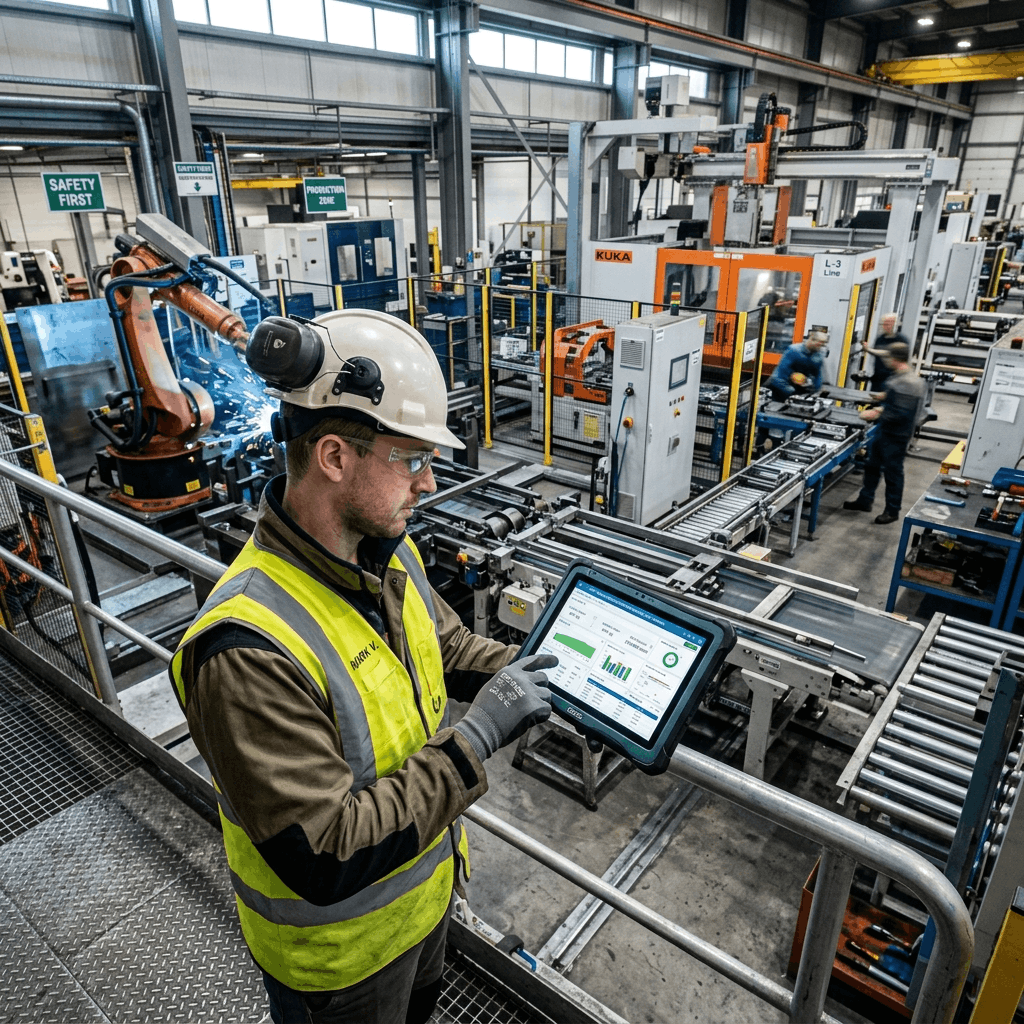
An ERP software helps by digitizing the entire production execution process. Instead of physical blueprints, the ERP delivers digital "Work Orders" directly to a tablet at the worker's station. These work orders contain the 100% accurate, up-to-date Bill of Materials (BOM) and step-by-step visual routing instructions.
The ERP also enforces discipline. If Step 3 in the manufacturing process requires a specific safety check, the software will not allow the worker to proceed to Step 4 in the system until they digitally sign off that the safety check was completed. This software-driven discipline dramatically reduces the number of defective products that have to be scrapped, saving massive amounts of money.
Benefit 4: Enhancing the Customer Experience
It may seem counterintuitive, but a manufacturing ERP is actually one of the most powerful customer service tools a company can possess.
When a major B2B client calls a manufacturer to ask, "When will my order of 1,000 units be delivered?" a company without an ERP has to guess. The sales rep has to call the warehouse, who then has to call the production manager. Eventually, the rep gets back to the client with an inaccurate estimate.
With an ERP, the sales rep simply types the client's name into the software. The system immediately displays the exact status of the order. The rep can tell the client: "500 units have finished assembly, 300 are currently in the painting booth, and the final 200 will be assembled tomorrow morning. Your full order will ship at exactly 2:00 PM on Thursday." Providing this level of fast, hyper-accurate information builds immense trust with high-value clients.
Benefit 5: Real-time Analytics and Executive Dashboards
A CEO cannot steer a company effectively if they only look at the financial data 30 days after the month has ended. They need to know what is happening right now.
ERP software helps executive leadership by providing highly visual, real-time dashboards. The CEO can open the ERP on their tablet and instantly see key performance indicators (KPIs):
- What was our total revenue generated today?
- What is the current uptime percentage of our top 5 machines?
- Which product line currently has the highest profit margin?
- How many overtime hours did we pay out this week?
By transforming raw factory data into digestible, actionable intelligence, the ERP allows management to make rapid, strategic decisions that outmaneuver slower competitors.
Conclusion: Moving from Reactive to Proactive
The ultimate way that ERP software helps the manufacturing industry is by shifting the business from a reactive state to a proactive state. You no longer react to stockouts; the system prevents them. You no longer react to angry customers; the system gives them accurate timelines upfront.
By automating the mundane administrative tasks and providing total visibility into the factory floor, an ERP system frees your human workforce to focus on what they do best: innovating, building great products, and growing the business.
At Delight ERP, we provide the proactive digital infrastructure that modern manufacturers need. Our platform is built to eliminate chaos, optimize your resources, and drive measurable profitability across every inch of your operation.
Streamline operations, reduce costs, and scale faster with Delight ERP.