
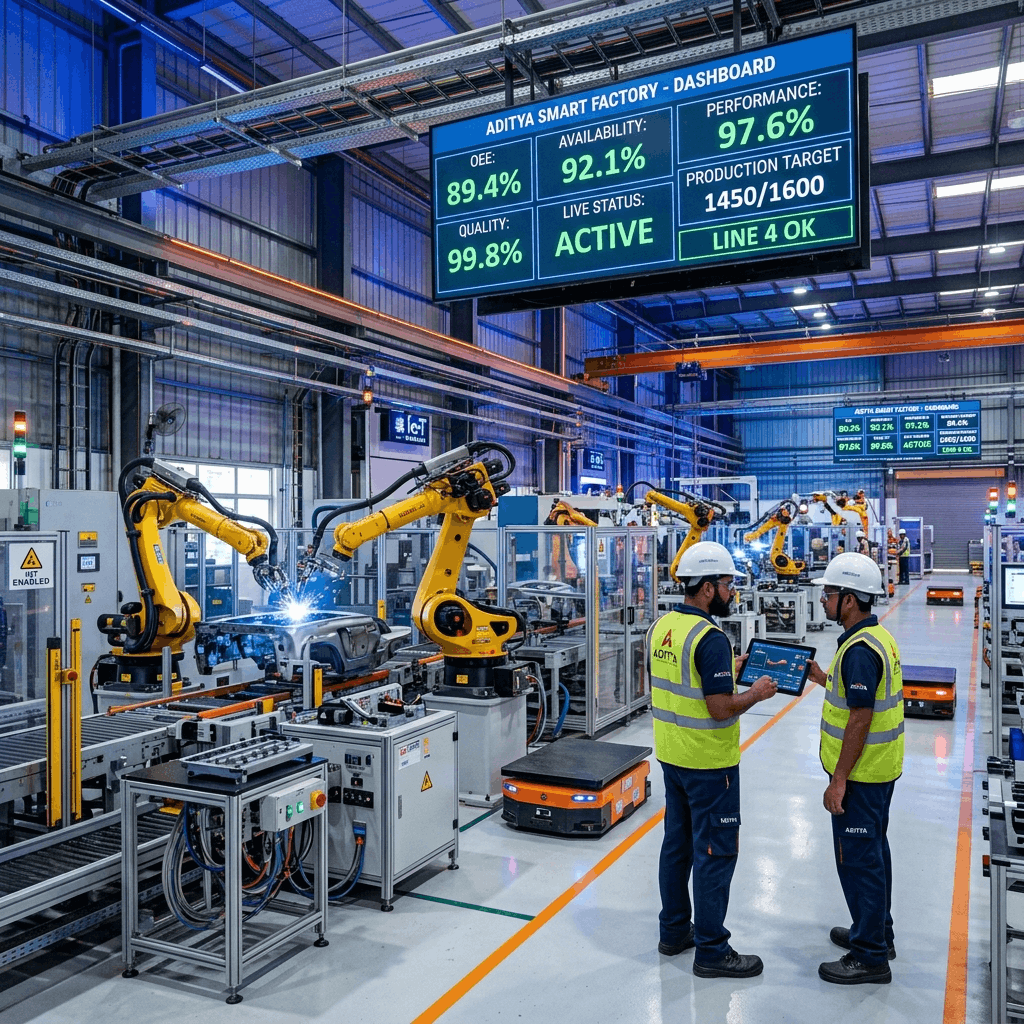
The Mandate for Continuous Improvement
To survive in the modern manufacturing landscape, a company must adopt a philosophy of continuous optimization. Global competition is too fierce, and raw material costs are too high, to allow inefficiencies to remain hidden on the factory floor.
However, you cannot optimize what you cannot measure. If your factory runs on paper work orders, disparate Excel spreadsheets, and intuition, you are effectively flying blind. The only way to achieve true, systemic optimization is by implementing a central nervous system for your business: Enterprise Resource Planning (ERP) software.
An ERP system ingests millions of data points from your machines, your warehouse, and your sales team, transforming that raw data into actionable intelligence. Here are five powerful ways an ERP system will relentlessly optimize your product manufacturing company.
Way 1: Enabling Lean Manufacturing and JIT Inventory
One of the core tenets of optimization is minimizing waste. The most expensive form of waste in manufacturing is excess inventory. Cash tied up in raw materials sitting on a shelf is cash that cannot be used to hire new engineers or buy faster machinery.
An ERP system is the fundamental prerequisite for achieving Just-in-Time (JIT) inventory management. In a JIT environment, raw materials arrive at the loading dock exactly when they are needed on the assembly line.
To achieve this, the ERP system flawlessly synchronizes your supply chain with your production schedule. It calculates the exact lead time of your vendors (e.g., Supplier A takes exactly 14 days to deliver sheet metal). The ERP then automatically generates a Purchase Order exactly 14 days before that sheet metal is scheduled to be cut on the factory floor. This precision reduces warehouse holding costs by millions of dollars over the lifetime of the business.
Way 2: Empowering the Workforce with Digital Instructions
A factory is only as optimized as its human workforce. When a worker has to assemble a complex new product, they often rely on a thick, paper binder containing engineering blueprints. If those blueprints are outdated, or if the worker misinterprets them, a defective product is built.
An ERP optimizes the human element by delivering Digital Work Instructions. When a worker begins a shift, they log into a rugged tablet at their workstation. The ERP displays the exact Work Order they need to complete, along with step-by-step visual instructions (including 3D models or short video clips) on how to assemble it.
If the engineering team updates the design, they update it once in the ERP, and the digital instructions are instantly updated across the entire factory. This guarantees that every worker is building the correct version of the product, drastically reducing training time for new hires and eliminating assembly errors.
Way 3: Predictive Maintenance via IoT Integration
The enemy of optimization is unplanned downtime. When a critical CNC machine breaks down in the middle of a massive production run, the entire factory halts, labor dollars are wasted, and customer deadlines are missed.
Modern ERP systems optimize machine uptime by integrating with the Internet of Things (IoT). Cheap, rugged sensors are attached to legacy manufacturing equipment to monitor vibration, motor heat, and power consumption.
This data streams constantly into the ERP. The software's AI analyzes the data and identifies the subtle warning signs that a motor is about to fail. The ERP then automatically schedules "Predictive Maintenance" during an overnight shift. The mechanic fixes the machine before it breaks, entirely eliminating catastrophic, unplanned factory downtime.
Way 4: Automating the Order-to-Cash Cycle
Optimization is not just about the physical factory floor; it is about the administrative back-office. The "Order-to-Cash" cycle is the process of receiving a customer order, building the product, shipping it, invoicing it, and finally receiving the cash in the bank.
In an unoptimized company, this process is highly manual. The warehouse ships the product, and then emails the accounting team to let them know. Three days later, the accounting team manually types up an invoice and mails it. This delays cash flow.
An ERP system fully automates this cycle. The moment the warehouse clerk scans the barcode indicating the finished product is loaded onto the delivery truck, the ERP instantly triggers a workflow. It automatically deducts the finished good from inventory, automatically generates the final invoice, and automatically emails it to the customer. This acceleration guarantees that the business collects its cash significantly faster.
Way 5: Destroying Departmental Information Silos
Perhaps the greatest optimization an ERP provides is cultural. As manufacturing companies grow, they naturally form departmental silos. The Sales team uses a CRM, the Warehouse uses an inventory app, and Finance uses QuickBooks. Because these systems do not communicate natively, the departments spend hours arguing over whose data is correct in cross-departmental meetings.
An ERP forces total alignment. Because it is a unified system, every department works from a Single Source of Truth.
The Sales team can see exactly when a product will finish manufacturing, allowing them to give the client an accurate delivery date. The Production team can see the upcoming sales pipeline, allowing them to staff the factory floor appropriately for the next month. This total visibility fosters collaboration, reduces internal friction, and allows the entire company to move forward as a single, optimized unit.
Conclusion: The Path to Operational Excellence
Optimization is not a destination; it is a continuous journey. You cannot embark on that journey if you are constantly putting out fires caused by bad data, lost paperwork, and broken machines.
Enterprise Resource Planning software provides the structural foundation required for operational excellence. By automating your supply chain, digitizing your assembly instructions, predicting machine failures, and unifying your departments, an ERP allows you to extract the absolute maximum value from your factory floor.
At Delight ERP, we are passionate about optimization. Our comprehensive manufacturing platform is designed to ruthlessly eliminate inefficiency, empowering your company to scale aggressively and dominate your market.
Streamline operations, reduce costs, and scale faster with Delight ERP.