
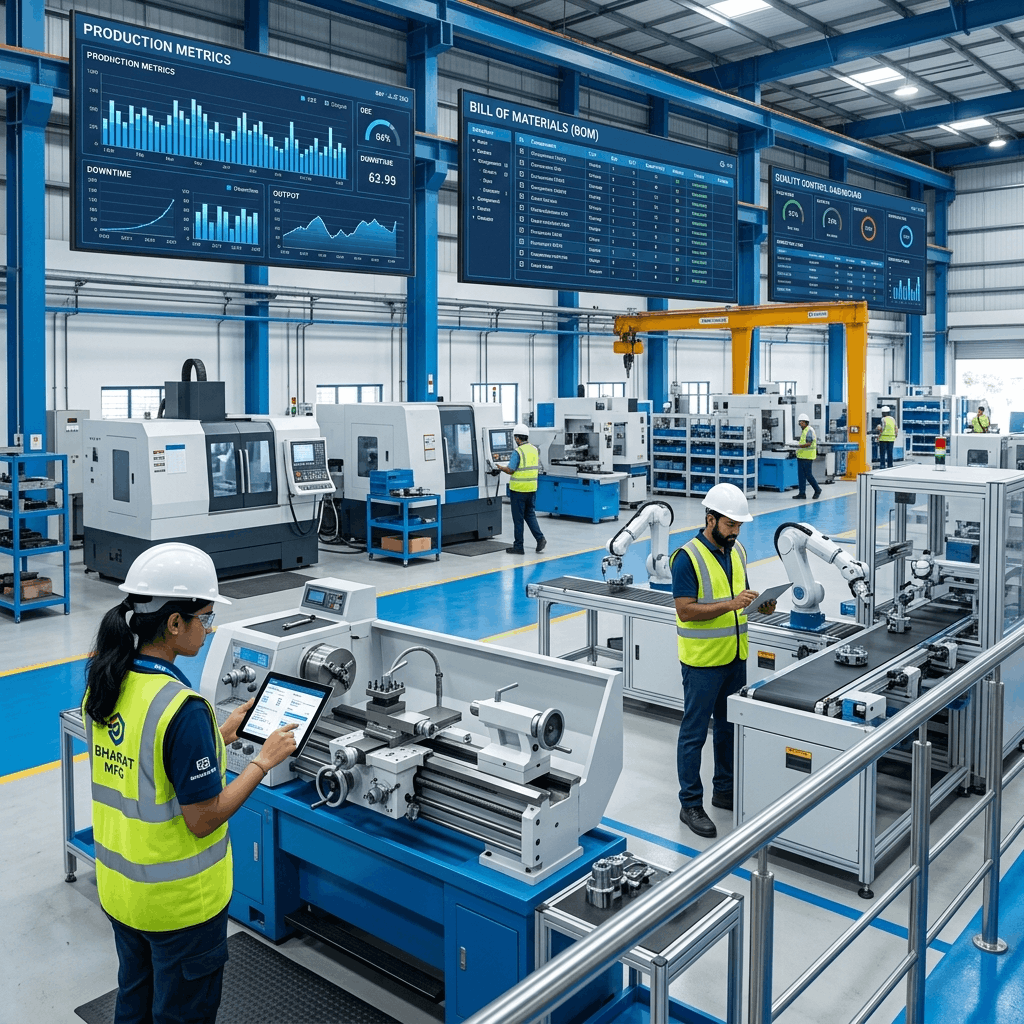
Small and Medium Enterprises (MSMEs) are the backbone of the Indian manufacturing sector. Yet, despite their agility and innovative spirit, many small manufacturers struggle to break through the glass ceiling of growth. Why? Because the tools that got them to ₹5 Crores in revenue are not the tools that will get them to ₹50 Crores.
Relying on whiteboards to schedule production, WhatsApp to communicate with the warehouse, and Excel to calculate complex Bill of Materials (BOM) eventually leads to chaos. Missed deliveries, inaccurate costing, and massive raw material wastage become daily occurrences.
This is where Production Management Software (often bundled within a larger ERP system) acts as a game-changer. It provides small manufacturers with the same operational discipline and data visibility enjoyed by massive multi-national corporations. Let's explore exactly how this software helps small manufacturers scale efficiently.
The Struggle of Small Scale Manufacturing
When a manufacturing business is small, the owner is usually involved in every single process. They know exactly how much steel is in the yard, they know which machine operator is the fastest, and they calculate pricing in their head based on years of experience.
But as order volumes increase, the owner becomes the bottleneck. They cannot be on the floor 24/7. When they hire managers and delegate, information gets lost. A simple miscalculation on a spreadsheet can lead to ordering the wrong gauge of sheet metal, causing a week-long delay and destroying the profit margin on a custom order.
A lack of centralized software means the business is entirely dependent on human memory and manual data entry, making it impossible to scale predictably.
What is Production Management Software?
Production management software is a specialized digital tool designed to plan, execute, track, and optimize the manufacturing process. When integrated into an Enterprise Resource Planning (ERP) system, it connects the shop floor directly to the accounting, sales, and procurement departments.
For a small manufacturer, it replaces the chaotic mix of physical job cards, spreadsheets, and verbal instructions with a structured, digital workflow.
1. Taming the Bill of Materials (BOM)
The Bill of Materials (BOM) is the recipe for your product. In many small businesses, this recipe is stored in an Excel file. If the price of a critical component increases by 15%, someone has to manually update that Excel file to see how it affects the final product cost. If they forget, the business might unknowingly sell the product at a loss.
An ERP system digitizes the BOM. It supports multi-level BOMs (where a sub-assembly has its own BOM). Because the ERP is also connected to the procurement module, if a vendor raises the price of a raw material, the ERP automatically recalculates the cost of every finished good that uses that material. This ensures your pricing and margins are always accurate, protecting your profitability.
2. Stopping Inventory Leakage
Inventory management is notoriously difficult for small manufacturers. You have raw materials, work-in-progress (WIP) items half-finished on the floor, and finished goods waiting to be shipped. Tracking this manually is a nightmare.
Production management software handles this via Material Requirements Planning (MRP). When a production order is initiated, the software checks the exact raw materials required against what is currently in the warehouse.
- It reserves those materials so they cannot be used for another order.
- As production progresses, it automatically deducts the raw materials from inventory.
- When the product is finished, it automatically adds the finished good to the warehouse inventory.
There is no manual stock counting required. The owner can check their phone at any time and know exactly how much capital is tied up in stock.
3. Realistic Production Planning and Scheduling
Without software, production scheduling usually involves a manager looking at a whiteboard and guessing how long an order will take. If a machine breaks down or an employee calls in sick, the entire schedule is thrown into chaos, and customers receive their orders late.
An ERP provides visual, data-driven production planning. It knows the capacity of every machine and the average time it takes to produce a specific component. Managers can drag and drop production orders on a digital calendar, and the software will instantly alert them if they are trying to schedule more work than a machine can handle.
If an urgent "VIP" order comes in, the software helps the manager see the exact impact of pausing current jobs to fulfill the urgent order, allowing for intelligent, data-backed decisions.
4. Enforcing Strict Quality Control (QC)
For a small manufacturer trying to win contracts from larger enterprise clients (like automotive OEMs), inconsistent quality is a dealbreaker.
A robust ERP system enforces Quality Control. Instead of treating QC as an afterthought, the software allows you to build mandatory QC checkpoints directly into the production routing. For example, before a machined part can be sent to the painting department, the operator might be forced by the software to input the exact micrometer measurements. If the measurements fall outside the allowed tolerance, the software stops the part from moving forward.
This prevents defective products from ever reaching the customer and ensures high compliance with ISO or other industry standards.
5. Accurate Job Costing and Profit Margins
Many small manufacturers price their goods based on what their competitors charge, rather than their actual internal costs. This is extremely dangerous.
An ERP tracks every single cost associated with a production order:
- The exact cost of the raw materials consumed (using FIFO or Average Costing).
- The labor cost (tracked by the operator logging into the job on the ERP terminal).
- Machine overhead costs (electricity, depreciation) allocated based on runtime.
When the job is finished, the ERP provides a detailed breakdown of the estimated cost versus the actual cost. If a specific product line is constantly going over budget due to excessive scrap or slow labor, the owner sees it immediately and can fix the process before losing more money.
Why Cloud ERP is the Best Choice for MSMEs
Historically, ERP software was too expensive for small businesses because it required purchasing physical servers, paying for expensive IT staff, and enduring year-long implementation cycles.
The advent of Cloud ERP has democratized this technology. Small manufacturers can now implement a powerful system like Delight ERP for a predictable monthly or annual subscription fee. The software runs securely on the cloud, meaning you don't need to buy servers. Your managers can access the system from anywhere—on the shop floor with a tablet, or at home on a laptop.
Conclusion: Stop Competing with Spreadsheets
If your goal is to keep your manufacturing business small and entirely dependent on your personal daily oversight, then spreadsheets and whiteboards might suffice.
But if your goal is to scale, take on larger contracts, improve your profit margins, and eventually step back from daily firefighting to focus on strategic growth, you must invest in the right digital infrastructure.
Production management software and ERP provide the control, visibility, and automation that transform a small workshop into a highly efficient, data-driven manufacturing enterprise. The longer you wait to implement it, the harder it will be to compete with those who already have.
Streamline operations, reduce costs, and scale faster with Delight ERP.