
The Extreme Seasonality of HVAC
The Air Conditioning (AC) and HVAC repair industry is one of the most uniquely stressful businesses to manage. For four months of the year (summer), your phone rings off the hook. Customers are furious, sweating, and demanding immediate service. For the other eight months of the year, business slows to a crawl.
Most local AC repair shops fail because they cannot handle the summer chaos. They lose paper tickets, dispatch technicians inefficiently, and anger clients by missing appointments. Worse, they fail to capitalize on the massive customer database they built in the summer to generate recurring revenue in the winter.
To break this cycle, you must digitize your dispatching and automate your marketing. You need a specialized Service CRM. Here is how it transforms an AC repair company into a highly profitable, year-round enterprise.
Phase 1: Surviving the Summer Volume Spike
On the hottest day of June, a local AC shop might receive 150 repair requests. If a single dispatcher is trying to write these down on a notepad and assign them via WhatsApp to 10 different technicians, the system will collapse. Tickets get lost, and technicians get double-booked.
A Service CRM aggregates the chaos. All incoming requests—whether from your website, WhatsApp, or phone calls—are funneled into a single, digital Ticketing Board. The CRM automatically categorizes them by urgency (e.g., a hospital's server room AC failing gets priority over a residential bedroom AC).
The dispatcher simply drags and drops these digital tickets onto the technicians' visual calendars. No sticky notes, no forgotten customers, no chaos.
Phase 2: GPS Route Optimization
If you send Technician Rahul to Sector 5 at 10 AM, Sector 20 at 12 PM, and back to Sector 5 at 2 PM, you are wasting money. Rahul will spend three hours stuck in traffic instead of fixing air conditioners, and you are paying for the wasted fuel.
A Service CRM optimizes travel via GPS. The CRM maps out all the pending repair tickets in a specific city zone. It then groups those tickets together and automatically calculates the most fuel-efficient, logical driving route for the assigned technician. This simple feature often allows a technician to complete 6 jobs a day instead of 4, instantly boosting your daily revenue by 50% without hiring more staff.
Phase 3: Generating Winter Off-Season Revenue
How do you keep your technicians employed during the cold months? You rely on Annual Maintenance Contracts (AMCs) and preventive servicing.
A CRM automates off-season marketing. In February, well before the summer rush begins, you can query your CRM database: "Find all customers who requested a repair last summer but do not have an active AMC." The CRM instantly generates a list of 2,000 people. With one click, you send them a targeted WhatsApp campaign: "Beat the summer rush! Get your AC fully serviced this week for a flat ₹499."
This generates immediate cash flow during your slowest months and fills up your technicians' schedules with preventive maintenance work.
Phase 4: Commercial Rooftop Asset Tracking
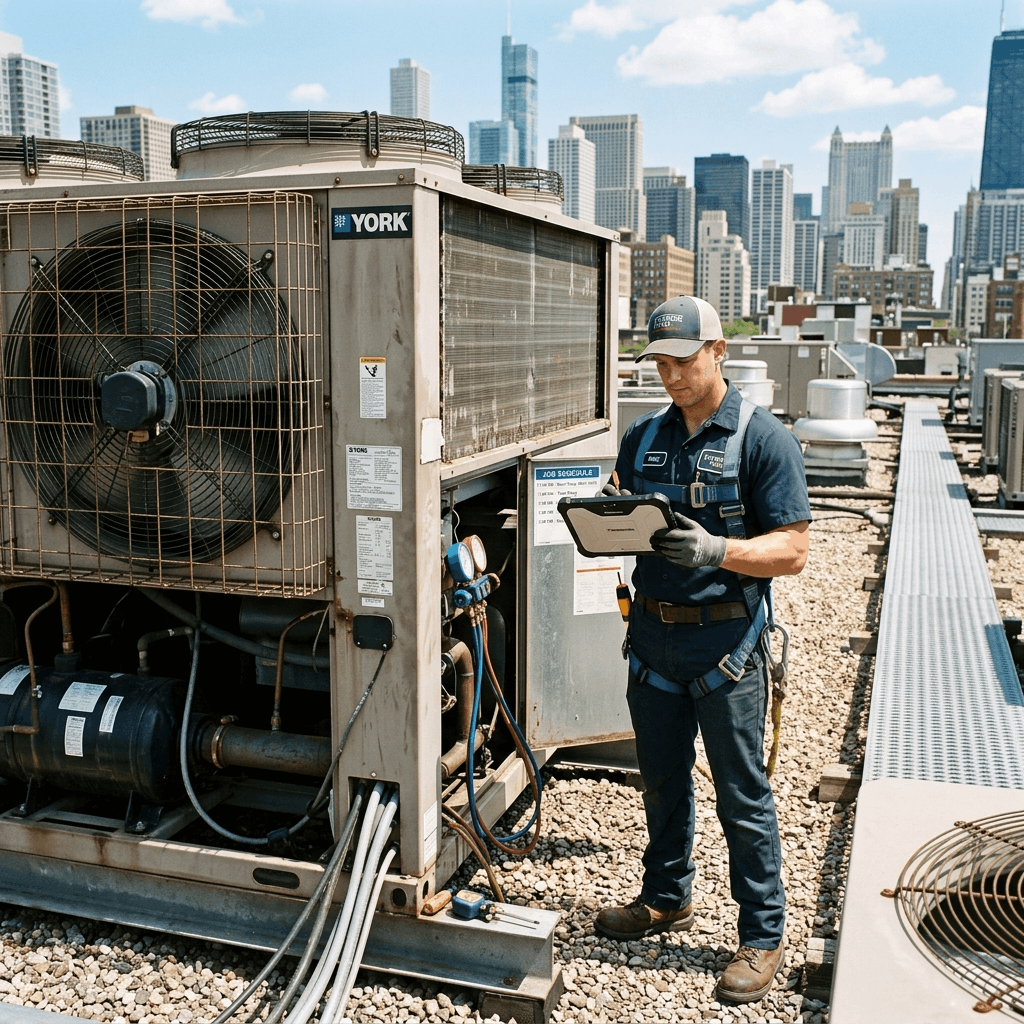
Residential AC repair is simple. Commercial HVAC repair is not. If you have a maintenance contract with a massive shopping mall, there might be twenty 10-ton HVAC units on the roof. Each unit requires different filters, different compressor sizes, and has a different service history.
If a technician goes to the roof without knowing exactly which unit is broken and what size filter it requires, they have to climb back down, drive to the parts supply house, and come back. This wastes hours.
A CRM tracks individual commercial assets. The CRM assigns a unique barcode/QR code to every single unit on that roof. Before the technician even leaves the office, they look at the CRM ticket, see that "Unit #4" is broken, see that it requires a 20x20x2 filter, and put the part in their van. It guarantees first-time-fix rates.
Phase 5: Eradicating Refrigerant Theft
Refrigerant gas (like R32 or R410A) is expensive. If a technician uses gas to fill a customer's AC but "forgets" to add it to the final paper invoice, the technician might pocket the cash, and the company eats the massive cost of the gas.
A Service CRM tightly controls inventory. Every cylinder in the van is tracked. The technician cannot close the digital ticket on their tablet without declaring whether gas was used. If they select "Yes," the CRM automatically deducts the exact weight from the van inventory and adds the line item to the customer's digital invoice. The digital paper trail eliminates theft entirely.
Conclusion: Cooling Down Your Operations
Running an AC repair business during peak summer without a digital system is an exercise in pure chaos. It burns out dispatchers, frustrates technicians, and angers sweating customers.
A Service CRM brings absolute order to that chaos. It optimizes your routes, protects your expensive inventory, and turns one-time emergency callers into lifelong AMC subscribers.
At Delight ERP, we build specialized Service CRM solutions that empower HVAC and AC repair businesses to scale smoothly, handle infinite ticket volume, and dominate the summer rush.
Streamline operations, reduce costs, and scale faster with Delight ERP.