
In This Article
- Introduction to eCommerce Success
- Step 1: Planning Your Online Business
- Step 2: Choosing the Right eCommerce Platform
- Step 3: Designing for User Experience (UX)
- Step 4: Product Catalog and Content
- Step 5: Payments, Shipping, and Taxes
- Step 6: Integrating with ERP Software
- Special Considerations for B2B eCommerce
- Marketing Your New eCommerce Website
- Conclusion
Introduction to eCommerce Success
The transition from a traditional brick-and-mortar storefront to a dynamic digital marketplace is no longer merely a strategic option; it is an absolute necessity for survival and growth in the modern economy. The global eCommerce landscape is expanding at an unprecedented rate, offering businesses unparalleled opportunities to reach global audiences, reduce overhead costs, and operate around the clock.
However, the question of how to create an eCommerce website for an online business is often met with a barrage of technical jargon, overwhelming choices, and conflicting advice. Building a successful online store involves much more than simply uploading pictures of products to a web page. It requires meticulous planning, a deep understanding of your target audience, a robust technological foundation, and a scalable operational strategy.
This comprehensive guide is designed to demystify the process of creating an eCommerce website. Whether you are a budding entrepreneur launching your first venture or an established manufacturer looking to open a direct-to-consumer (D2C) or a B2B channel, this article will walk you through the critical steps. Furthermore, we will explore why integrating your online store with a robust ERP Software system is the secret to managing rapid growth without operational chaos.
Step 1: Planning Your Online Business
Before writing a single line of code or choosing a domain name, you must lay a solid strategic foundation. The success of your eCommerce website hinges on the clarity of your business plan.
Identify Your Niche and Target Audience
The internet is vast, and attempting to sell everything to everyone is a recipe for failure. You must define a specific niche. What problem does your product solve? Who is the ideal customer? Understanding your target audience's demographics, purchasing behavior, and pain points will dictate your website's design, your marketing strategy, and your product selection.
Determine Your Business Model
Are you operating on a Business-to-Consumer (B2C) model, selling directly to individual shoppers? Or are you a Business-to-Business (B2B) enterprise, selling bulk goods to other companies? The distinction is critical. B2B eCommerce requires specialized features such as bulk pricing, custom catalogs, and complex approval workflows, which are often best handled by a dedicated B2B Customer Portal.
Select a Domain Name
Your domain name is your digital address. It should be memorable, easy to spell, and closely aligned with your brand identity. Keep it concise and avoid using hyphens or complex spellings. If possible, secure a .com domain, as it remains the most recognized and trusted extension globally.
Step 2: Choosing the Right eCommerce Platform
The eCommerce platform you select will serve as the engine of your online business. It dictates how easily you can manage products, process orders, and scale your operations. Broadly speaking, platforms fall into two categories: hosted (SaaS) and self-hosted.
Hosted eCommerce Platforms (SaaS)
Platforms like Shopify, BigCommerce, and Wix are hosted solutions. This means the provider manages the servers, security, and software updates. They are generally user-friendly, quick to set up, and require minimal technical expertise.
- Pros: Easy to use, excellent customer support, reliable hosting, fast deployment.
- Cons: Monthly subscription fees, limited customization of the core code, transaction fees on some platforms.
Self-Hosted Platforms
Platforms like WooCommerce (built on WordPress) and Magento are self-hosted. You download the software and host it on your own servers (or through a third-party hosting provider). This offers maximum control and flexibility.
- Pros: Infinite customization, total control over data, no platform-specific transaction fees.
- Cons: Steeper learning curve, requires you to manage hosting and security, can be expensive to develop and maintain.
When making your choice, consider your budget, your technical capabilities, and your long-term growth projections. Crucially, ensure that the platform you choose has robust API capabilities to allow for seamless integration with your back-end systems.
Step 3: Designing for User Experience (UX)
Your website's design is your digital storefront. Within milliseconds of landing on your page, a visitor will make a judgment about your brand's credibility. A cluttered, confusing, or visually unappealing website will result in high bounce rates and lost sales.
Prioritize Mobile Responsiveness
The majority of online shopping now occurs on mobile devices. If your eCommerce website is not fully responsive—meaning it adapts seamlessly to screens of all sizes—you are alienating a massive portion of your potential customer base. Google also heavily penalizes non-mobile-friendly sites in search rankings.
Intuitive Navigation
Customers should be able to find what they are looking for with minimal effort. Implement clear, logical categorization, a highly visible search bar, and easily accessible shopping cart and checkout buttons. The fewer clicks it takes for a user to go from the homepage to a completed purchase, the higher your conversion rate will be.
Trust Signals
Building trust is paramount in eCommerce. Ensure your site displays clear return policies, secure payment badges, and easily accessible customer service contact information. Customer reviews and testimonials are also powerful tools for establishing credibility and social proof.
Step 4: Product Catalog and Content
In a physical store, a customer can pick up a product, feel its weight, and examine its details. Online, your product pages must bridge that sensory gap through compelling content.
High-Quality Product Imagery
Invest in professional-quality product photography. Provide multiple images from different angles, and include a zoom feature so customers can inspect the details. For certain products, lifestyle images showing the item in use can significantly boost engagement.
Persuasive Product Descriptions
Do not simply copy and paste the manufacturer's specifications. Write unique, persuasive product descriptions that highlight the benefits of the product, not just its features. Anticipate the customer's questions and answer them proactively in the description.
SEO Optimization for Products
Ensure that your product titles and descriptions incorporate relevant keywords that your target audience is searching for. Optimize image alt-text and meta descriptions to improve your visibility in search engine results pages (SERPs).
Step 5: Payments, Shipping, and Taxes
The logistical aspects of eCommerce are often the most complex to navigate, but getting them right is critical for a smooth customer experience and legal compliance.
Payment Gateways
You need a secure method to process customer payments. Integrating a reliable payment gateway like Stripe, PayPal, or specialized regional providers is essential. Ensure your site has a valid SSL certificate to encrypt sensitive customer data—this is non-negotiable.
Shipping Strategy
How will you get your products to your customers? Will you offer free shipping, flat-rate shipping, or real-time carrier rates based on weight and destination? Define your shipping zones and partner with reliable logistics providers. Clearly communicate your shipping policies, including estimated delivery times, on your website.
Tax Compliance
Navigating eCommerce taxation can be a minefield, especially if you sell across state or national borders. Utilize automated tax calculation software that integrates with your eCommerce platform to ensure you are collecting and remitting the correct sales tax based on the customer's location.
Step 6: Integrating with ERP Software
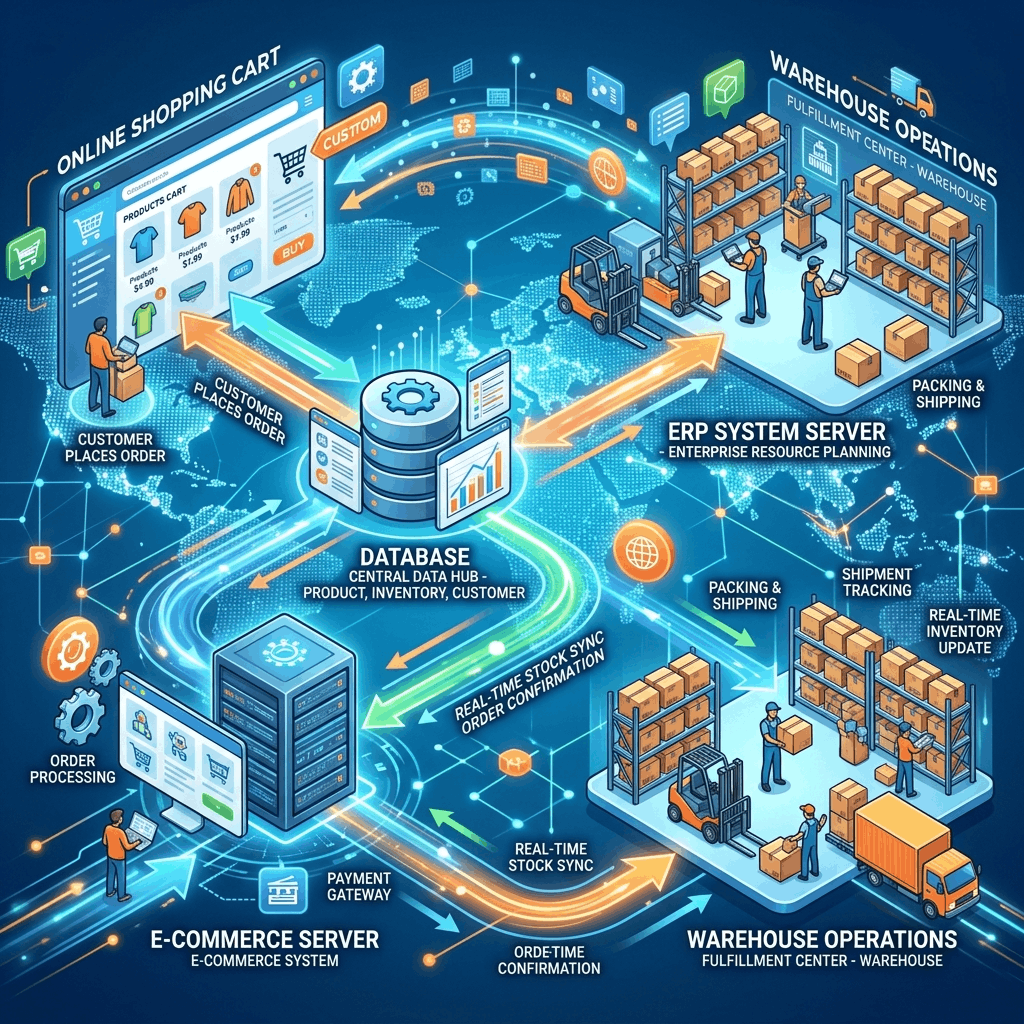
This is the step that separates amateur online stores from scalable, professional eCommerce enterprises. As your order volume grows, attempting to manage inventory, accounting, and fulfillment manually will lead to disastrous errors, stockouts, and unhappy customers.
Integrating your eCommerce platform with a comprehensive Cloud ERP Software system automates the flow of data across your entire business.
Real-Time Inventory Synchronization
When an item is sold on your website, your ERP system instantly updates the inventory levels. This prevents you from selling products you do not have in stock, a common issue that severely damages customer trust. It also triggers reorder alerts when stock falls below a defined threshold.
Streamlined Order Fulfillment
Orders placed online flow directly into the ERP system, automatically generating pick lists, packing slips, and shipping labels for the warehouse team. This eliminates manual data entry, speeds up the fulfillment process, and reduces the likelihood of shipping errors.
Centralized Customer Data
An ERP system combined with a CRM Software module provides a 360-degree view of your customers. You can track their purchase history, support interactions, and preferences across all channels, enabling personalized marketing and superior customer service.
Special Considerations for B2B eCommerce
If your online business involves selling to other businesses, a standard retail eCommerce platform may not suffice. B2B transactions are inherently more complex.
B2B buyers expect a consumer-like online experience, but they require specialized functionality. They need the ability to view customized pricing tiers based on their contracts, request bulk quotes, manage complex account hierarchies, and pay via purchase orders rather than credit cards.
For these scenarios, a dedicated B2B Customer Portal that is deeply integrated with your ERP is essential. It empowers your B2B clients to self-serve, placing orders, tracking shipments, and managing invoices 24/7, thereby drastically reducing the administrative burden on your sales team.
Marketing Your New eCommerce Website
Building a beautiful eCommerce website is only half the battle. If you do not actively drive traffic to it, you will not generate sales. A robust digital marketing strategy is crucial for your launch and ongoing success.
Search Engine Optimization (SEO)
Optimize your entire site structure, category pages, and blog content to rank higher in Google search results. Technical SEO (site speed, mobile optimization) and content marketing are vital for driving organic, long-term traffic.
Paid Advertising
Utilize Google Ads (Search and Shopping campaigns) and social media advertising (Facebook, Instagram) to drive targeted traffic quickly. Retargeting campaigns are particularly effective in eCommerce for bringing back users who abandoned their shopping carts.
Email Marketing
Build an email list from day one. Offer a small discount in exchange for an email address. Email marketing remains one of the highest ROI channels in eCommerce, allowing you to nurture leads, announce new products, and recover abandoned carts through automated sequences.
Conclusion
Creating an eCommerce website for an online business is a multifaceted project that requires careful planning, technical execution, and ongoing optimization. By selecting the right platform, designing for user experience, and executing a strong marketing strategy, you can build a highly profitable online sales channel.
However, true scalability and operational efficiency are only achieved when the front-end shopping experience is seamlessly connected to the back-end operations. By integrating your eCommerce platform with a powerful ERP system like Delight ERP, you automate inventory management, streamline order fulfillment, and gain the centralized data visibility required to dominate your market.
Whether you are launching a B2C brand or establishing a sophisticated B2B portal, laying a solid technological foundation today ensures your business is prepared for the growth of tomorrow.
Frequently Asked Questions
Streamline operations, reduce costs, and scale faster with Delight ERP.