
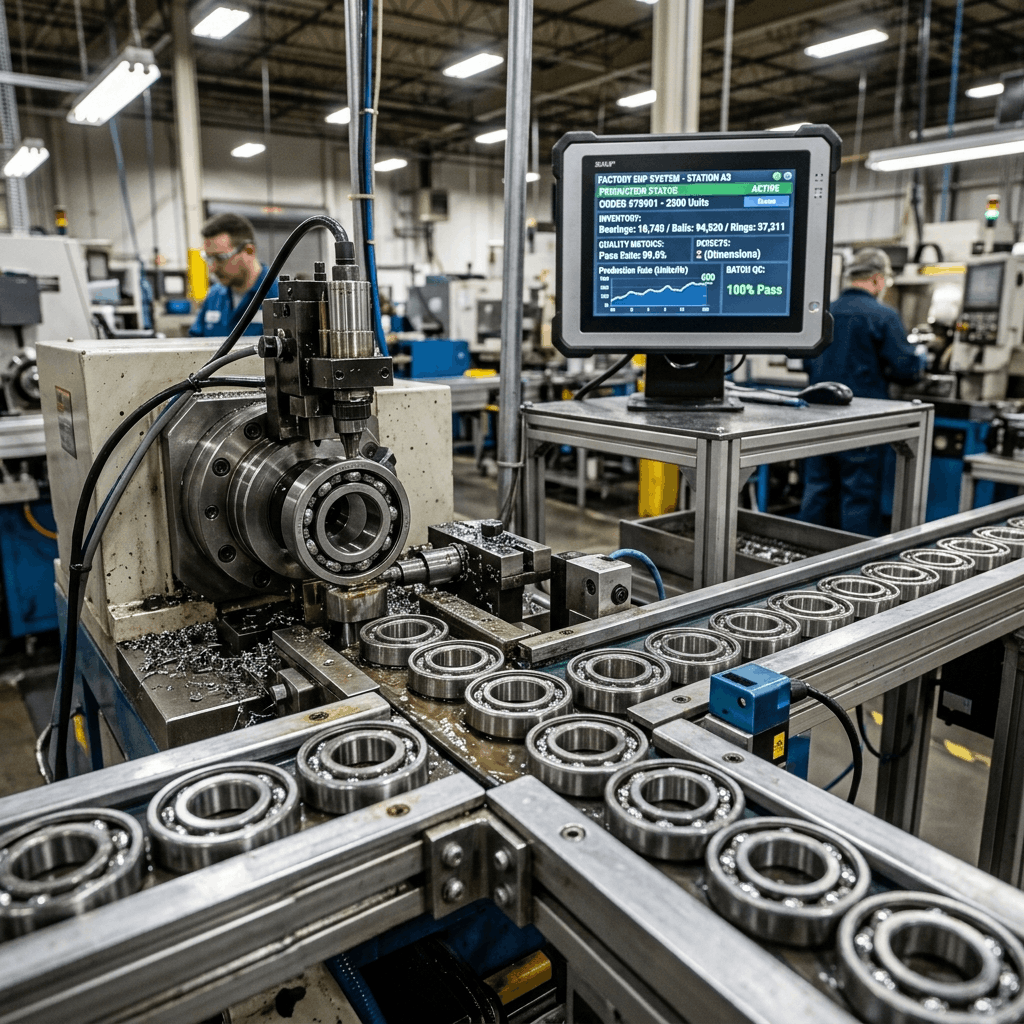
The Business of Extreme Precision
Bearings are the unsung heroes of the modern industrial world. Whether they are tiny ball bearings inside a medical drill or massive roller bearings supporting a wind turbine, they must operate under immense stress with virtually zero friction. In the bearing industry, a manufacturing deviation of a single micron can result in catastrophic mechanical failure.
Managing this level of extreme precision across millions of units requires a flawless operational backbone. A standard accounting software package cannot handle the complex multi-stage routing, metallurgical tracking, and strict quality control required to produce a perfect bearing.
Implementing a specialized Enterprise Resource Planning (ERP) system is the only way a bearing manufacturer can scale efficiently while maintaining zero-defect tolerances. Here is the step-by-step guide to how ERP software is successfully implemented across the five major stages of bearing production.
Step 1: Raw Material Lot Tracking (Steel Coils)
The life of a bearing begins as raw material, typically high-carbon chromium steel or specialized alloys. The quality of the finished bearing is entirely dependent on the chemical composition of this raw steel.
When implementing an ERP, the first step is activating the Lot Traceability Module. When a truckload of steel wire or tubing arrives from the mill, the ERP assigns it a unique Barcode/Lot ID. The ERP records the exact metallurgical certificate provided by the mill against this Lot ID.
This provides "Bi-Directional Traceability." If a customer's automotive gearbox fails three years later, and they return the broken bearing, the manufacturer can scan the part. The ERP will instantly trace it backward through the supply chain, identifying the exact coil of steel it was cut from. The manufacturer can then trace forward to recall any other bearings made from that specific, defective batch of steel, limiting their legal liability.
Step 2: Routing the Forging and Machining Centers
Once the steel is cut, it must be formed into the inner ring, outer ring, and rolling elements. This is done through intense hot forging or cold forming, followed by CNC lathe machining.
A generic software system simply lists "Make Bearing" as one step. A specialized manufacturing ERP uses Multi-Stage Routing.
The ERP creates a digital roadmap for the factory floor. It routes the raw steel to the forging press. Once forged, the ERP automatically updates the inventory status to "WIP - Forged" and routes the physical bin to the CNC lathes. The ERP's Advanced Planning and Scheduling (APS) engine ensures that the heavy presses and the precision lathes are perfectly synchronized, eliminating bottlenecks and preventing massive piles of WIP (Work in Progress) inventory from clogging the factory floor.
Step 3: Heat Treatment and Mandatory QC Checkpoints
After machining, the steel is soft. To endure the friction of a spinning axle, the bearing components must be hardened in massive heat treatment furnaces. This is the most critical phase of production.
During ERP implementation, engineers build Embedded Quality Control (QC) Checkpoints into the system. The ERP physically will not allow the components to move to the next stage until they pass inspection.
After the rings come out of the furnace, the ERP locks the batch status. A Quality Control inspector must perform a Rockwell hardness test. The inspector logs into the ERP via a tablet and inputs the exact hardness score. If the score is outside the acceptable tolerance, the ERP instantly quarantines the batch and alerts the engineering manager. This systemic enforcement guarantees that soft, defective steel never makes it into a finished bearing.
Step 4: Grinding, Assembly, and BOM Synchronization
Once hardened, the components are ground down to exact micron tolerances. Finally, the four separate pieces—the outer ring, inner ring, rolling elements (balls/rollers), and the cage (retainer)—must be assembled.
This creates an inventory nightmare. If you have 10,000 outer rings but only 8,000 cages, you cannot complete the assembly, and production halts.
An ERP solves this by enforcing a strict Multi-Level Bill of Materials (BOM). The ERP acts as the conductor of the orchestra. It analyzes the sales forecast and dynamically ensures that the forging lines are producing the exact matching ratio of rings, balls, and cages required for next week's assembly schedule. This flawless synchronization ensures that the assembly workers are never standing around waiting for missing sub-components.
Step 5: Lubrication, Packaging, and Global Distribution
The final step involves injecting the bearing with specific grease, sealing it, and packaging it for shipment. Because bearings are susceptible to rust, they must be packaged meticulously.
The ERP implementation finalizes with the Distribution and Logistics Module. When the bearings are boxed, the ERP automatically prints compliance labels featuring the customer's specific part numbers and barcodes.
If the bearing manufacturer is selling to massive automotive OEMs (like Ford or Toyota), they must use Electronic Data Interchange (EDI). The ERP automatically translates the shipment data into an EDI Advanced Shipping Notice (ASN) and transmits it instantly to the automotive factory, ensuring compliance with strict "Just in Time" (JIT) supply chain requirements.
Conclusion: A Flawless Digital Foundation
Manufacturing precision bearings is an unforgiving business. You cannot manage multi-stage CNC routing, intense heat treatment cycles, and strict metallurgical traceability using a whiteboard and a handful of spreadsheets.
Implementing an Enterprise Resource Planning system provides the flawless digital foundation required to master this complexity. It connects the steel purchasing agent, the CNC operator, the QA inspector, and the shipping dock into a single, unified nervous system.
At Delight ERP, we specialize in discrete manufacturing. Our platform is engineered to handle strict lot traceability, multi-stage routing, and automated quality control, allowing your bearing business to operate with the same frictionless precision as the products you manufacture.
Streamline operations, reduce costs, and scale faster with Delight ERP.