
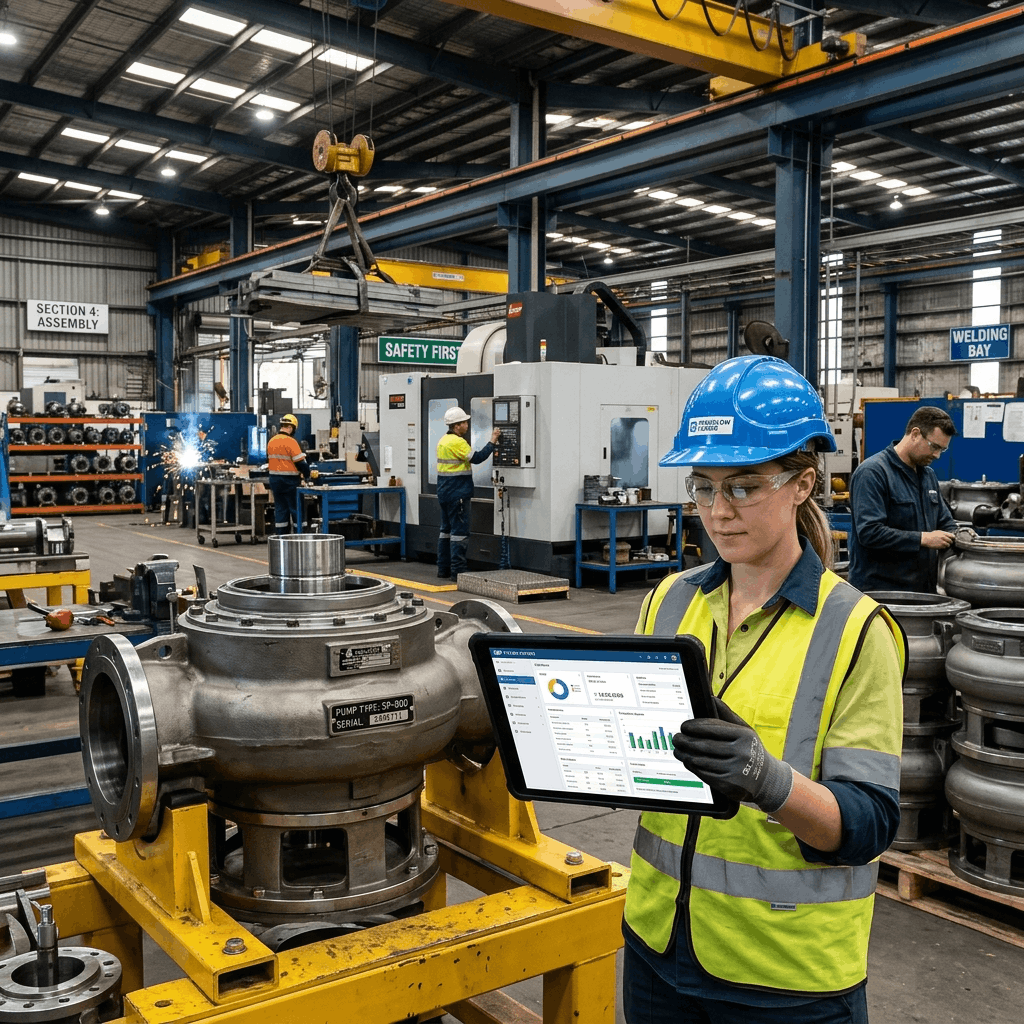
The Engineering Challenge of Submersible Pumps
Submersible pumps are critical infrastructure. They are used in deep agricultural wells, massive municipal sewage systems, and offshore oil rigs. Because they operate entirely underwater, they must be engineered to absolute perfection. A failure deep underground is incredibly expensive to retrieve and repair.
Manufacturing these devices is highly complex. It involves electrical engineering (motor winding), mechanical engineering (impellers and drive shafts), and rigorous waterproofing (stainless steel housings and mechanical seals). Managing this complex assembly process across hundreds of units simultaneously is impossible to do effectively with spreadsheets.
To ensure total reliability and scale production, manufacturers must implement a specialized Enterprise Resource Planning (ERP) system. Here is the step-by-step guide to how ERP software is successfully implemented in the submersible pump industry.
Step 1: Managing Complex Bills of Materials (BOM)
A submersible pump is not a single widget; it is an assembly of sub-assemblies. The electrical motor is one sub-assembly. The hydraulic pump body (containing the impellers) is another sub-assembly. These two components must be manufactured in parallel and then joined together.
An ERP manages this via a Multi-Level Bill of Materials (BOM). During implementation, engineers map out the exact "recipe" for the pump in the software. When a sales order is placed for 50 agricultural bore-well pumps, the ERP's MRP (Material Requirements Planning) engine explodes the BOM.
The system instantly calculates exactly how many cast iron impellers, mechanical seals, ball bearings, and meters of copper wire are required. If the warehouse is short on rubber O-rings, the ERP automatically generates a Purchase Order to the supplier, ensuring assembly is never delayed due to a missing 50-cent part.
Step 2: Securing Copper and High-Value Raw Materials
The heart of any electric submersible motor is the copper winding. Copper is an incredibly expensive, highly volatile commodity. If a manufacturer is not tracking their copper inventory down to the gram, they are likely losing thousands of dollars to waste or theft.
A specialized ERP utilizes Catch Weight and Precision Tracking. The software tracks copper inventory not just by the "spool," but by exact weight. When a worker checks out a spool of copper to wind a motor, the ERP logs the exact weight. When they return the spool, the ERP weighs it again, calculating exactly how much copper was consumed on that specific motor.
This provides the CFO with a hyper-accurate, real-time Cost of Goods Sold (COGS). If the global price of copper suddenly spikes by 15%, the ERP will instantly flag that the profit margin on the 5-Horsepower pump has dropped, prompting the sales team to adjust pricing.
Step 3: Routing, Motor Winding, and Hydrostatic Testing
Because these pumps operate submerged in water, quality control is a matter of life and death for the product. The electrical motor must be perfectly sealed.
The ERP enforces strict Production Routing and QC Checkpoints. The software creates a digital roadmap. The motor cannot proceed to final assembly until it has passed an electrical resistance (Megger) test. More importantly, the fully assembled pump cannot be boxed for shipping until it passes a Hydrostatic Pressure Test.
The ERP physically locks the batch. The Quality Control inspector must log into the ERP via a tablet, execute the pressure test, and input the exact PSI (pounds per square inch) held over a 15-minute window. If the pump loses pressure (indicating a microscopic leak), the ERP instantly quarantines the pump as "Defective" and routes it to the rework station, guaranteeing that a leaky pump is never shipped to a customer.
Step 4: Serialized Inventory and Warranty Tracking
If you manufacture 100,000 plastic cups, you don't care about the individual cup. If you manufacture an $8,000 industrial submersible pump, you need to track that specific pump for the next 10 years.
A manufacturing ERP utilizes Strict Serialization. At the end of the assembly line, the ERP generates a unique Serial Number and prints a metal nameplate. This serial number is tied to the pump's entire digital history in the database.
The ERP knows exactly which worker wound the motor, the exact lot of copper used, the results of the hydrostatic pressure test, and the exact date it was shipped to the customer. This is crucial for Warranty Management. If a customer calls three years later claiming the pump broke under warranty, the manufacturer types the serial number into the ERP. Within seconds, the system verifies if the warranty is still active, protecting the company from fraudulent repair claims.
Step 5: Automating Field Service and Maintenance
For industrial pump manufacturers, the sale of the pump is only the beginning. A massive portion of their revenue comes from long-term service contracts and selling replacement parts.
When a municipal sewage pump breaks down, a repair technician must be dispatched immediately. Modern ERP systems include a Field Service Management (FSM) module.
The customer calls the support desk and provides the pump's serial number. The ERP instantly pulls up the "As-Built" BOM, showing exactly which impellers and seals were originally installed in that specific unit. The ERP then automatically checks the warehouse for those exact spare parts, reserves them, and dispatches a field technician via a mobile app. The technician arrives at the site with the exact right parts on the very first visit, drastically reducing repair turnaround times and keeping the customer happy.
Conclusion: Flowing Toward Profitability
Manufacturing submersible pumps requires balancing complex electrical engineering with rugged mechanical construction. Attempting to manage copper inventory, hydrostatic testing, and decades-long warranties across thousands of units using fragmented software is a recipe for operational failure.
Implementing an Enterprise Resource Planning system brings total clarity to the factory floor. It connects the procurement team buying the copper, the engineer designing the BOM, the inspector running the pressure tests, and the field technician repairing the pump into one synchronized digital ecosystem.
At Delight ERP, we provide the industrial-strength architecture required by heavy equipment manufacturers. Our platform handles strict serialization, multi-level BOMs, and integrated field service tracking, ensuring your pump business operates as flawlessly as the products you build.
Streamline operations, reduce costs, and scale faster with Delight ERP.