
In This Article
The Problem of the Fragmented Business
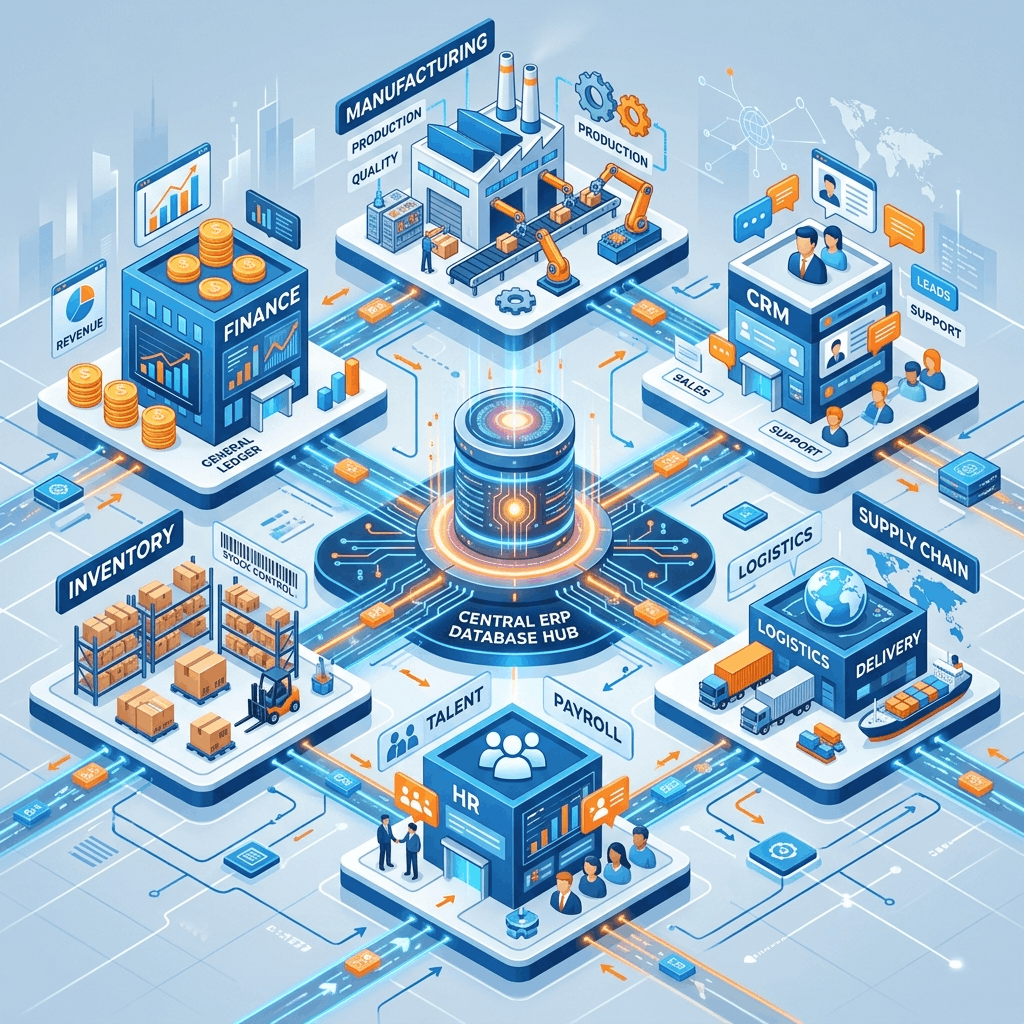
Imagine a human body where the brain, the heart, and the lungs all operate independently, unable to communicate with each other. The body would quickly fail. Yet, this is exactly how many growing businesses operate. The sales team uses one CRM, the warehouse manager relies on an Excel spreadsheet, and the finance department uses basic accounting software.
This fragmentation leads to "data silos." When departments cannot communicate in real-time, errors proliferate. The sales team sells products that the warehouse does not actually have. The accounting team spends days manually re-entering data to generate a simple invoice. The business becomes sluggish and reactive.
This is where ERP Software (Enterprise Resource Planning) becomes critical. It is the central nervous system that connects every disjointed part of your business.
1. Creating a Single Source of Truth
The most fundamental importance of an ERP system is that it replaces fragmented databases with a single, unified data repository.
When an employee enters data into an ERP, that data is instantly accessible to every other authorized user in the company, regardless of their department. If a customer changes their shipping address with the sales team, the logistics team sees the updated address immediately, preventing misrouted packages. This "Single Source of Truth" eliminates the massive communication breakdowns that plague growing companies.
2. Radical Automation of Workflows
In a fragmented business, moving a task from one department to another requires human intervention—a phone call, an email, or physically walking a piece of paper to someone's desk. This is incredibly slow and expensive.
An ERP system automates the flow of work. For example, when a salesperson clicks "Won" on a deal in the CRM Software module, the ERP automatically generates a sales order, subtracts the necessary raw materials from the inventory count, sends a picking ticket to the warehouse printer, and drafts an invoice for the accounting team. Workflows that used to take days of administrative effort now happen in milliseconds.
3. Real-Time Inventory and Supply Chain Control
For any company that buys, builds, or sells physical products, inventory is usually the largest financial asset. Managing it poorly destroys profitability.
A comprehensive Supply Chain Management ERP provides pinpoint, real-time tracking of every single item. You know exactly what is in the warehouse, what is currently being manufactured, and what is in transit from suppliers. Furthermore, the ERP utilizes historical data to forecast future demand, automatically prompting the purchasing department to reorder stock before a stockout occurs. It optimizes cash flow by ensuring you never hold too much or too little inventory.
4. Unprecedented Financial Visibility
Business owners cannot make strategic decisions based on hunches; they need hard financial facts. In companies without an ERP, generating a Profit & Loss statement often takes weeks after the month has ended. By the time executives see the data, it is historical trivia.
Because an ERP tracks every operational event—from a factory worker's clocked hours to the shipping cost of a specific pallet—it provides real-time financial dashboards. Executives can log in at any moment and see the exact, minute-by-minute profitability of the company. They can identify which product lines are losing money and which sales regions are outperforming, allowing them to pivot strategy instantly.
5. The Foundation for True Scalability
A business built on spreadsheets and manual processes has a hard ceiling on its growth. If you double your order volume, you have to double your administrative headcount just to process the paperwork. This means profitability never scales.
Implementing Cloud ERP Software breaks this ceiling. Because the system automates the heavy lifting of data processing, your company can process 1,000 orders just as easily as it processes 100 orders, without needing to hire a proportional amount of back-office staff. It provides the digital infrastructure required to grow revenue exponentially while keeping overhead costs relatively flat.
Conclusion: The Cost of Doing Nothing
Many business owners hesitate to implement an ERP because of the perceived upfront cost and the disruption of changing their processes. However, the true question is not "Can we afford an ERP?" but rather, "Can we afford to continue operating without one?"
The hidden costs of a fragmented business—lost sales, administrative waste, inventory errors, and poor decision-making due to delayed data—far outweigh the investment in modern software. Delight ERP is designed to eliminate these inefficiencies, providing the clarity, control, and automation necessary to thrive in the modern economic landscape.
Frequently Asked Questions
Streamline operations, reduce costs, and scale faster with Delight ERP.