
In This Article
General vs. Industry-Specific ERP
Many businesses make a fatal mistake when purchasing ERP Software: they buy a "generic" system. Generic ERPs are great for service companies or retail stores, but they completely fail when exposed to the brutal complexity of a manufacturing plant floor.
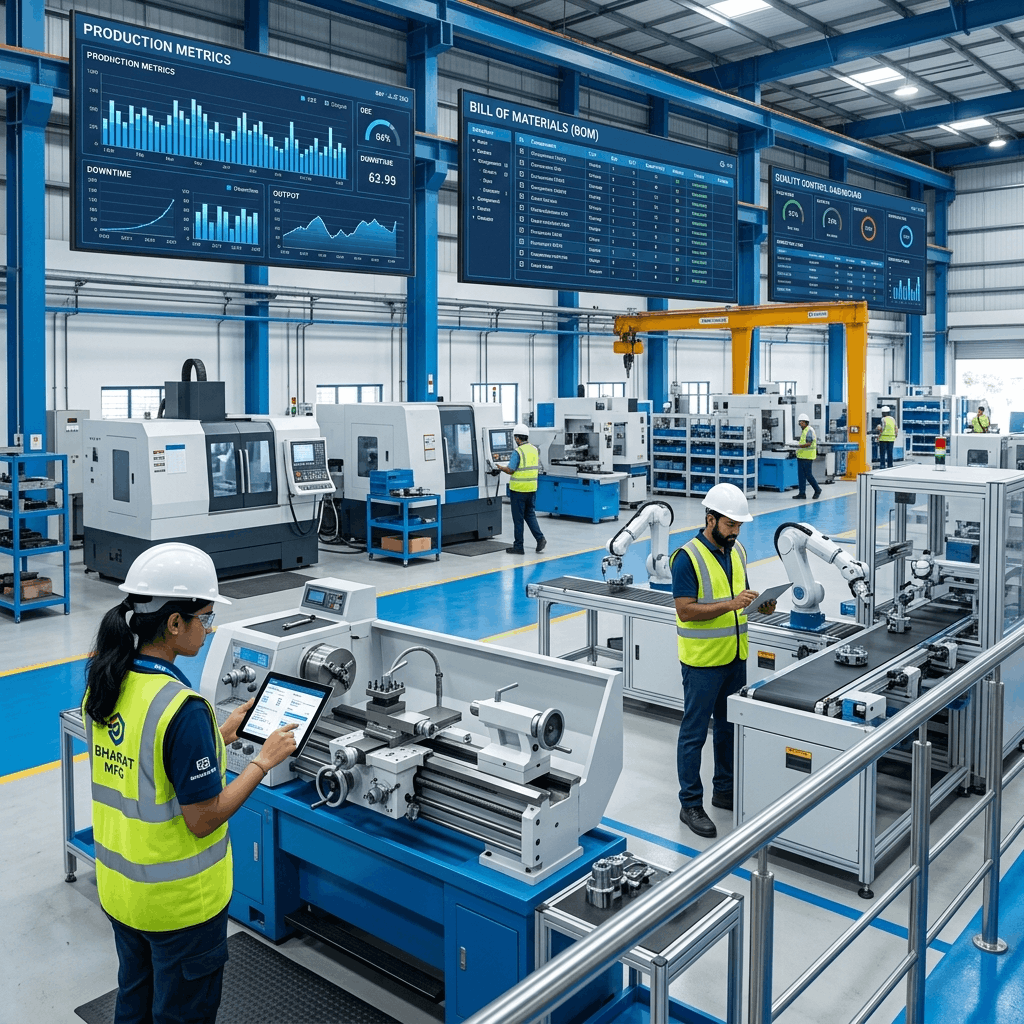
A manufacturing plant does not just buy and sell goods; it transforms them. It deals with raw materials, scrap rates, machine downtime, labor routings, and complex sub-assemblies. To manage this transformation profitably, you need a purpose-built Manufacturing ERP. Here are the five non-negotiable features your system must have.
1. Advanced Bill of Materials (BOM) Management
The Bill of Materials (BOM) is the recipe for your product. Without a hyper-accurate BOM, your costs will be wrong, and your production will fail.
A generic inventory system might allow you to bundle a few items together. A true Manufacturing ERP supports Multi-Level BOMs. This means if you are building a bicycle, the BOM doesn't just list "Wheels, Frame, Handlebars." It breaks down the "Wheel" sub-assembly into spokes, rims, hubs, and the specific labor routing required to lace the wheel. The software must also handle revision control, tracking engineering changes to the BOM over time to ensure the shop floor is never building an outdated version of a product.
2. Material Requirements Planning (MRP)
MRP is the mathematical brain of the manufacturing process. It answers the questions: What do we need to buy? How much do we need? And exactly when do we need it to arrive?
An advanced MRP module looks at incoming sales orders and the master production schedule. It explodes the BOMs to calculate exactly how many raw materials are required. Crucially, it then checks current inventory levels and factors in supplier lead times. If a supplier takes 4 weeks to deliver specialized steel, the MRP system will automatically generate a purchase order exactly 4 weeks before the steel is scheduled to be cut on the factory floor, enabling Just-In-Time (JIT) manufacturing.
3. Dynamic Production Scheduling
A factory is a constantly shifting puzzle. If one machine goes down for maintenance, or a key employee calls in sick, a rigid production plan instantly falls apart.
Manufacturing ERPs feature dynamic scheduling tools. They map out all production runs against available machine capacity and labor hours. If a disruption occurs, the system's Advanced Planning and Scheduling (APS) algorithm instantly recalculates the most efficient way to re-route the Work-in-Progress (WIP) through alternative machines, ensuring that the bottleneck is minimized and delivery deadlines are still met.
4. Real-Time Shop Floor Control
Executives sitting in an office cannot manage a factory based on data from yesterday. They need to know what is happening on the machines right now.
Shop Floor Control modules utilize digital kiosks or tablets at every workstation. When a worker begins a routing step, they scan a barcode. The ERP system tracks exactly how much time they spend on that operation and exactly how much raw material they consume. This provides real-time visibility into WIP and allows the finance department to calculate the exact, minute-by-minute cost of production, rather than waiting for end-of-month estimates.
5. Integrated Quality Assurance (QA)
Quality control cannot be an afterthought; it must be built into the manufacturing process. If you catch a defect after the product is fully assembled, you have wasted maximum time and money.
A robust ERP integrates QA directly into the routing steps. The system can be programmed to halt production at step 4 until a worker inputs a specific micrometer measurement. If the measurement falls outside the acceptable tolerance range, the ERP automatically flags the part, generates a non-conformance report, and routes the defective item to the scrap or rework pile, preventing bad parts from moving down the assembly line.
Conclusion: Choosing the Right Tool for the Job
Trying to run a manufacturing business on generic accounting software is like trying to build a house with a butter knife. You might eventually get it done, but it will be painful, slow, and full of errors.
By investing in a Cloud ERP Software solution designed specifically for manufacturing—like Delight ERP—you equip your team with the precision tools they need. From advanced BOM management to real-time shop floor control, these features provide the visibility and automation required to minimize waste, maximize throughput, and protect your profit margins.
Frequently Asked Questions
Streamline operations, reduce costs, and scale faster with Delight ERP.