
In This Article
- The End of the Traditional Supply Chain
- 1. The Shift from 'Just-In-Time' to 'Just-In-Case' Resilience
- 2. Artificial Intelligence and Predictive Forecasting
- 3. The Demand for End-to-End Visibility
- 4. Hyper-Diversification of Supplier Networks
- 5. The Central Role of Cloud ERP
- Conclusion: Adapting to the New Normal
The End of the Traditional Supply Chain
For decades, the ultimate goal of Supply Chain Management (SCM) was cost reduction. The strategy was simple: find the cheapest offshore manufacturer, order inventory in massive bulk, and run operations as leanly as possible. This was a highly efficient model, but it was incredibly fragile.
Recent global disruptions have exposed the cracks in this fragile system. A single geopolitical event, a natural disaster, or a sudden spike in consumer demand can instantly cripple a traditional supply chain, leaving shelves empty and revenue destroyed. Today, the focus has shifted from pure cost-efficiency to agility and resilience. Here are the key trends defining modern supply chain management.
1. The Shift from 'Just-In-Time' to 'Just-In-Case' Resilience
The famous "Just-In-Time" (JIT) manufacturing model dictates that inventory should arrive at the factory floor exactly when it is needed, minimizing warehousing costs. While mathematically perfect, JIT leaves zero margin for error.
The prevailing trend is a shift toward "Just-In-Case" resilience. Companies are intentionally building strategic buffers into their supply chains. They are willing to accept slightly higher warehousing holding costs in exchange for the security of having safety stock. This ensures that if a primary shipping lane is blocked or a vendor is delayed, the factory can continue operating without interruption.
2. Artificial Intelligence and Predictive Forecasting
Historically, businesses predicted future demand by simply looking at last year's sales spreadsheet. In today's volatile market, historical data is no longer enough to predict the future.
Advanced Supply Chain Management ERP systems now leverage Artificial Intelligence (AI) and Machine Learning. These systems analyze vast datasets—not just past sales, but current social media trends, economic indicators, and even weather patterns—to generate highly accurate, predictive demand forecasts. This allows procurement teams to order the right products weeks before the market demand actually peaks.
3. The Demand for End-to-End Visibility
You cannot fix a supply chain problem if you do not know it exists. In the past, once a purchase order was sent to an overseas vendor, the buying company had little visibility until the cargo ship arrived at the local port.
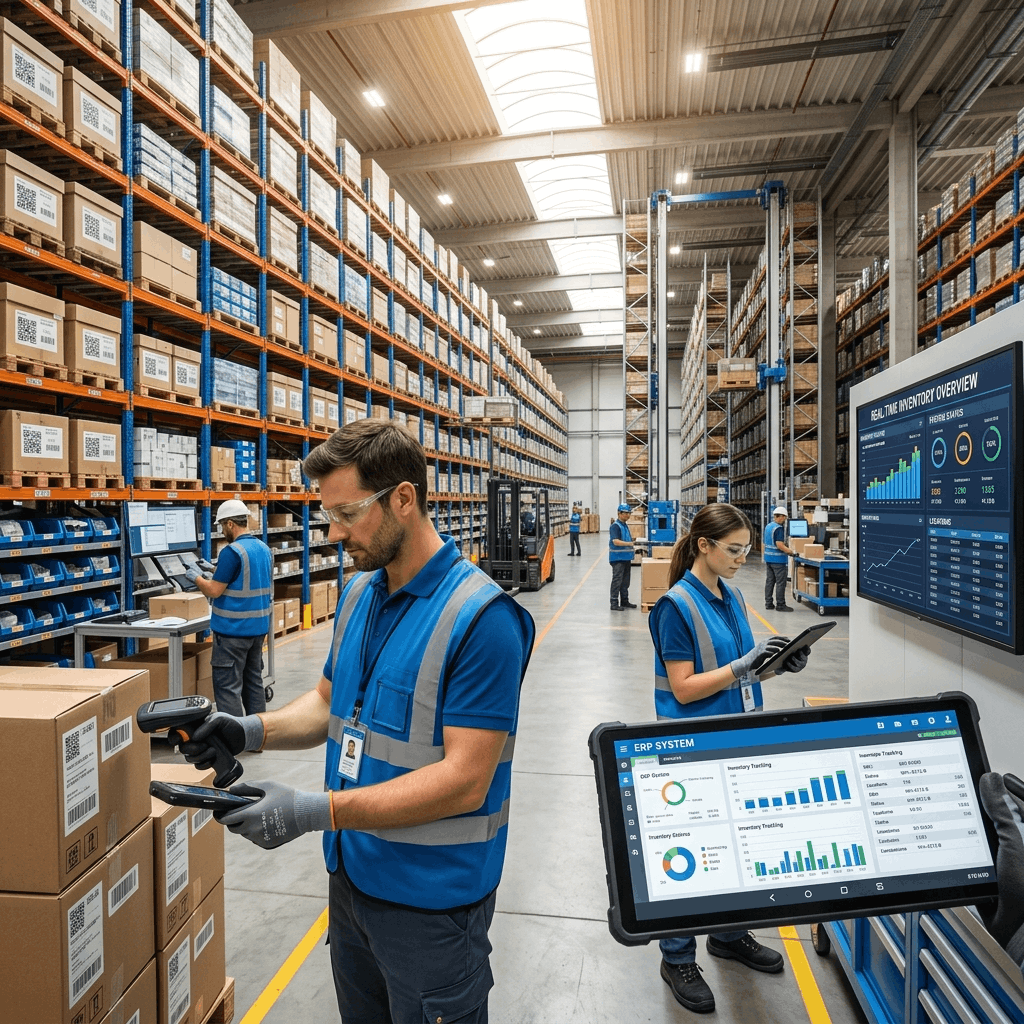
Today, true end-to-end visibility is a baseline requirement. Utilizing IoT (Internet of Things) sensors and cloud-based tracking, executives expect to see the real-time status of their inventory at every node: knowing exactly when it leaves the manufacturer's floor, the current GPS location of the shipping container, and the exact moment it is scanned into the local warehouse.
4. Hyper-Diversification of Supplier Networks
The era of single-sourcing is dead. Relying on one massive supplier in a single geographic region creates a catastrophic single point of failure.
Modern supply chain managers are diversifying their networks. They are establishing relationships with multiple suppliers across different continents, often blending a cheap offshore supplier for bulk orders with a slightly more expensive nearshore or local supplier for urgent, fast-turnaround orders. If geopolitical tensions or natural disasters take one region offline, the business can immediately pivot its purchase orders to an alternative vendor without missing a beat.
5. The Central Role of Cloud ERP
Managing a diversified, resilient, AI-driven supply chain is impossible using disconnected software. If your warehouse software cannot talk to your accounting software, visibility is impossible.
The foundational trend enabling all other supply chain advancements is the adoption of Cloud ERP Software. An ERP system acts as the digital nervous system, unifying procurement, inventory, manufacturing, and sales into a single, real-time database. It provides the centralized control tower required to orchestrate complex global operations.
Conclusion: Adapting to the New Normal
The disruptions of recent years were not anomalies; they are the new normal. The supply chains of the future must be built to withstand continuous volatility.
By prioritizing resilience over pure cost-cutting, embracing AI-driven forecasting, demanding real-time visibility, and integrating operations through platforms like Delight ERP, businesses can transform their supply chain from a fragile liability into a competitive weapon that guarantees product availability, regardless of global circumstances.
Frequently Asked Questions
Streamline operations, reduce costs, and scale faster with Delight ERP.