
In This Article
- The Silent Killer of Manufacturing Profits
- 1. Shifting from Reactive to Proactive Maintenance
- 2. Automated Spare Parts Inventory
- 3. Real-Time OEE (Overall Equipment Effectiveness)
- 4. Intelligent Production Scheduling
- 5. Total Asset Lifecycle Management
- Conclusion: Protecting the Heart of Your Business
The Silent Killer of Manufacturing Profits
In a manufacturing plant, the machines are the heartbeat of the business. When the machines are running efficiently, the company makes money. When a critical machine breaks down unexpectedly, profits bleed out rapidly. It isn't just the cost of the emergency repair; it is the cost of idle labor, ruined raw materials, expedited shipping fees to make up for lost time, and the permanent damage to your reputation when you miss a customer's deadline.
Many traditional manufacturers still rely on a "run-to-failure" strategy, managing their expensive CNC machines, presses, and extruders on whiteboards or disconnected spreadsheets. To scale profitably, businesses must adopt Manufacturing ERP software to digitize and automate their machinery management.
1. Shifting from Reactive to Proactive Maintenance
Reactive maintenance—waiting until a machine catches fire before fixing it—is the most expensive way to run a factory. An ERP system forces your organization into a proactive, preventive maintenance posture.
The ERP acts as the central brain. It records the specific running hours, cycle counts, or production volume of every machine on the shop floor. You input the manufacturer's recommended service intervals. When a machine approaches 10,000 running hours, the ERP automatically generates a preventive maintenance work order, assigning a technician to service the machine during a planned, low-impact window, entirely preventing the catastrophic failure.
2. Automated Spare Parts Inventory
There is nothing more frustrating for a plant manager than scheduling a preventive maintenance window, taking the machine offline, and then realizing the maintenance team does not have the necessary replacement belt in the tool crib. The machine sits idle while you wait three days for the part to ship.
A comprehensive ERP Software system manages your MRO (Maintenance, Repair, and Operations) inventory just as rigorously as it manages your raw materials. The system tracks your spare parts. By utilizing automated reorder points, the ERP will automatically generate a purchase order for critical bearings or lubricants the moment stock drops below the minimum threshold, ensuring the maintenance team is never waiting on parts.
3. Real-Time OEE (Overall Equipment Effectiveness)
You cannot optimize what you do not measure. Overall Equipment Effectiveness (OEE) is the gold standard metric for measuring manufacturing productivity. It calculates a machine's Availability (uptime), Performance (speed), and Quality (defect rate).
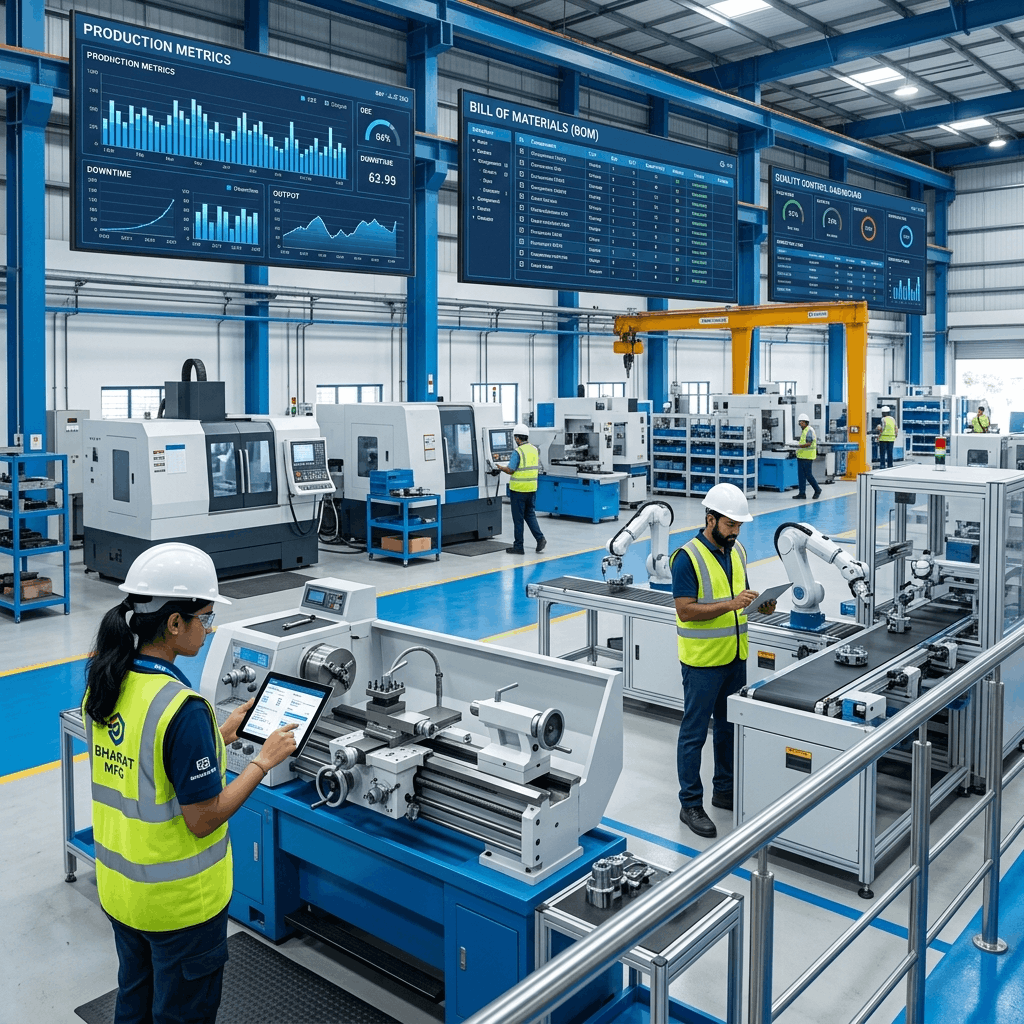
Modern ERP systems with Shop Floor Control modules calculate OEE in real-time. If a specific loom or milling machine is running at 60% OEE while the rest of the floor is at 85%, the ERP dashboard highlights the anomaly in red. Management can instantly investigate whether the machine needs recalibration, whether the raw material is subpar, or if the operator requires additional training.
4. Intelligent Production Scheduling
In a disconnected factory, the maintenance manager might take a critical machine offline for service exactly when the production manager needs it to rush a high-priority order. This lack of communication causes massive internal friction.
Because Cloud ERP Software provides a single, unified database, the production and maintenance schedules are perfectly synchronized. When the ERP's Advanced Planning and Scheduling (APS) algorithm assigns work to the shop floor, it automatically routes jobs around planned maintenance windows. It ensures that delivery dates promised to clients via the CRM Software are based on actual, available machine capacity.
5. Total Asset Lifecycle Management
Every machine eventually reaches the end of its profitable life. But how do you know exactly when it is cheaper to buy a new $500,000 machine rather than continuing to repair the old one?
An ERP tracks the total financial history of every asset. It tracks the original purchase depreciation, the exact cost of every spare part ever used on it, the labor hours spent repairing it, and the financial cost of the downtime it has caused. With a single click, CFOs can generate an Asset Lifecycle report, providing hard, mathematical data to justify the capital expenditure of a new machine.
Conclusion: Protecting the Heart of Your Business
Machinery is the most expensive capital investment a manufacturer will make. Managing millions of dollars of equipment with paper clipboards and reactive habits is financial malpractice.
By implementing Delight ERP, manufacturers transform their approach to machinery management. By automating preventive maintenance, ensuring spare part availability, and tracking real-time OEE, businesses can drastically reduce unplanned downtime, maximize their machine lifespan, and protect their profit margins.
Frequently Asked Questions
Streamline operations, reduce costs, and scale faster with Delight ERP.