
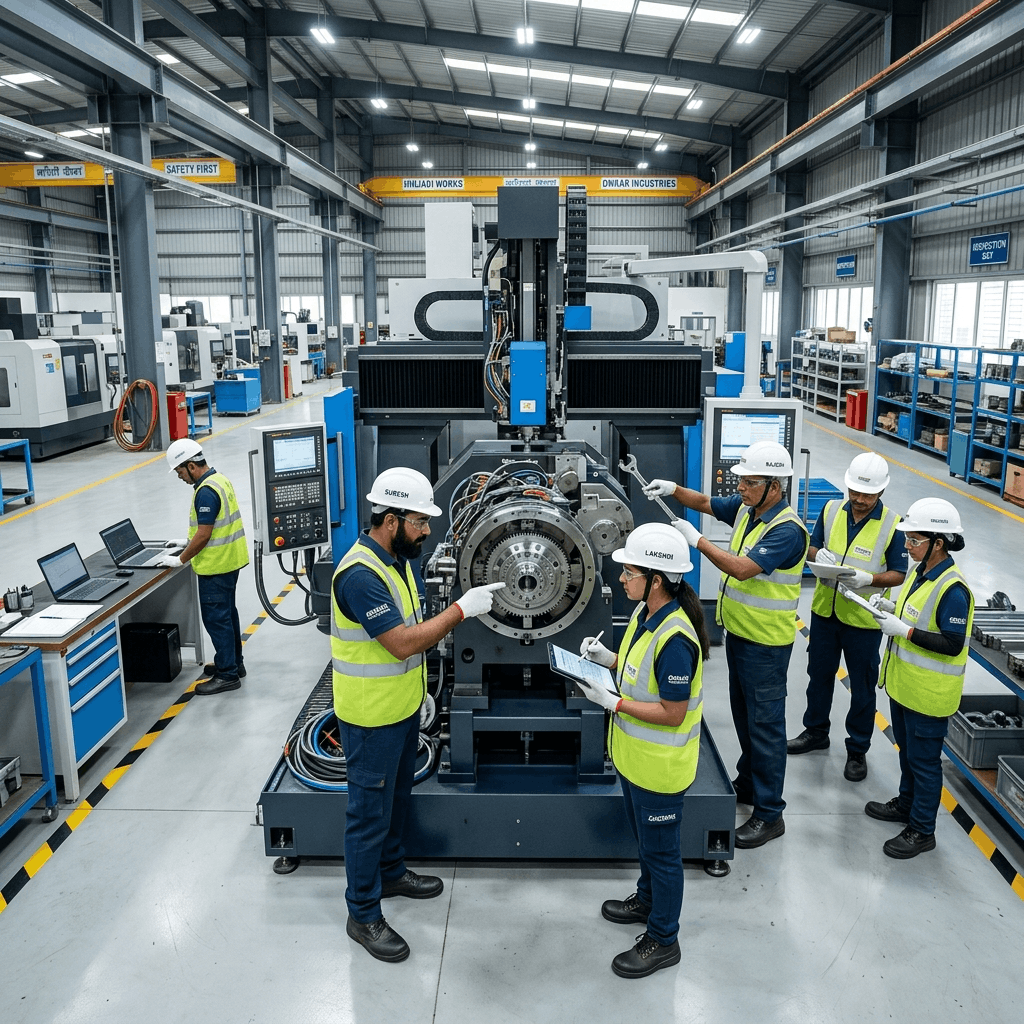
The manufacturing floor of 2026 looks fundamentally different from 2020. Digital transformation, accelerated by post-pandemic supply chain pressures and government incentives (PLI scheme, Make in India), has compressed what was a decade of technology adoption into three years. For Indian manufacturers, the businesses winning new customers and expanding margins are those who have embraced the latest manufacturing ERP capabilities — while those running on legacy systems or spreadsheets are watching their competitive position erode.
Why Manufacturing ERP Is Evolving Faster Than Ever
Three forces are driving rapid evolution in manufacturing ERP: AI/ML maturity making predictive capabilities affordable for SMBs, Cloud infrastructure making real-time data processing accessible without expensive on-premise hardware, and regulatory pressure (GST, e-invoicing, e-way bills) forcing businesses to digitalise their compliance processes. The result is a new generation of manufacturing ERP that is smarter, more connected, and more accessible than anything available even 3 years ago.
Trend 1: AI-Powered Production Planning
Traditional MRP (Material Requirements Planning) is deterministic — it calculates requirements based on fixed lead times and demand forecasts, but cannot adapt when realities diverge from plans. AI-powered MRP is probabilistic — it models uncertainty, accounts for supplier variability, and recommends optimal responses when disruptions occur.
For a bearing manufacturer in Rajkot, this means: when a key raw material supplier reports a 2-week delay, the AI doesn't just flag the problem — it immediately recommends which production orders to reschedule, which alternative suppliers to approach, and which customer orders to prioritise, all within seconds.
Trend 2: IoT Integration for Real-Time Shop Floor Data
In 2026, machines talk to ERP systems. IoT sensors on CNC machines, injection moulding equipment, and assembly lines feed real-time production data — machine status, cycle counts, reject rates, energy consumption — directly into the ERP. This eliminates the lag (and human error) of manual data entry and gives production managers a live view of their factory's performance from any device.
The business impact: when machine efficiency drops below 85%, the system automatically flags it and creates a maintenance work order — before a breakdown causes production stoppage. Predictive maintenance saves Indian manufacturers an estimated 15–25% in maintenance costs and significantly reduces unplanned downtime.
Trend 3: Mobile-First Manufacturing ERP
The factory floor is not an office. Production supervisors, quality inspectors, and warehouse staff need ERP access on handheld devices, not desktop computers. Modern manufacturing ERP is designed mobile-first — every critical workflow (production order confirmation, quality inspection, goods receipt, dispatch confirmation) is optimised for smartphone or tablet use.
For Indian manufacturers, where factory floors often have limited desk space and workers are more comfortable with mobile interfaces than desktop UIs, this is particularly valuable. Delight ERP's mobile app gives production staff full access to their tasks, material requisitions, and quality checklists on Android devices.
Experience the Future of Manufacturing ERP
Delight ERP brings AI planning, mobile-first design, and real-time visibility to Indian manufacturers. Book your personalised demo.
Book Free Demo →Trend 4: Predictive Maintenance Intelligence
Unplanned machine downtime is one of the costliest events in manufacturing. A ₹5 crore CNC machine sitting idle costs ₹1–2 lakhs per hour in lost production. Predictive maintenance ERP integrates with machine condition monitoring systems (vibration sensors, temperature sensors, oil analysis) to identify maintenance needs before failures occur.
The ERP schedules predictive maintenance during planned production gaps, orders required spare parts automatically, and tracks maintenance history to identify recurring issues. Indian manufacturers with predictive maintenance programs report 30–50% reduction in unplanned downtime and 15–20% reduction in total maintenance expenditure.
Trend 5: Cloud-Native Multi-Site Manufacturing
Indian manufacturers are increasingly operating across multiple locations — a factory in Rajkot, a warehouse in Ahmedabad, a satellite production unit in Bhavnagar. Cloud-native ERP makes multi-site management seamless: unified inventory, centralised procurement, consolidated financial reporting, and real-time inter-site transfers — all accessible from any location on any device.
Trend 6: Embedded Quality Management
Quality management is no longer a separate system — it is embedded within every transaction in modern manufacturing ERP. Receiving a purchase order automatically triggers a QC inspection checklist. Completing a production order requires passing in-process quality checks before the next stage begins. Dispatch is blocked until final inspection is passed and documented.
This embedded approach makes quality management automatic rather than optional, dramatically reducing the risk of defective goods reaching customers. Statistical Process Control (SPC) analysis identifies quality trends before they become defects.
Trend 7: E-Invoice and GST Automation
India's e-invoicing mandate has expanded significantly since 2021 and will eventually cover all registered taxpayers. Manufacturing ERP systems must now generate IRN (Invoice Reference Numbers) in real-time as invoices are raised, embed QR codes containing transaction data, and maintain complete audit trails for GST compliance. Forward-looking ERP vendors have already automated this entire process, making e-invoicing invisible to users while ensuring 100% compliance.
Trend 8: Sustainability and Carbon Footprint Tracking
As India commits to its Net Zero targets and large enterprise customers increasingly require sustainability reporting from their supply chains, manufacturing ERP is evolving to track carbon intensity, energy consumption per unit of output, and waste generation. This is currently a leading-edge capability, but will be mainstream within 3–5 years as ESG reporting requirements cascade from large enterprises to their SMB suppliers.
Conclusion
The manufacturing ERP of 2026 is not just a digital version of your old processes — it is a fundamentally smarter, more connected, more predictive system that transforms how manufacturing businesses operate. Indian manufacturers who adopt these technologies will find themselves able to produce higher quality products at lower cost, with better delivery reliability, than competitors running on legacy systems. The technology is available and affordable — the only barrier is the decision to move. Start your manufacturing ERP journey with Delight ERP today.
Streamline operations, reduce costs, and scale faster with Delight ERP.