
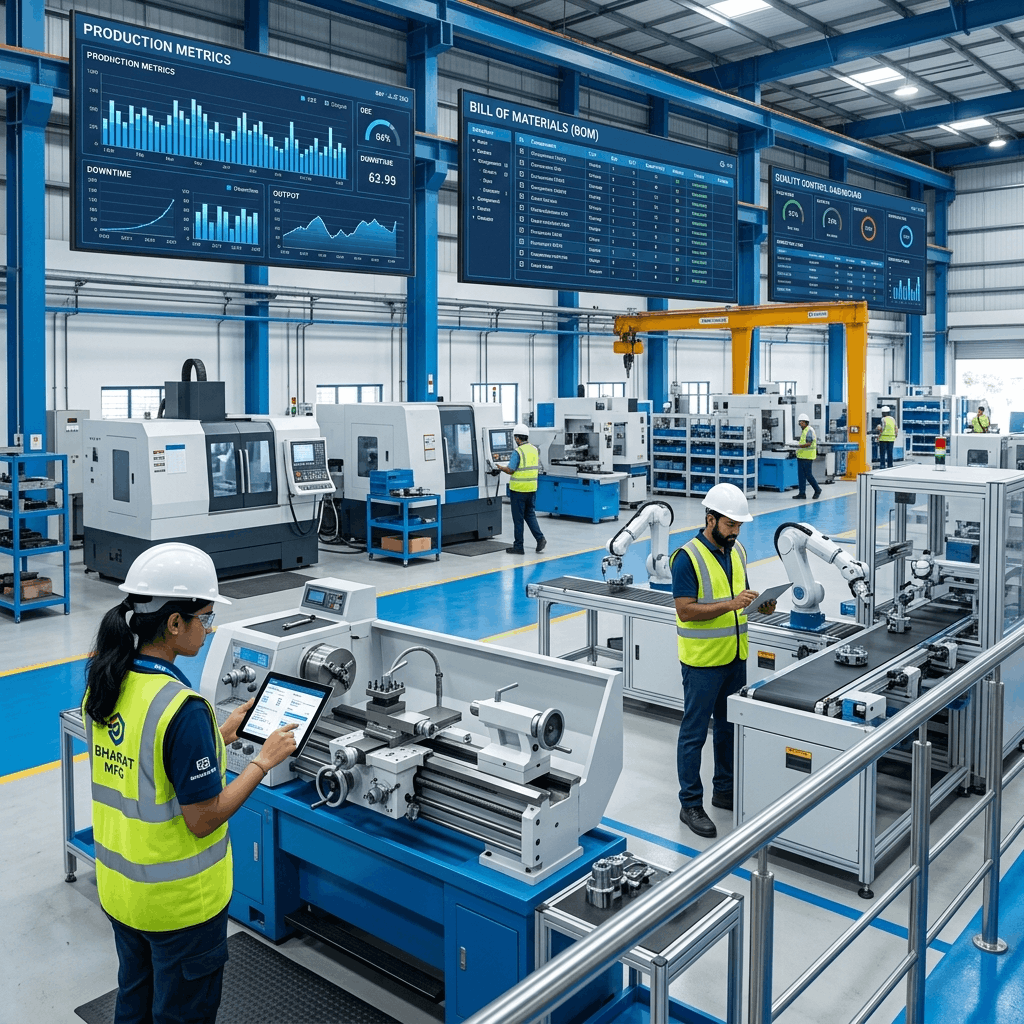
Almost every startup manufacturing company begins its journey using basic, off-the-shelf accounting software. In the early days, when order volumes are low and production consists of simple assembly, a basic financial ledger is sufficient. However, as your factory scales, you will inevitably hit a technological wall. Supply chains become complex, machine downtime gets expensive, and accurately costing your finished goods becomes a nightmare. This is the exact moment when you must transition from simple Accounting Software to a robust Manufacturing ERP System.
In this detailed comparison, we will explore why standard accounting tools fail on the factory floor and how a Manufacturing ERP acts as the central nervous system for your entire operational lifecycle.
The Fundamental Limitation of Accounting Software
Accounting software is designed for a single primary purpose: tracking money. It records invoices, manages payroll, and generates tax documents. It operates under a simple paradigm: you buy a finished product for $10, and you sell it for $20. But a manufacturer does not operate this way. A manufacturer buys steel, electricity, and labor, and physically transforms them into a $20 product. Accounting software cannot calculate this physical transformation. It simply sees raw expenses.
Inventory Tracking vs. Material Requirements Planning (MRP)
Most modern accounting software has basic inventory tracking. It can tell you that you currently have 500 widgets on the shelf. However, it cannot look into the future. A Manufacturing ERP contains an MRP engine. When a customer orders 1,000 finished goods, the MRP engine automatically checks your inventory, calculates the raw materials required, factors in supplier shipping delays, and generates purchase orders so the materials arrive exactly when the machines are ready to run.
Stop Guessing Your Inventory Needs
Delight ERP's MRP engine automatically schedules your raw material purchasing, eliminating stockouts and production delays.
Talk to an Expert → View MRP FeaturesBills of Materials (BOM) and Shop Floor Routing
A finished product is built using a recipe called a Bill of Materials (BOM). In complex manufacturing, these are multi-level BOMs (sub-assemblies that contain their own sub-assemblies). Accounting software has zero concept of a BOM. Furthermore, accounting software cannot route these materials across the shop floor. A Manufacturing ERP tracks exactly which workstation (cutting, welding, painting) the product is currently sitting at, providing real-time visibility into production bottlenecks.
Calculating True Cost of Goods Sold (COGS)
How much does it actually cost you to manufacture one unit of your product? If you use basic accounting software, you are likely guessing. A Manufacturing ERP calculates the true COGS by aggregating the exact cost of raw materials used, the fractional cost of the machine overhead for the 10 minutes it ran, and the specific labor rate of the worker who assembled it. This surgical precision allows executives to identify exactly which product lines are profitable and which are bleeding money.
Quality Control and Lot Traceability
In industries like food processing, pharmaceuticals, or automotive, regulatory bodies mandate strict Lot Traceability. If a supplier recalls a bad batch of plastic, you must know exactly which of your finished products contained that plastic. Accounting software cannot do this. A Manufacturing ERP provides complete, end-to-end forward and backward traceability, ensuring compliance and preventing catastrophic, untargeted product recalls.
When to Make the Switch
If your floor managers are tracking production runs on whiteboards, if your purchasing team is manually calculating raw material requirements in Excel, and if your finance team struggles to provide accurate profit margins on individual products, you have outgrown your accounting software. Do not let basic financial ledgers throttle your factory's growth. Upgrading to a comprehensive Manufacturing ERP is the definitive step toward total operational dominance.
Streamline operations, reduce costs, and scale faster with Delight ERP.