
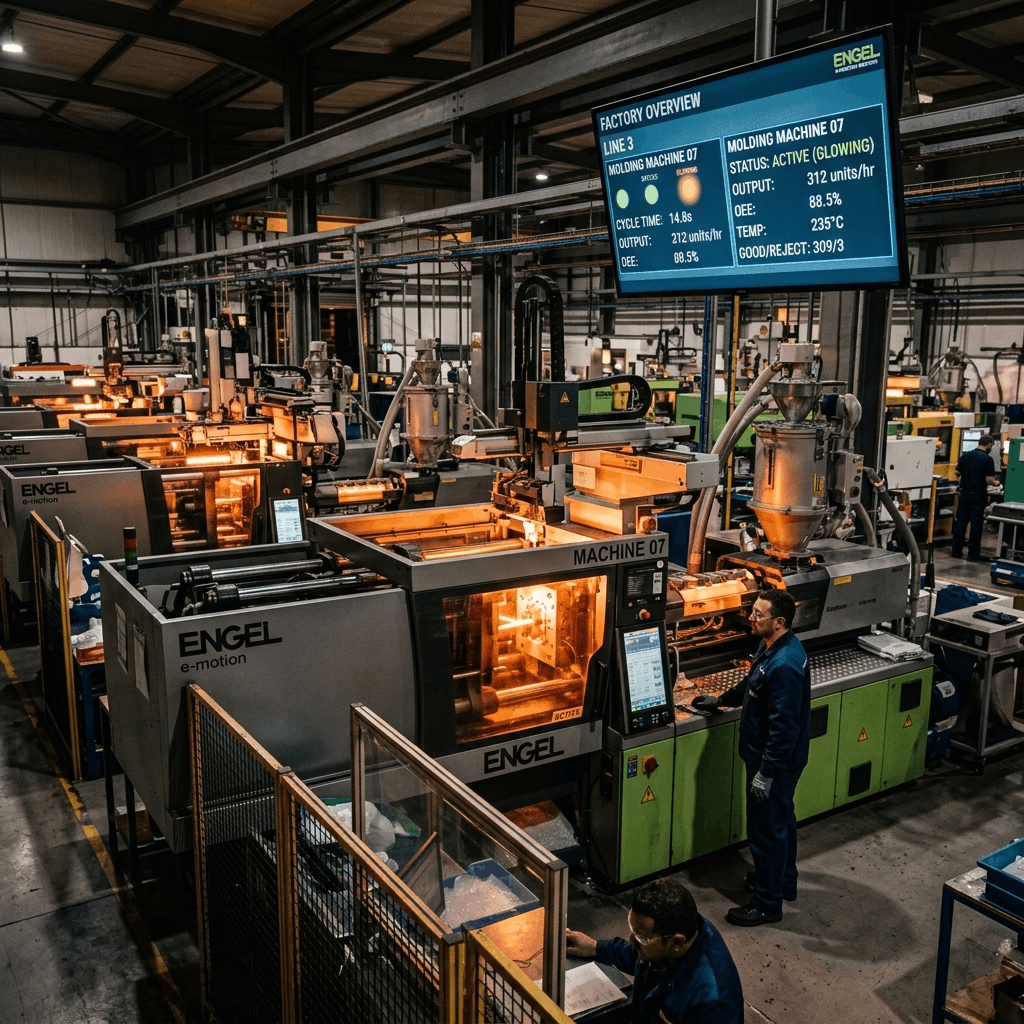
The Unique Pressures of the Plastics Industry
Plastic manufacturing is a completely different beast than discrete manufacturing (like assembling a bicycle). Plastics manufacturers operate in a "process manufacturing" environment. Instead of bolting solid parts together, they deal with volatile raw materials—resins, polymers, dyes, and additives—that are melted, mixed, injected, extruded, or blown into finished shapes.
This process is heavily reliant on expensive, high-speed machinery. Furthermore, the industry operates on razor-thin margins and faces increasing pressure from global environmental regulations regarding waste and recycling.
A standard, generic business software package will catastrophically fail in a plastics environment. It cannot handle recipes, it cannot handle plastic scrap, and it cannot schedule an injection molding machine. To survive and remain profitable, plastic manufacturers absolutely need a highly specialized Enterprise Resource Planning (ERP) system. Here is why.
Need 1: Complex Recipe and Formulation Management
When you assemble a wooden chair, the Bill of Materials (BOM) is static: you need 4 legs and 1 seat. When you manufacture a plastic bottle, the BOM is fluid. It is a Recipe.
A plastic recipe must account for the primary resin (e.g., PET or HDPE), the specific colorant dye, UV inhibitors, and plasticizers. These are mixed in highly specific ratios by weight. A specialized ERP system features a robust Recipe Management module that locks these formulations down.
If the engineering team decides that a product needs to be 10% more flexible, they adjust the recipe in the ERP. The system instantly recalculates the new ratio of plasticizers needed per 100 pounds of raw resin and updates the digital work instructions for the machine operators. This prevents human math errors on the factory floor that could lead to thousands of defective, brittle parts being produced.
Need 2: Managing Scrap, Regrind, and Waste Sustainability
One of the most unique and critical aspects of plastics manufacturing is the concept of Regrind. During the injection molding process, excess plastic is created (the "runners" and "sprues" that connect the molded parts).
This excess plastic is not thrown away; it is chopped up (reground) and fed back into the hopper to be melted down for the next batch. Managing this workflow is an accounting nightmare without software.
A specialized plastics ERP handles regrind elegantly. When a production run finishes, the ERP prompts the operator to weigh the scrap. The system then automatically brings that scrap back into the inventory ledger as "Regrind Material" with a specific cost assigned to it.
Furthermore, the ERP enforces quality control limits. It can dictate that a specific recipe can only safely contain a maximum of 15% regrind mixed with 85% virgin resin, ensuring the structural integrity of the final product while maximizing material efficiency.
Need 3: Multi-UOM (Unit of Measure) Conversions
Discrete manufacturers generally buy in "eaches" (e.g., buying 500 screws). Plastic manufacturers deal in multiple, confusing Units of Measure (UOM).
You might purchase raw resin pellets by the railcar (Tons). You might store that resin in your silos by the Pound (lbs). You might consume that resin in the machine by the Ounce (oz). Finally, you sell the finished plastic cup by the Case (containing 500 pieces).
If an employee has to calculate these conversions manually on a calculator, inventory counts will be perpetually incorrect. A plastics ERP features automated Multi-UOM conversion. When you receive a railcar of resin, the ERP instantly and perfectly converts that tonnage into pounds for the inventory ledger. When you sell a case of cups, it automatically deducts the exact ounces of resin required from the silo inventory. This guarantees inventory accuracy down to the decimal point.
Need 4: Injection Molding Scheduling and Cycle Times
Scheduling a plastic factory is essentially an advanced mathematical puzzle. You have to schedule the machine itself, the specific physical mold (the heavy metal tool that shapes the plastic), and the labor.
Plastics ERPs feature Advanced Planning and Scheduling (APS) engines tailored for "Family Molds" and "Cycle Times." For example, a single family mold might produce one large part and two small parts simultaneously in a 45-second cycle time.
The ERP analyzes the incoming sales orders, knows that the mold produces parts in a 1:2 ratio, knows the machine takes 45 seconds per cycle, and knows it takes 4 hours to change out the mold. It then mathematically generates the perfect daily schedule to maximize the machine's uptime, minimizing the time spent unbolting and swapping heavy molds.
Need 5: Navigating Resin Price Volatility
The primary raw material for plastics (resin) is derived from petroleum. Therefore, the cost of a plastic manufacturer's raw materials fluctuates wildly based on the global oil market.
If the cost of oil spikes, and a manufacturer is locked into a fixed-price contract with a customer, their profit margins can vanish overnight. An ERP system protects against this through Real-time Job Costing.
The ERP tracks the exact purchase price of every single pound of resin in the silo. When a job is run, the ERP calculates the Cost of Goods Sold (COGS) based on the actual cost of the resin consumed that day, not an estimated average. If the CFO sees that a specific product line is no longer profitable due to resin price spikes, they can instantly renegotiate pricing with the client or pause production, saving the company from severe financial losses.
Conclusion: Shaping the Future of Plastics
The plastics industry is entering a highly competitive, highly regulated era. Survival depends on extreme efficiency, minimal waste, and the ability to pivot rapidly as raw material costs fluctuate.
Trying to manage recipes, regrind, and injection machine cycle times without specialized software is a massive operational liability. Implementing a robust ERP system designed for process manufacturing provides the total control and visibility needed to scale profitably.
At Delight ERP, we provide specialized tools for the plastics industry. Our platform is built to handle your complex resin formulations, automate your multi-UOM conversions, and schedule your factory floor with absolute precision.
Streamline operations, reduce costs, and scale faster with Delight ERP.