
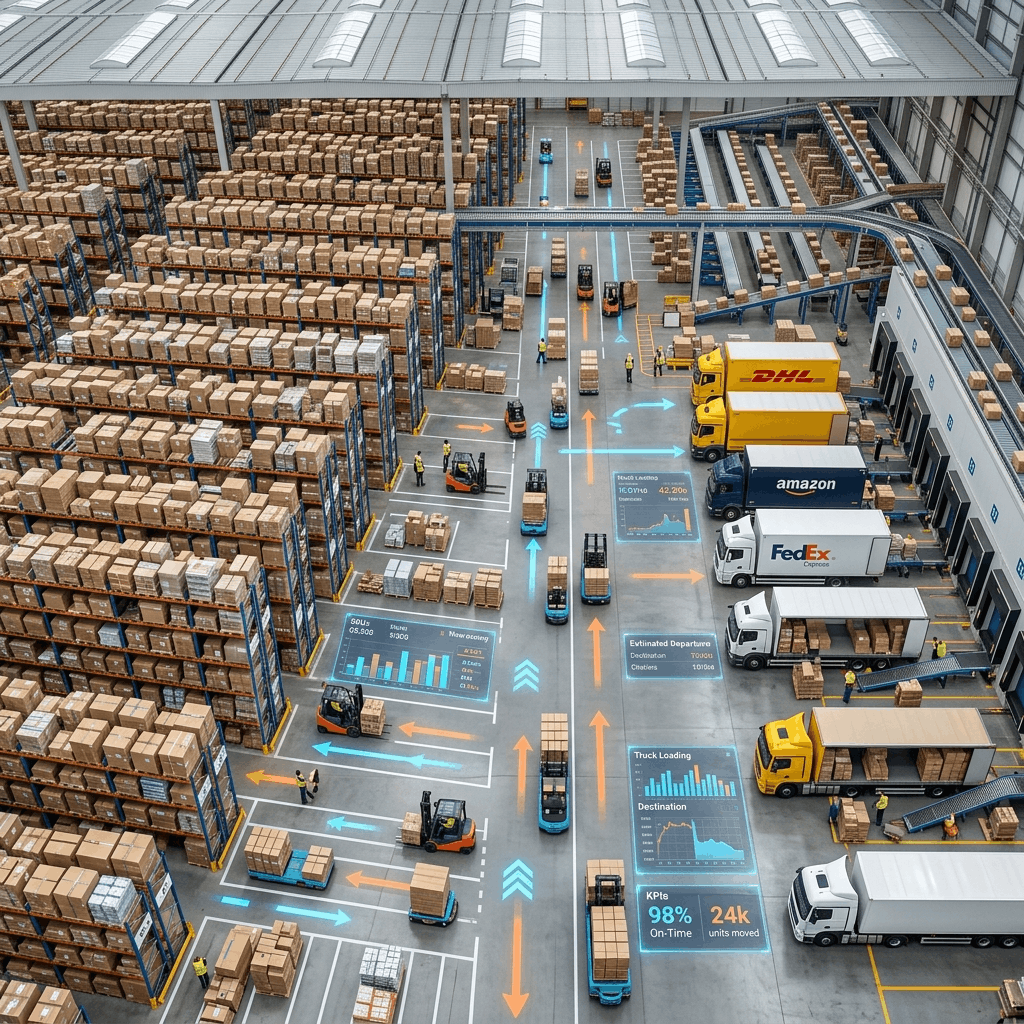
The Rising Costs of Global Logistics
In the modern business landscape, supply chains are under unprecedented financial pressure. Volatile fuel prices, international trade tariffs, rising warehouse real estate costs, and labor shortages have combined to create an environment where logistics costs are rapidly eating into corporate profit margins. For many manufacturing and distribution companies, Supply Chain Management (SCM) represents the single largest expense on their Profit & Loss statement.
Executives are constantly tasked with finding ways to "cut costs" in the supply chain. However, aggressively slashing budgets without a strategic plan usually results in degraded product quality and delayed customer deliveries, which ultimately damages the brand. The true secret to reducing supply chain costs is not to stop spending money, but to eliminate wasteful spending through absolute operational efficiency.
This level of surgical efficiency is impossible to achieve with disconnected spreadsheets and legacy software. It requires a unified Enterprise Resource Planning (ERP) system. Let's break down the six specific areas where implementing an ERP system will drastically reduce your supply chain management costs.
Area 1: Eliminating Dead Stock and Holding Costs
One of the most insidious hidden costs in any business is the "inventory carrying cost" or holding cost. It is estimated that holding inventory costs a business roughly 20% to 30% of the inventory's total value every single year. This includes the cost of warehouse space, insurance, security, and most importantly, depreciation and obsolescence.
When companies use manual demand planning, they often over-order raw materials "just to be safe." This results in warehouses full of dead stock—items that are never used and eventually must be sold at a massive loss or scrapped entirely. This is a catastrophic waste of operating capital.
An ERP system solves this by utilizing advanced, AI-driven demand forecasting. The system analyzes historical sales data and market trends to predict exactly how much of a product will sell. It then calculates the precise amount of raw materials needed to meet that demand. This allows businesses to transition to Just-In-Time (JIT) inventory management, where materials arrive exactly when they are needed on the factory floor, drastically reducing the need for massive, expensive warehouses.
Area 2: Eradicating Stockouts and Lost Sales Revenue
Conversely, while overstocking costs money in warehouse fees, understocking (stockouts) costs money in lost sales and permanently damages customer loyalty. If a customer tries to buy a product and it is out of stock, 70% of them will immediately go to a competitor and likely never return.
Furthermore, when a company realizes they are short on materials needed to fulfill a massive B2B order, they are forced to pay exorbitant expedited air-freight fees to rush the raw materials to the factory. These "emergency" shipping fees obliterate profit margins.
An ERP system provides real-time visibility into inventory levels across all locations. It features automated reorder points. When the stock of a critical component drops below a mathematically optimized threshold, the ERP automatically alerts the procurement team or automatically generates a purchase order. This guarantees that you never miss a sale due to a stockout, and you never have to pay emergency shipping fees.
Area 3: Optimizing Procurement and Vendor Pricing
Procurement teams are tasked with buying materials at the lowest possible price without sacrificing quality. However, when procurement managers are bogged down with manually writing purchase orders and chasing email approvals, they do not have time to actually negotiate strategically.
An ERP automates the entire Procure-to-Pay workflow. It centralizes all vendor data, allowing managers to instantly compare pricing, lead times, and historical performance across multiple suppliers. If Vendor A is constantly delivering late, the ERP flags this, giving the procurement manager the hard data needed to demand a discount or switch to Vendor B.
Additionally, because the ERP tracks aggregate demand across the entire company, it allows procurement teams to consolidate orders. Instead of three different factories ordering small batches of the same material at retail prices, the ERP combines the demand, allowing the procurement team to negotiate massive bulk-discount pricing from the supplier.
Area 4: Automating Manual Administrative Labor
Labor is expensive. If your highly paid supply chain managers are spending 20 hours a week manually typing tracking numbers from emails into a master Excel spreadsheet, you are burning money. Manual data entry is not only expensive; it is highly prone to human error. A single misplaced decimal point in a purchase order can cost a company thousands of dollars.
An ERP system integrates seamlessly across departments to automate administrative workflows. When a customer places an order on the e-commerce portal, the ERP instantly generates the sales order, decrements the inventory, creates the warehouse picking slip, generates the shipping label, and creates the financial invoice—all in milliseconds, with zero human intervention.
This allows your supply chain staff to stop acting as data-entry clerks and start acting as strategic analysts, focusing their time on finding new ways to optimize routes and negotiate better vendor contracts.
Area 5: Reducing Shipping and Freight Expenses
Final-mile delivery and freight routing are notoriously expensive. If a company does not have sophisticated software, they are likely relying on standard shipping rates and inefficient delivery routes.
Advanced ERP systems feature integrated Transportation Management Systems (TMS). When an order is ready to ship, the ERP automatically pings the APIs of multiple shipping carriers (FedEx, UPS, DHL, local freight lines) and instantly selects the carrier that offers the lowest price for that specific package weight and destination while still meeting the required delivery date.
Furthermore, for companies that operate their own delivery fleets, the ERP provides route optimization software. It calculates the most fuel-efficient route for the driver to take to complete 20 deliveries in a single day, drastically reducing fuel consumption and vehicle wear-and-tear.
Area 6: Lowering Manufacturing Scrap and Waste
In manufacturing supply chains, a significant amount of money is lost to "scrap"—raw materials that are ruined during the production process due to machine malfunctions, poor quality control, or worker errors.
A modern Manufacturing ERP monitors the shop floor in real-time. It ensures that workers are using the exact, optimized Bill of Materials (BOM) so they don't use more raw material than necessary. It also integrates with IoT sensors on the machinery. If a machine begins operating slightly out of tolerance—which would result in defective products—the ERP instantly halts the machine and alerts maintenance before a massive batch of expensive raw materials is ruined.
Calculating the ROI of an ERP Investment
Implementing a comprehensive ERP system is a significant financial investment, but it is one of the very few software investments that directly pays for itself. When you calculate the combined savings from reduced holding costs, eliminated stockouts, bulk procurement discounts, slashed administrative labor, optimized freight rates, and reduced manufacturing scrap, the numbers are staggering.
Most mid-sized manufacturing and distribution companies that properly implement an ERP system see a complete Return on Investment (ROI) within 12 to 18 months. After the system has paid for itself, those reduced costs drop straight to the bottom line as pure profit year after year.
If you are serious about surviving in a hyper-competitive global market, optimizing your supply chain is not optional. At Delight ERP, our software is engineered specifically to find and eliminate the financial leaks in your supply chain. We provide the absolute visibility and powerful automation required to turn your logistics network from a heavy cost center into a strategic, profit-generating advantage.
Streamline operations, reduce costs, and scale faster with Delight ERP.