
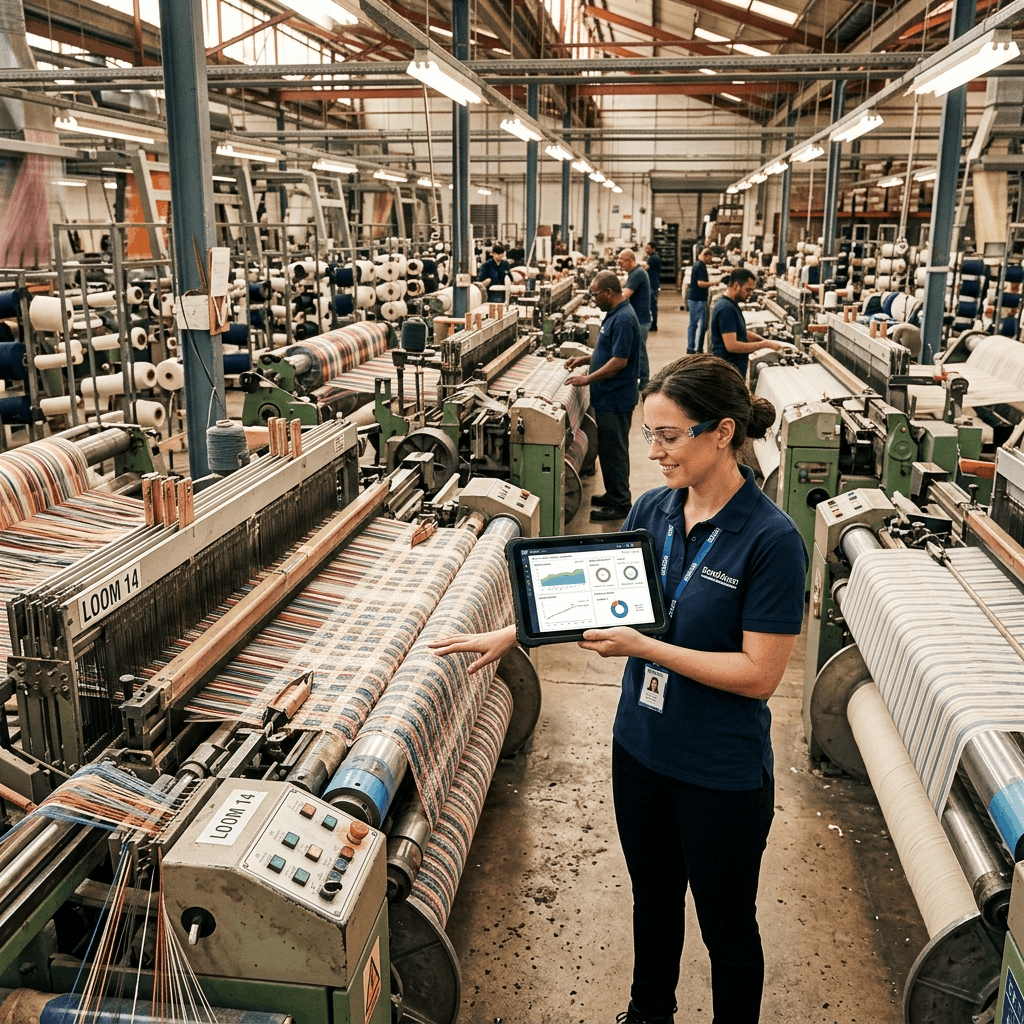
The Unique Chaos of the Textile Supply Chain
The textile and apparel manufacturing industry is notoriously complex. Unlike discrete manufacturing, where a company might build five variations of a metal desk, a textile company must build thousands of variations of a single garment. The supply chain stretches from raw cotton fields to complex chemical dyeing plants, through massive sewing floors, and finally to highly demanding global retail outlets.
Furthermore, the industry is beholden to the hyper-accelerated concept of "Fast Fashion." Trends change every month. If a textile manufacturer is slow to procure materials or slow to adjust their production schedule, they will end up with warehouses full of obsolete garments that nobody wants to buy.
To survive in this high-volume, low-margin environment, textile companies must implement Enterprise Resource Planning (ERP) software designed specifically for the garment industry. A generic ERP will collapse under the weight of textile data. Here is the vital role that specialized ERP plays in modern textile manufacturing.
Role 1: Managing Massive Matrix Inventories (Color/Size/Style)
The biggest hurdle in textile manufacturing is SKU proliferation (the massive multiplication of stock-keeping units). If you design a single t-shirt, you don't just have one product. If that shirt comes in 5 sizes (S, M, L, XL, XXL) and 5 colors (Red, Blue, Green, Black, White), you suddenly have 25 unique SKUs to track. If you offer two different fits (Slim and Regular), you now have 50 SKUs.
A generic inventory system forces you to manage these 50 items as completely separate entities, which makes purchasing and production scheduling a nightmare. A textile ERP solves this through Matrix Inventory Management.
Instead of viewing a massive vertical list of 50 SKUs, the ERP allows the production manager to view a single "Parent" product (The T-Shirt). Beneath it, a two-dimensional grid (a matrix) displays the exact inventory levels, pending orders, and production schedules for every size and color combination simultaneously. This allows planners to easily say, "We need to ramp up production on the Blue/Medium shirts, but pause the Red/Small shirts," preventing disastrous overstock scenarios.
Role 2: Strict Tracking of Dye Lots and Shade Variations
Dyeing fabric involves complex chemical processes that are highly sensitive to temperature, humidity, and chemical concentration. Because of this, it is physically impossible to get the exact same shade of "Navy Blue" in two different batches of dyeing (known as a "Lot").
If a worker accidentally sews the front half of a jacket using Fabric Lot A, and the sleeves using Fabric Lot B, the customer will notice a subtle "shade variation" when they walk into sunlight, and they will return the defective garment.
The ERP plays a critical role in enforcing Dye Lot Traceability. When rolls of fabric enter the warehouse, the ERP generates a unique barcode for that specific dye lot. When the cutting room floor requests fabric for a work order, the ERP system physically restricts the workers from mixing different dye lots into the same production batch. This strict digital enforcement ensures absolute color uniformity across every finished garment.
Role 3: Accounting for Shrinkage and Material Loss
When you cut a piece of steel in a machine shop, the steel stays the same size. When you wash or dye a roll of cotton fabric, it shrinks.
If a manufacturer needs 100 meters of finished fabric to sew a batch of dresses, but they only purchase 100 meters of raw fabric, they will run out of material because the fabric might shrink by 5% during the pre-washing phase.
A textile ERP manages this complexity automatically through Calculated Shrinkage Factors. The engineering team inputs the known shrinkage rate of a specific fabric into the ERP's Bill of Materials. When the system generates a Purchase Order to the supplier, it mathematically inflates the requested yardage (e.g., ordering 106 meters) to perfectly account for the expected loss. This ensures the sewing floor never runs short of fabric midway through a massive order.
Role 4: Accelerating "Fast Fashion" with PLM
The timeline from an initial design sketch to a finished product sitting on a retail shelf has compressed dramatically. In the "Fast Fashion" era, brands expect manufacturers to turn around entirely new product lines in a matter of weeks.
To survive this pace, a textile ERP integrates deeply with Product Lifecycle Management (PLM) tools. When a designer finishes a CAD sketch of a new jacket, they upload it directly into the ERP.
The ERP immediately triggers a workflow: it alerts the procurement manager to source the required zippers, it alerts the costing department to calculate the retail price based on raw material costs, and it alerts the production manager to reserve time on the sewing machines. By replacing emails and meetings with instant digital workflows, the ERP slashes weeks off the product development cycle.
Role 5: Unifying Multi-Channel Sales Networks
Modern textile companies rarely sell through a single channel. A large manufacturer might sell massive wholesale containers to big-box retailers (B2B), while simultaneously selling individual garments directly to consumers through a Shopify website (B2C), and fulfilling orders for boutique shops.
Managing these highly disparate sales channels from different software systems leads to massive inventory discrepancies. You might accidentally sell a jacket on your website that was actually just loaded onto a truck for a wholesale client.
The ERP acts as the ultimate unifier. It serves as the central brain that connects all sales channels. The moment the B2C website sells a jacket, the central ERP inventory drops by one. The wholesale team instantly sees the updated inventory, preventing them from promising stock that no longer exists. This unified architecture prevents stockouts, protects customer relationships, and enables aggressive omni-channel growth.
Conclusion: Weaving It All Together
The textile industry is a delicate web of complex variables. From managing the volatile prices of raw cotton to ensuring perfect color uniformity across millions of garments, the margin for error is razor-thin.
An Enterprise Resource Planning system is not just an optional upgrade for a textile company; it is the structural loom that holds the entire business together. By mastering matrix inventories, automating shrinkage calculations, and accelerating the design lifecycle, an ERP allows textile manufacturers to operate with unprecedented agility and profitability.
At Delight ERP, we understand the unique language of textiles. Our platform is engineered to handle your complex dye lots, matrix SKUs, and fast-paced supply chains, giving you the digital foundation needed to dominate the global apparel market.
Streamline operations, reduce costs, and scale faster with Delight ERP.