
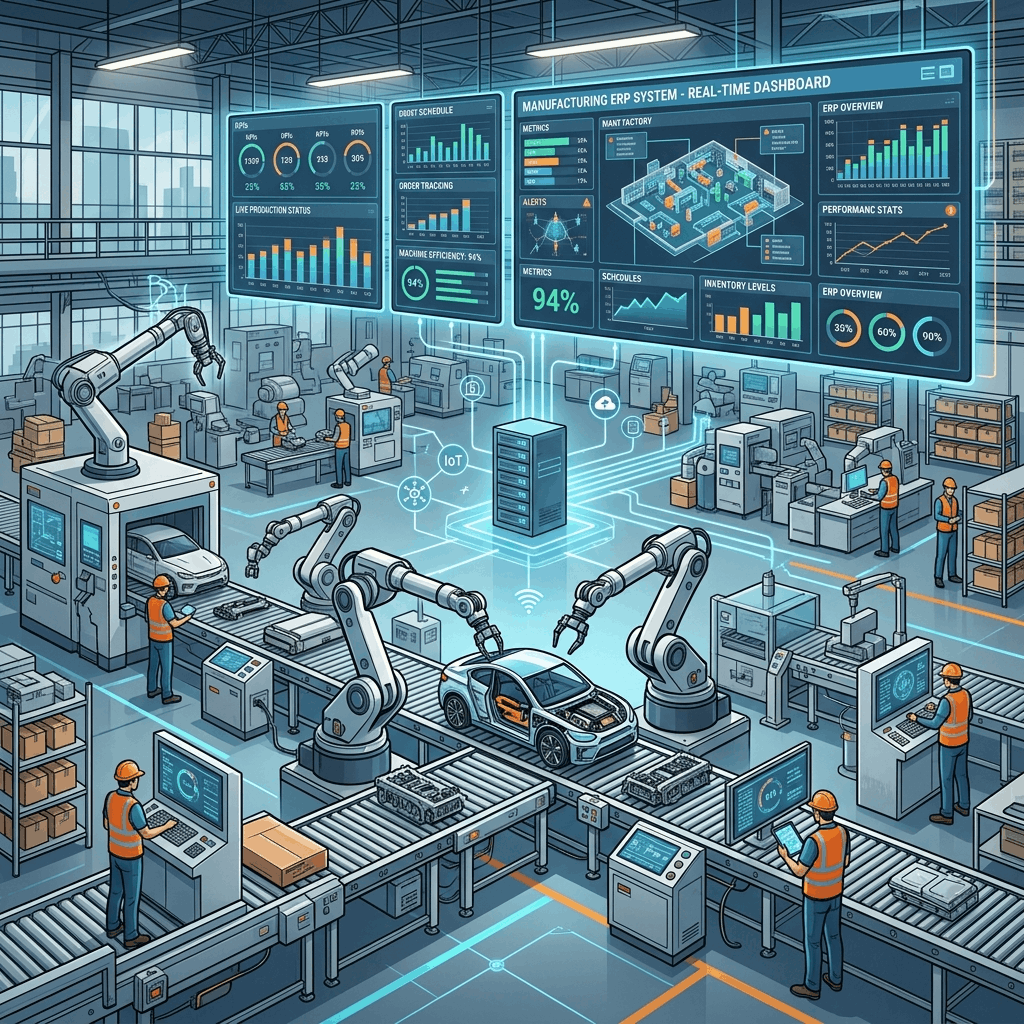
The Complexity of the Modern Factory Floor
Manufacturing is arguably the most operationally complex sector in the global economy. A retail business simply buys a finished product and sells it for a higher price. A manufacturer, however, must buy raw materials, store them, schedule labor, run heavy machinery, assemble complex parts, test for quality, and then finally ship a finished product.
Managing this chaotic symphony of moving parts requires absolute precision. When communication breaks down between the sales team promising a delivery date and the warehouse realizing they lack the raw materials, the entire system grinds to a halt.
This is where Enterprise Resource Planning (ERP) software becomes indispensable. A specialized manufacturing ERP is not just an accounting tool; it is the central nervous system of the factory. Let's examine the critical roles an ERP system plays in the modern manufacturing industry.
Role 1: The Unified Data Hub
In a legacy manufacturing environment, data is heavily siloed. The engineering team uses CAD software to design products. The warehouse team uses Excel spreadsheets to track inventory. The accounting team uses QuickBooks to manage cash flow. Because these systems do not talk to each other, a massive amount of human effort is wasted manually copying data from one system to the next, inevitably leading to errors.
The primary role of an ERP is to shatter these silos and create a Single Source of Truth. When an ERP is implemented, everyone in the company logs into the exact same unified database.
When the sales team inputs a massive new order into the ERP, the warehouse immediately sees the demand spike and can check raw material levels. The production manager instantly sees the new order in their queue, and the CFO immediately sees the projected revenue. This unified visibility prevents the "left hand not knowing what the right hand is doing" syndrome that paralyzes growing manufacturers.
Role 2: Bill of Materials (BOM) and Routing Management
At the heart of any manufactured product is the Bill of Materials (BOM). If you are building a simple wooden chair, the BOM is short: 4 legs, 1 seat, 1 backrest, 16 screws.
However, if you are building an industrial generator, you are dealing with a "Multi-Level BOM" consisting of thousands of parts, sub-assemblies, and electrical components. Managing this on a spreadsheet is impossible.
An ERP manages complex BOMs effortlessly. When a work order is generated to build the generator, the ERP automatically allocates all 5,000 required parts from the inventory ledger. More importantly, the ERP handles Production Routing. It doesn't just know what parts are needed; it knows exactly how they should be assembled. It maps out the precise sequence of operations—e.g., Step 1: Welding (Machine A), Step 2: Painting (Machine B), Step 3: Electrical Assembly (Workstation C)—ensuring the product flows logically across the shop floor.
Role 3: Capacity Planning and Scheduling
A factory only makes money when its machines are running. However, scheduling those machines is a monumental mathematical challenge. You have 20 different machines, 50 workers on different shifts, and 100 open work orders with different priority levels.
A manufacturing ERP utilizes Advanced Planning and Scheduling (APS) algorithms to solve this puzzle. The software analyzes the routing data for all open orders and maps it against the real-time availability of your physical machines and human labor.
The ERP will automatically generate a highly optimized daily schedule that minimizes setup times, prevents bottlenecks (e.g., ensuring 10 different orders don't all hit the single painting booth at the exact same time), and maximizes the overall throughput of the factory. If a machine unexpectedly breaks down, the ERP can instantly recalculate the entire factory's schedule to reroute work and minimize the delay.
Role 4: Quality Control and Compliance
In industries like aerospace, automotive, or medical devices, producing a defective part is not just an annoyance; it is a critical safety failure that can trigger massive lawsuits and brand destruction.
The ERP plays a foundational role in enforcing quality control (QC). Within the software's production routing, management can embed hard "QC Checkpoints." For example, after a metal part is milled, the system will pause the work order. The machinist is required to physically measure the part with calipers and input the exact dimensions into the ERP.
If the dimensions fall outside the acceptable tolerance parameters, the ERP immediately flags the part as defective, halts its progression down the assembly line, and alerts a supervisor. This systemic enforcement guarantees that defective products never reach the customer.
Role 5: Financial Visibility and Granular Job Costing
Many manufacturers struggle to answer a fundamental question: "Are we actually making money on this specific product?" They know their overall revenue is up, but they don't know which product lines are highly profitable and which ones are secretly draining cash.
A manufacturing ERP solves this through Granular Job Costing. Because the ERP controls the entire factory, it tracks every penny associated with a specific production run. It tracks the exact purchase price of the steel used. It tracks the exact amount of electricity the welding machine consumed during the run. It tracks the exact hourly wage of the specific operator who ran the machine for 45 minutes.
By aggregating all these micro-costs, the ERP provides the CFO with an incredibly accurate, real-time Cost of Goods Sold (COGS). If the CFO sees that the profit margin on "Product A" has slipped from 20% to 5% because steel prices rose, they can immediately authorize a price increase, protecting the health of the business.
Conclusion: The Backbone of Industry
The role of ERP in the manufacturing industry cannot be overstated. It is the digital backbone that supports the immense physical weight of industrial production.
Without an ERP, a manufacturer is relying on guesswork, spreadsheets, and luck—a strategy that will inevitably fail as the business attempts to scale. By unifying data, automating complex BOMs, optimizing schedules, and enforcing quality, an ERP system transforms a chaotic factory floor into a highly tuned, deeply profitable machine.
At Delight ERP, we are dedicated to empowering manufacturers. Our comprehensive platform provides the advanced tools required to streamline your operations, reduce overhead costs, and scale your business with absolute confidence.
Streamline operations, reduce costs, and scale faster with Delight ERP.