
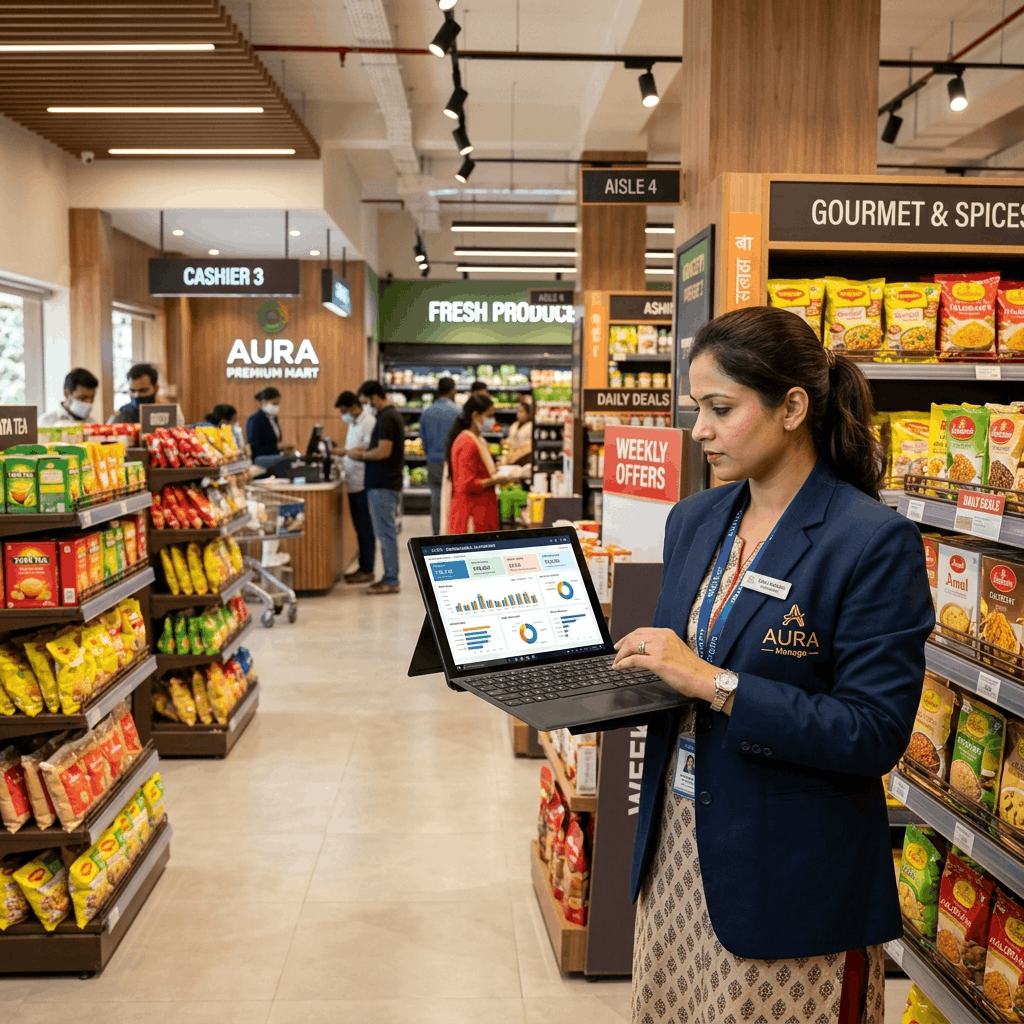
Opening your first retail store is a massive achievement. Opening your second store is an entirely different logistical beast. When a retail brand expands from a single location to a multi-store chain, the operational complexity does not just double; it multiplies exponentially. Relying on standalone Point of Sale (POS) systems and fragmented spreadsheets will quickly lead to inventory disasters, accounting nightmares, and a catastrophic loss of control.
To successfully scale a retail empire in 2026, owners must adopt Multiple Store Management Software—a specialized sub-category of Retail ERP systems. By connecting every physical location, warehouse, and eCommerce platform to a single, centralized brain, executives regain total control. Here are the top 10 advantages of implementing this technology.
The Multi-Store Management Nightmare
Without a unified system, each retail location acts as its own isolated island. Store A does not know that Store B is completely sold out of a high-demand item, and the central warehouse does not know that Store C hasn't sold a single unit of a specific product in three months. The accounting department is forced to manually reconcile daily sales reports from five different POS systems, resulting in week-long delays in financial reporting.
Multiple Store Management Software bridges these islands, turning a fragmented chain of shops into a singular, highly optimized corporate machine.
1. Centralized Global Inventory
The most immediate benefit is the eradication of inventory blind spots. The software provides a master dashboard that tracks every single SKU across every single location in real-time. When a barcode is scanned at the register in Mumbai, the master inventory count in the corporate database is instantly reduced. You never have to guess what your stock levels are; you know with mathematical certainty.
2. Inter-Store Inventory Transfers
If a customer walks into Store A looking for a size 10 shoe and it is out of stock, a standalone POS means the sale is lost. With multi-store software, the cashier can instantly check the database and see that Store B (located five miles away) has two pairs in stock. The cashier can immediately trigger a digital transfer request, securing the sale and vastly improving the customer experience.
3. Unified Accounting and General Ledger
Manually consolidating End-of-Day (EOD) Z-reports from dozens of different stores is an agonizing, error-prone task for the accounting department. A unified system automatically funnels all sales data, taxes collected, and inventory costs directly into the central General Ledger. The CFO can pull a P&L statement for the entire company—or drill down into the profitability of a specific location—with a single click.
Stop Guessing, Start Knowing
Consolidate your entire retail chain into a single, powerful dashboard with Delight ERP.
Talk to our Retail Experts → Explore Retail Solutions4. Standardized Pricing and Promotions
Running a company-wide "Black Friday" sale is a nightmare if you have to manually update the pricing in 20 different local POS systems. With a centralized ERP, marketing executives can create a complex promotional rule (e.g., "Buy 2 Get 1 Free on all Winter Apparel") at the headquarters, and instantly push that pricing logic out to every single cash register in the country simultaneously.
5. Comprehensive Employee Scheduling
Managing staff across multiple locations requires robust HR tools. Multi-store software allows area managers to build schedules that float employees between different stores based on demand. Furthermore, the POS terminals act as digital time-clocks, ensuring that payroll data flows directly into the central HR module without manual transcription.
6. Centralized Purchasing Power
If individual store managers are ordering their own inventory from suppliers, you are losing massive bulk-purchasing discounts. The central ERP analyzes the sales velocity across all locations, calculates the aggregate demand, and generates a single, massive Purchase Order to the supplier. The goods are delivered to a central warehouse, and the ERP then generates optimized shipping manifests to distribute the stock to the individual stores based on their specific sales trends.
7. Omnichannel eCommerce Integration
Modern consumers expect to be able to "Buy Online, Pick Up In-Store" (BOPIS). This is mathematically impossible without centralized software. The ERP connects your Shopify or WooCommerce website directly to your physical store inventory. When an online order is placed, the ERP reserves the inventory at the designated physical store and alerts the local staff to pack the bag before the customer arrives.
8. Universal Customer Loyalty Programs
If a customer earns loyalty points by shopping at your downtown location, they expect to be able to redeem those points at your suburban location the next day. Fragmented systems cannot handle this. A unified CRM tracks the customer's purchase history and point balances globally, ensuring a frictionless brand experience regardless of which physical store they walk into.
9. Real-Time Executive Dashboards
Retail moves fast. Executives need to know which stores are underperforming today, not next month. The software provides dynamic dashboards displaying Key Performance Indicators (KPIs) like Sales per Square Foot, Average Transaction Value, and Footfall Conversions, allowing management to deploy targeted training or marketing interventions immediately.
10. Rapid Scalability for New Locations
Perhaps the greatest advantage is scalability. When you open your 50th store, the IT configuration should take minutes, not weeks. Because the entire infrastructure (pricing, inventory catalogs, user permissions) already exists in the cloud ERP, adding a new store is simply a matter of shipping hardware to the location and logging into the centralized web portal. You can replicate your operational success infinitely.
Streamline operations, reduce costs, and scale faster with Delight ERP.