
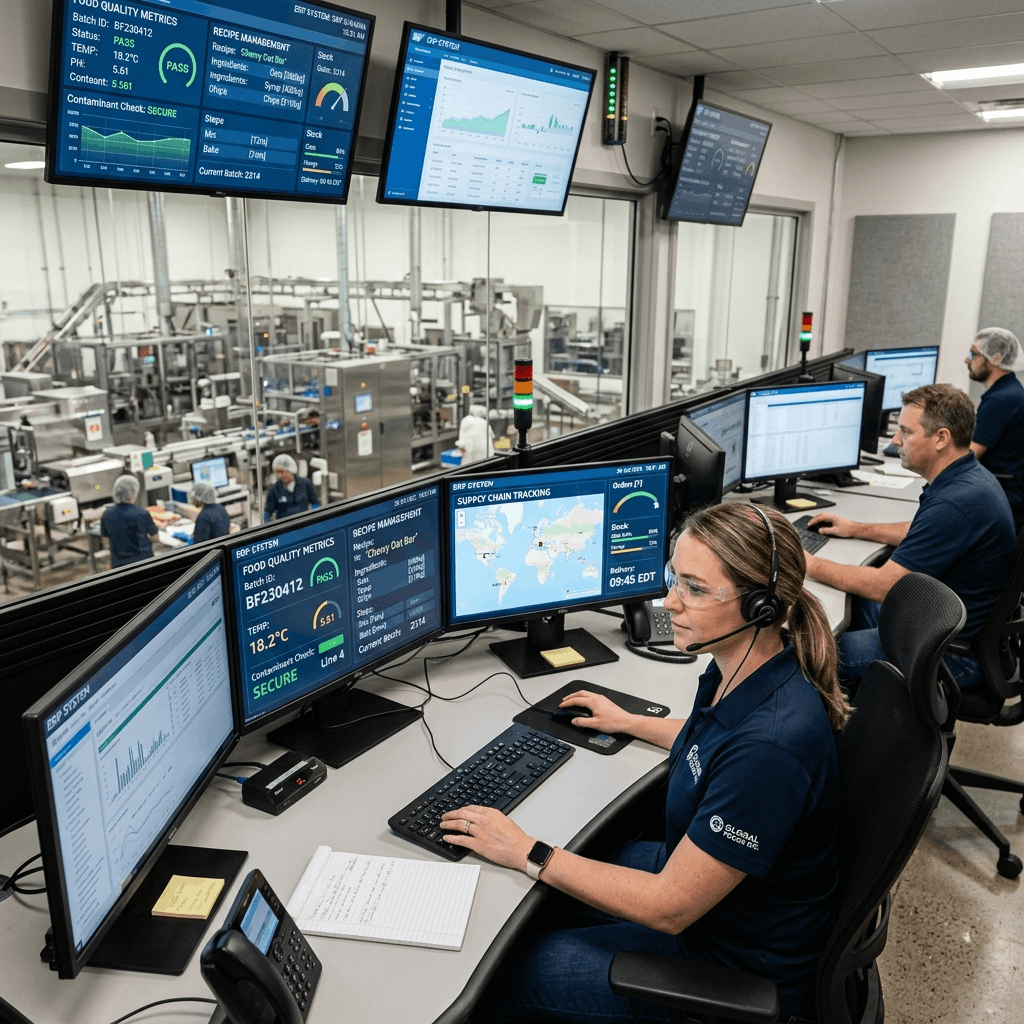
Why Generic Software Fails in the Food Industry
If you manufacture wooden tables, your raw materials do not rot. If you assemble computers, your finished goods do not carry the risk of poisoning your customers. The Food and Beverage (F&B) industry operates under a unique set of terrifying pressures: highly perishable inventory, draconian FDA regulations, fluctuating commodity prices, and razor-thin profit margins.
A generic business software package is built to count solid, unchanging widgets. It will fundamentally fail in a food manufacturing environment. To survive and scale, an F&B company must deploy a highly specialized Enterprise Resource Planning (ERP) system.
When evaluating a food ERP, there are specific functional pillars that must be present. Let's break down the top 10 key features that define a world-class Food ERP software.
Features 1-2: Traceability & Expiration Management
1. Bi-Directional Lot Traceability:
This is the single most critical feature of a Food ERP. If a supplier informs you that a specific batch of raw almonds was contaminated with salmonella, you must execute a rapid recall. "Bi-directional" means the ERP can trace forward and backward. You can enter the contaminated almond Lot ID, and the system will instantly trace forward to tell you exactly which finished granola bars contain those almonds, and which retail stores they were shipped to. Conversely, if a customer gets sick from a specific granola bar, you can trace backward to see exactly which farm the almonds came from.
2. FEFO (First Expired, First Out) Inventory Control:
Standard businesses use FIFO (First In, First Out). Food businesses must use FEFO. The ERP tracks the exact expiration date of every raw material in the warehouse. When a worker goes to pick milk for a recipe, the ERP's barcode scanner directs them to the specific pallet of milk that will expire the soonest, regardless of when it arrived on the dock. This drastically reduces massive financial losses caused by inventory spoilage.
Features 3-4: Recipes & Variable Weights
3. Dynamic Recipe and Formulation Management:
A recipe for 10 gallons of soup is easy. Scaling that recipe to 10,000 gallons requires complex chemistry. A Food ERP manages "Formulations" dynamically. When the production manager alters the desired batch size, the ERP automatically recalculates the exact weight or volume of every ingredient required. It also manages version control, ensuring the factory floor is never using last year's outdated recipe.
4. Catch Weight Management:
If you sell artisan cheese or wholesale meats, you do not sell exact, identical widgets. Every single block of cheese weighs a slightly different amount. The ERP handles "Catch Weight" by tracking the inventory by the "case" or "unit," but seamlessly billing the customer by the exact, decimal-point "poundage" recorded on the integrated warehouse scale. This ensures you never accidentally give away expensive product for free.
Features 5-6: Quality Control & Allergen Safety
5. Strict Allergen Segregation and Scheduling:
Cross-contamination is a massive liability. The ERP utilizes advanced planning to mitigate risk. It will automatically schedule peanut-free products to run on the machinery early in the week, and peanut products to run late in the week. It prevents scheduling errors that could lead to deadly cross-contamination.
6. Embedded Quality Control (QC) Checkpoints:
The ERP serves as a digital enforcer. During the production routing, the ERP will halt the system and force a worker to take a physical temperature reading of a cooking vat. The worker must enter that temperature into the tablet. If the temperature is below the safe threshold, the ERP locks the batch and alerts a supervisor, ensuring unsafe food never reaches the packaging line.
Features 7-8: Forecasting & Supply Chain Agility
7. AI-Driven Demand Forecasting:
Because food spoils, you cannot simply over-produce and let inventory sit in a warehouse. A Food ERP uses predictive analytics based on historical sales data, seasonality, and even weather patterns to predict exactly how much product you will sell next month. It then generates incredibly precise purchase orders to ensure you buy exactly the right amount of raw ingredients—no more, no less.
8. Multi-UOM (Unit of Measure) Conversions:
You might buy flour by the Ton, store it in a silo by the Pound, consume it in a recipe by the Ounce, and sell the finished bread by the Dozen. A Food ERP performs these complex mathematical conversions instantly and automatically in the background, ensuring absolute inventory accuracy.
Features 9-10: EDI Integration & Real-time Job Costing
9. Electronic Data Interchange (EDI) for Big Retail:
If a food manufacturer wants to sell their product to a massive grocery chain like Kroger or Whole Foods, they cannot use email. They must use EDI. An advanced Food ERP features native EDI integration, allowing it to seamlessly receive massive digital purchase orders from big-box retailers and transmit automated shipping notices back to them.
10. Real-Time Granular Job Costing:
Commodity prices fluctuate wildly. The price of eggs might spike 30% in a week. The ERP tracks the exact purchase price of the specific lot of eggs used in today's production run. It then calculates a hyper-accurate, real-time Cost of Goods Sold (COGS). If the CFO sees that the profit margin on a cake has suddenly dropped to zero due to the egg price spike, they can instantly adjust wholesale pricing.
Conclusion: Protecting Your Brand
The Food and Beverage industry does not forgive mistakes. A single massive recall caused by a lost spreadsheet or a mixed-up dye lot can bankrupt a company and permanently destroy a brand's reputation.
Implementing a specialized Food ERP is not just an IT upgrade; it is a fundamental risk management strategy. By securing the 10 features outlined above, food manufacturers gain the total visibility, strict traceability, and automated efficiency required to scale safely and profitably.
At Delight ERP, we are dedicated to food safety and manufacturing efficiency. Our platform is engineered with the strict FEFO inventory, rapid lot traceability, and dynamic recipe management tools required to protect your brand and dominate the F&B industry.
Streamline operations, reduce costs, and scale faster with Delight ERP.