
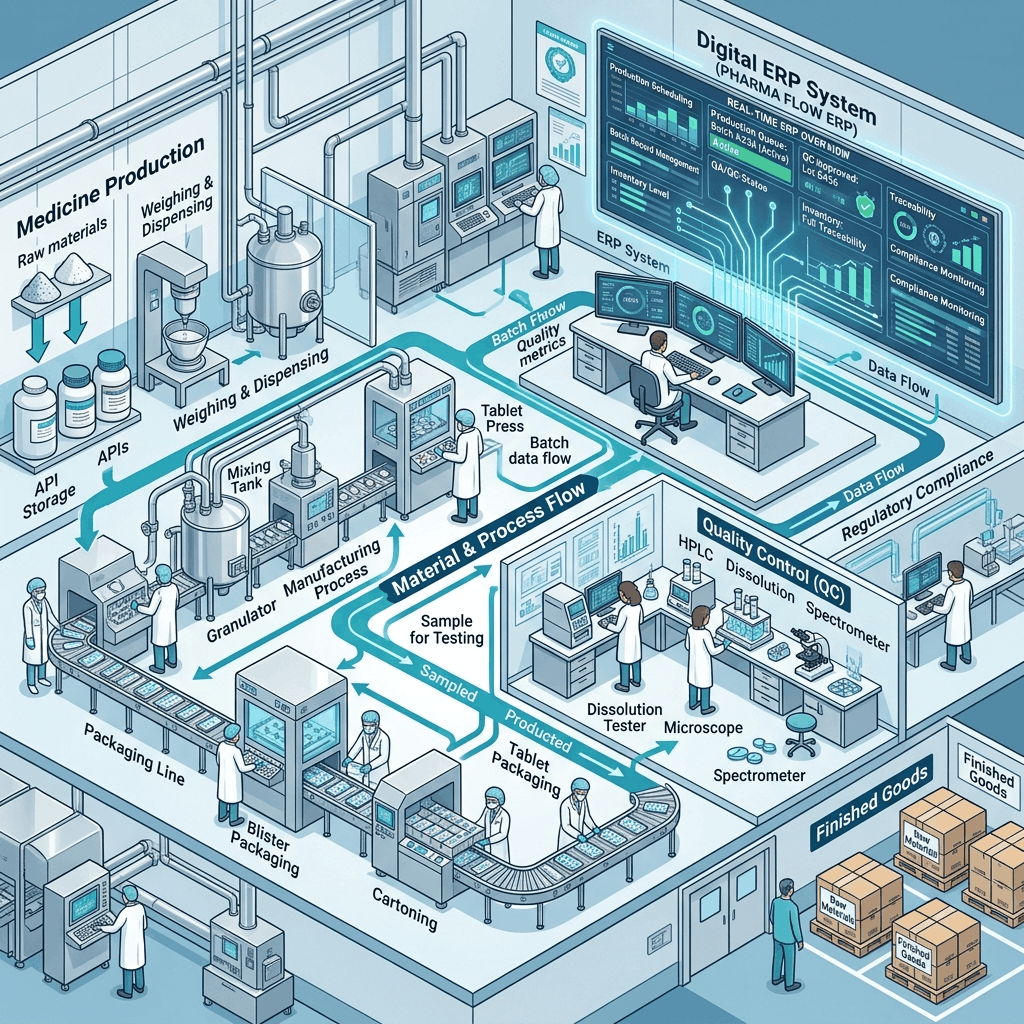
The High Stakes of Pharmaceutical Manufacturing
Unlike almost any other industry, the pharmaceutical sector operates with zero margin for error. If a furniture manufacturer makes a mistake, a customer receives a wobbly chair. If a pharmaceutical manufacturer makes a mistake, lives are immediately put at risk.
Because the stakes are so high, pharmaceutical companies operate under the most stringent regulatory microscopes in the world. Organizations like the US Food and Drug Administration (FDA), the European Medicines Agency (EMA), and various national bodies impose massive fines—and even criminal charges—for deviations in quality control, improper documentation, or lack of traceability.
Managing this immense complexity using spreadsheets, disparate accounting software, or generic manufacturing tools is not just inefficient; it is a profound legal liability. To survive and scale, pharmaceutical companies require highly specialized Enterprise Resource Planning (ERP) software designed specifically for the unique rigors of chemical formulation and biomedical compliance. Here are the top four reasons why.
Reason 1: Uncompromising Regulatory Compliance & Quality Control
In pharma, compliance is not an afterthought; it is the core driver of the business. Good Manufacturing Practices (GMP) require that every single action taken on the factory floor is documented, verified, and secured.
A specialized pharmaceutical ERP acts as the ultimate digital enforcer of these regulations. It replaces physical clipboards with rigorous digital workflows. For example, before a worker can mix a batch of Active Pharmaceutical Ingredients (APIs), the ERP can force them to complete a digital checklist verifying the cleanliness of the mixing vat.
Furthermore, ERP systems provide Electronic Signatures (21 CFR Part 11 compliance). When a Quality Assurance (QA) manager approves a batch for release, they must digitally sign it within the system. This creates a permanent, immutable digital audit trail. When FDA auditors arrive, the company does not scramble to find physical binders of paperwork; they simply pull up the ERP dashboard, proving absolute compliance in seconds.
Reason 2: Ironclad Master Recipe and Formula Management
Standard manufacturers deal in "Bills of Materials" (BOM)—a simple list of parts to build a bicycle. Pharmaceutical manufacturers deal in complex, volatile Master Recipes and Formulas.
A drug recipe is incredibly sensitive. The chemical ratios must be exact down to the microgram. Furthermore, these recipes are highly guarded intellectual property resulting from millions of dollars in R&D.
A pharma-specific ERP provides a secure Master Recipe Management module. It locks down the formulation so that a machine operator cannot accidentally (or intentionally) alter the chemical ratios. If the R&D team updates a formulation, the ERP utilizes strict version control, ensuring that only the newly approved version is used on the production floor while archiving the old version for historical auditing.
The system also manages "yields" and "scalability." If a recipe is designed for a 100-liter vat, the ERP can automatically and precisely recalculate the chemical ratios if production needs to be scaled up to a 5,000-liter vat, eliminating dangerous human math errors.
Reason 3: Precision Expiration Management and Batch Traceability
Inventory management in pharma is uniquely challenging because chemicals degrade. Using an expired API in a drug compound is a catastrophic failure.
A generic ERP uses "First-In, First-Out" (FIFO) logic for inventory. A pharma ERP uses First-Expired, First-Out (FEFO) logic. The system actively tracks the exact shelf life of every chemical drum in the warehouse. When an operator is instructed to retrieve materials, the ERP directs them to the exact barcode of the batch that is closest to expiring (but still safe). If an operator tries to scan an expired barrel, the software instantly blocks the transaction and stops production.
Equally critical is Bidirectional Batch Traceability. If a chemical vendor notifies you that a specific batch of raw powder was contaminated, a pharma ERP can trace that exact batch forward through your entire manufacturing process to identify exactly which finished bottles of medicine contain the contaminant, allowing for a surgical, highly targeted product recall rather than recalling an entire year's worth of product.
Reason 4: Cost Control and Pricing Agility
While compliance is the priority, pharmaceutical companies are still businesses that must maintain profitability. The cost of raw chemical APIs fluctuates wildly based on global supply chains.
An ERP system integrates the factory floor directly with the finance department. When the procurement team purchases a batch of raw materials at a higher-than-average price, the ERP automatically tracks those specific materials through production and recalculates the "Cost of Goods Sold" (COGS) for that specific batch of finished drugs.
This provides executive leadership with real-time visibility into their profit margins. If a critical ingredient triples in price due to global shortages, the ERP immediately flags the margin compression, allowing management to adjust distribution pricing, seek alternative approved suppliers, or pivot production to a more profitable product line.
Conclusion: Software as a Lifeline
In the pharmaceutical industry, software is no longer just a tool for accounting; it is a critical lifeline that protects the consumer from harm and the business from ruin.
Relying on fragmented systems guarantees blind spots, and in this highly regulated sector, blind spots lead to severe FDA warnings and massive product recalls. Implementing a robust, specialized ERP system provides the digital armor necessary to manufacture life-saving products safely, efficiently, and profitably at scale.
At Delight ERP, we understand the incredible complexity of process manufacturing. Our software is designed to handle intricate formulations, enforce strict quality control, and provide the bulletproof traceability required to thrive in the modern pharmaceutical landscape.
Streamline operations, reduce costs, and scale faster with Delight ERP.