
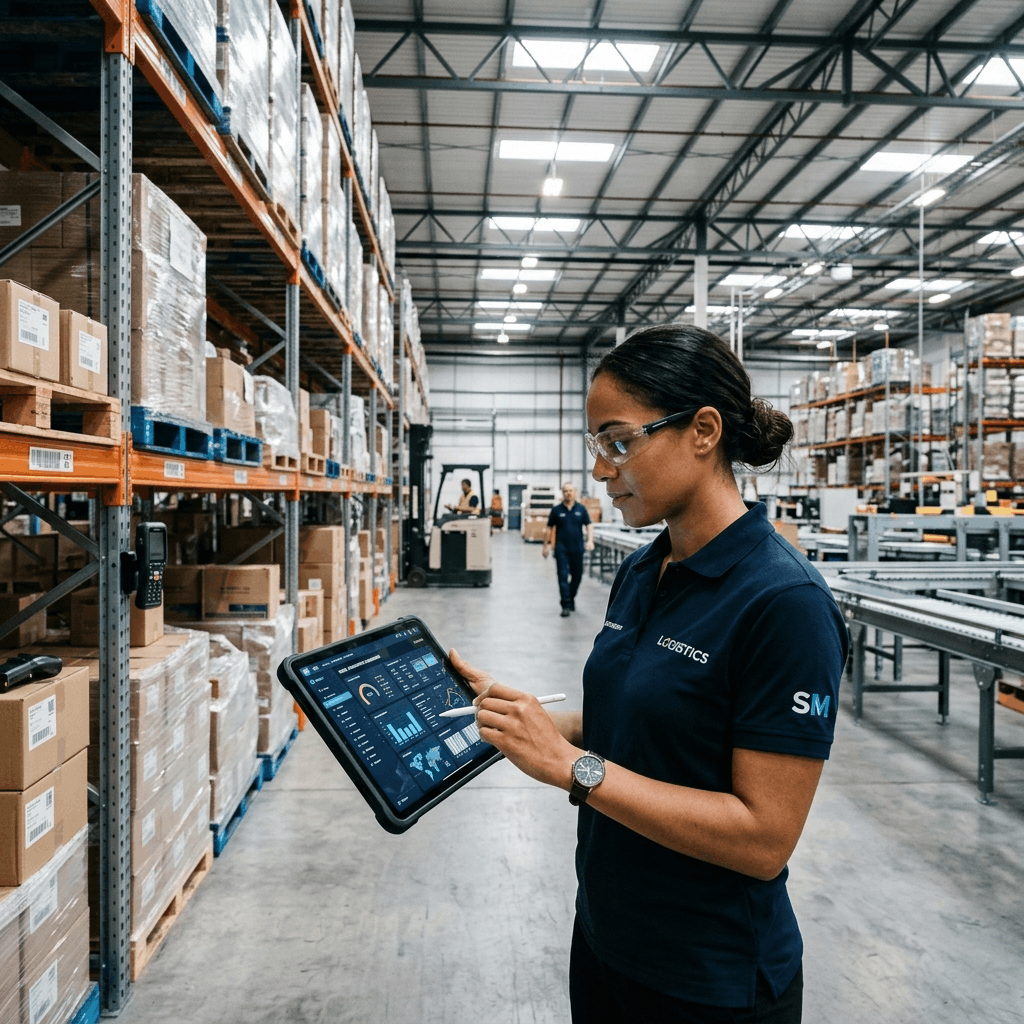
The Heartbeat of the Business: Inventory
For product-centric businesses—whether in manufacturing, wholesale distribution, or retail—inventory is not just a line item on a balance sheet. It is the physical manifestation of the company's working capital. Inventory is the heartbeat of the business; if it stops flowing smoothly, the company dies.
Historically, managing this vital resource was incredibly difficult. Warehouse managers relied on a combination of handwritten ledgers, disconnected spreadsheets, and annual physical stock counts. This resulted in a dangerous lack of visibility. Companies frequently found themselves in one of two nightmare scenarios: they either ordered far too much stock, tying up crucial cash flow in goods that wouldn't sell, or they ordered too little, resulting in stockouts, halted production lines, and furious customers.
To scale rapidly without descending into logistical chaos, modern businesses must abandon manual methods. They must adopt Enterprise Resource Planning (ERP) software. Let's explore the top benefits of using a unified ERP system to master inventory management.
Benefit 1: Unprecedented Real-Time Stock Visibility
The most immediate and powerful benefit of implementing an ERP system is absolute visibility. In a manual system, your "current" stock levels are usually 24 to 48 hours out of date because they rely on batch data entry at the end of the day.
An ERP system operates in genuine real-time. When a warehouse worker scans a barcode to receive a pallet of goods, the inventory count in the central database increments instantly. When a salesperson halfway across the country clicks "Submit Order" on their laptop, the inventory count instantly decrements.
This means that any manager, anywhere in the world, can log into the ERP dashboard and see the exact, second-by-second truth regarding what is on the shelves, what is in transit, and what has already been promised to customers. This visibility entirely eliminates the guesswork that leads to disastrous purchasing decisions.
Benefit 2: Automated Replenishment and Procurement
In a growing business, the procurement team can easily become overwhelmed trying to track hundreds or thousands of individual SKUs (Stock Keeping Units). If they forget to reorder a single critical component, an entire manufacturing run can grind to a halt.
ERP software eliminates human error through automation. A manager can configure specific "reorder points" for every item in the inventory. For example, the system can be told: "If the stock of Item X drops below 50 units, immediately order 200 more."
When that threshold is breached, the ERP does not just send an alert. It can automatically generate a Purchase Order, select the vendor with the best negotiated pricing from the database, and email the PO directly to the supplier without a human ever touching a keyboard. This ensures that fast-moving items are always in stock.
Benefit 3: AI-Driven Demand Forecasting
Knowing exactly what you have in stock right now is only half the battle. To be truly successful, you must know what you will need to have in stock three months from now.
Old-school inventory management relied on the "min-max" method or simple historical averages, which are useless in rapidly changing markets. Modern ERP systems feature sophisticated demand forecasting engines. They ingest years of historical sales data, overlay upcoming marketing campaigns scheduled by the sales team, and analyze macroeconomic seasonal trends.
The system uses these massive datasets to generate incredibly precise predictions of future customer demand. It ensures that you order exactly enough raw materials to fulfill future orders, preventing you from overspending on inventory that will end up sitting in the warehouse collecting dust.
Benefit 4: Centralized Multi-Warehouse Management
As businesses grow, they rarely confine their operations to a single building. They open regional distribution centers, utilize third-party logistics (3PL) warehouses, or even manage retail storefronts. Tracking stock across multiple disparate locations is a nightmare without central software.
An ERP system is inherently designed to manage limitless locations. It allows you to view your inventory globally, regionally, or drill down to a specific bin number in a specific aisle of a specific warehouse in Chicago.
Crucially, it allows for intelligent order routing. If a customer in New York places an order, the ERP will automatically fulfill that order from the closest warehouse holding the stock, minimizing shipping times and slashing freight costs. If one warehouse is running low on a product while another has a surplus, the system will automatically recommend an inter-warehouse transfer rather than ordering new stock from the supplier.
Benefit 5: Drastic Reduction in Holding Costs
Holding excess inventory is incredibly expensive. You are not only tying up cash that could be used to hire new staff or invest in R&D, but you are also paying for the square footage to store it, the insurance to protect it, and suffering the costs of depreciation if the item expires or becomes obsolete.
By combining real-time visibility, automated replenishment, and precision demand forecasting, an ERP allows businesses to adopt "lean inventory" strategies. You can drastically lower your safety stock levels because you trust the system to reorder precisely on time.
It is not uncommon for companies implementing an ERP system to reduce their overall inventory holding costs by 20% to 30% within the first year, resulting in a massive influx of freed-up cash flow.
Benefit 6: Complete End-to-End Traceability
For industries like food and beverage, pharmaceuticals, and aerospace manufacturing, knowing how many items you have is not enough; you must know exactly where each specific item came from.
ERP systems provide complete end-to-end traceability using serial numbers and batch/lot numbers. If a supplier notifies you that a specific batch of raw materials they shipped you was defective, the ERP can instantly trace that specific batch.
Within seconds, the system will tell you exactly which finished products that defective material was used in, which warehouse currently holds those products, and—most importantly—which customers have already received them. This turns what would be a chaotic, weeks-long product recall into a targeted, surgical operation that protects both your customers and your brand reputation.
Why Standalone Systems Are No Longer Sufficient
Many business owners mistakenly believe they can solve their problems by purchasing a standalone "Inventory Management" app. While these apps are better than spreadsheets, they create a massive fundamental problem: Data Silos.
A standalone app only manages the warehouse. It does not talk to your accounting software. It does not talk to your CRM. It does not talk to your manufacturing floor. When a warehouse worker adjusts a stock count in a standalone app because an item broke, the accounting department's balance sheet does not automatically update to reflect the financial loss. An accountant must manually re-enter that data at the end of the month.
An ERP system unifies the entire business. When inventory moves, the financial ledger updates instantly. When sales close a deal, procurement is immediately notified. The supply chain acts as one unified organism.
Transforming Inventory from a Liability into an Asset
In today's hyper-competitive landscape, you cannot afford to have capital trapped in dead stock on warehouse shelves, nor can you afford to lose customers to competitors because you couldn't fulfill an order.
Implementing an ERP system transforms your inventory management from a chaotic, reactive nightmare into a strategic, proactive advantage. It gives you the tools to optimize your cash flow, drastically reduce overhead, and deliver exceptional service to your customers every single time.
At Delight ERP, our comprehensive platform is built to handle the complexities of modern inventory networks. From advanced barcode scanning integrations to AI-driven forecasting algorithms, our software empowers you to take absolute control of your supply chain and aggressively scale your business.
Streamline operations, reduce costs, and scale faster with Delight ERP.