
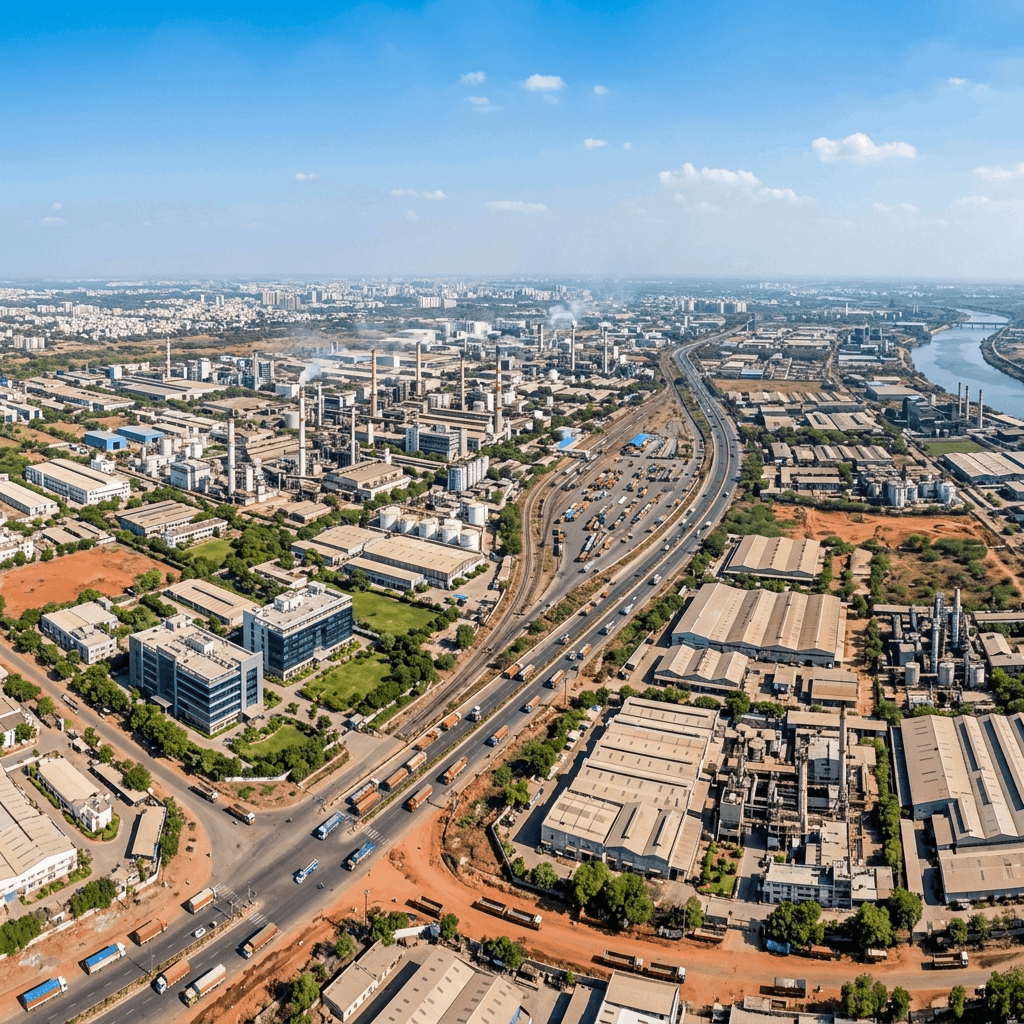
Ahmedabad — the commercial capital of Gujarat and India's fifth-largest city — is one of the most diversified industrial hubs in the country. Historically celebrated as the "Manchester of India" for its thriving textile mills, the city has rapidly evolved into a multi-sector manufacturing powerhouse. From pharmaceuticals and automotive to engineering and chemicals, the industrial belts surrounding Ahmedabad contribute over ₹3 lakh crore to India's manufacturing GDP annually.
Whether you are a B2B supplier looking to tap into Gujarat's industrial ecosystem, a manufacturer evaluating the region for expansion, or a business owner exploring ERP solutions to scale your Ahmedabad-based operations — this comprehensive guide covers the top manufacturing sectors, key companies, industrial zones, and the technology driving growth in this region.
Why Ahmedabad Is Gujarat's Industrial Powerhouse
Ahmedabad's industrial dominance is not accidental — it is the result of over a century of entrepreneurial culture, strategic government policies, and geographical advantages. The city sits at the crossroads of national highways connecting Delhi, Mumbai, and the Kandla/Mundra ports on the western coast, making it a natural logistics hub for manufacturing and export.
Several factors have made Ahmedabad one of India's top manufacturing destinations:
- Entrepreneurial Culture: Gujarat has one of the highest rates of entrepreneurship in India. The Ahmedabad region alone has over 15,000 registered manufacturing units — from large-cap multinationals to mid-market SMBs.
- Government Incentives: The Gujarat Industrial Policy offers capital subsidies, interest subsidies, and tax exemptions for new manufacturing units. Special Investment Regions (SIRs) like Mandal-Becharaji provide plug-and-play infrastructure.
- Port Proximity: Mundra Port (India's largest private port) and Kandla Port are within 350 km, making export logistics cost-effective. This is critical for the pharma and chemical industries that export 40–60% of production.
- Skilled Labour Pool: Engineering colleges, ITIs, and polytechnics across Gujarat produce a steady pipeline of skilled technical workers for the manufacturing sector.
- Power & Infrastructure: Gujarat has among the lowest industrial power tariffs in India and reliable electricity supply — crucial for continuous manufacturing operations.
Key Industrial Zones Around Ahmedabad
The manufacturing ecosystem around Ahmedabad is organized into well-defined industrial zones, each specializing in specific sectors. Understanding this layout is essential for B2B suppliers, logistics companies, and manufacturers evaluating the region.
| Industrial Zone | Distance from Ahmedabad | Primary Industries | Key Companies |
|---|---|---|---|
| Sanand | 25 km | Automotive, Electronics | Tata Motors, Suzuki, Ford (now Tata) |
| Changodar | 20 km | Engineering, Chemicals | Symphony, Thermax, Gujarat Fluorochemicals |
| Naroda | 12 km | Textiles, FMCG, Packaging | Arvind, Rasna |
| Odhav | 10 km | Heavy Machinery, Auto Parts | Gujarat Machine Tools, Jyoti CNC |
| Vatva | 15 km | Chemicals, Dyes, Pigments | Atul Ltd, GNFC units |
| Moraiya | 20 km | Pharmaceuticals, Biotech | Zydus, Intas, Claris |
| Mandal-Becharaji (MBSIR) | 80 km | Automotive, Defence, Electronics | Suzuki Motor Gujarat, Hitachi |
Each zone has its own GIDC (Gujarat Industrial Development Corporation) infrastructure with dedicated power substations, effluent treatment plants, and common facility centres. For manufacturers setting up operations, the choice of zone depends on the industry vertical, supply chain proximity, and labour availability.
The Pharmaceutical Giants
Ahmedabad is the undisputed pharmaceutical capital of India. The region accounts for over 35% of India's total drug manufacturing and a significant share of pharmaceutical exports. Companies headquartered here produce everything from generic medicines and vaccines to complex Active Pharmaceutical Ingredients (APIs) and biosimilars.
Zydus Lifesciences (formerly Cadila Healthcare)
One of India's largest pharmaceutical companies, Zydus operates massive manufacturing and R&D facilities across the Ahmedabad region. Their portfolio spans generics, biosimilars, vaccines (including ZyCoV-D — the world's first plasmid DNA COVID-19 vaccine), and consumer wellness products. With over 25,000 employees and operations in 50+ countries, Zydus is a cornerstone of Ahmedabad's pharmaceutical ecosystem.
Torrent Pharmaceuticals
A dominant player in the cardiovascular, CNS, and gastro-intestinal segments, Torrent Pharmaceuticals operates state-of-the-art manufacturing plants in the Ahmedabad region. The company has grown to become one of India's top 10 pharma companies by revenue, with a strong presence in branded generics across India, Brazil, and Germany.
Intas Pharmaceuticals
A rapidly growing global pharma giant, Intas has a massive manufacturing footprint in the Special Economic Zone (SEZ) near Ahmedabad. The company specialises in oncology, immunology, and ophthalmology products and has expanded aggressively into regulated markets like the US, UK, and EU.
Claris Lifesciences (now part of Baxter International)
Claris was a pioneer in sterile injectable manufacturing in India. Acquired by Baxter International, their Ahmedabad facility continues to be a major production hub for IV fluids, injectable drugs, and nutritional products for global markets.
The Automotive Hub of Sanand
The industrial estate of Sanand, located just 25 kilometres southwest of Ahmedabad, famously transformed when Tata Motors relocated their Nano plant there in 2008. What started as a single factory has since become a ₹50,000+ crore automotive ecosystem with global OEMs and over 100 Tier-1 and Tier-2 suppliers.
Tata Motors
Tata Motors operates a massive vehicle manufacturing facility at Sanand, producing passenger vehicles and driving an extensive ecosystem of auto component suppliers. The plant has expanded significantly beyond the original Nano project, now assembling multiple vehicle models including electric vehicles (EVs) under the Tata brand.
Suzuki Motor Gujarat (Maruti Suzuki)
Located in the Mandal-Becharaji Special Investment Region (MBSIR), Suzuki Motor Gujarat's plant is one of the most technologically advanced automotive facilities in India. With a production capacity of 750,000 vehicles per year, this facility supplies vehicles to Maruti Suzuki India and exports to international markets.
Ford India (Acquired by Tata Motors)
The massive Ford engine and vehicle assembly plant in Sanand was acquired by Tata Motors, further consolidating the region's automotive dominance. The plant continues to serve as a manufacturing hub for powertrains and components.
The Auto Ancillary Ecosystem
The real story of Sanand is not just the OEMs — it's the massive ecosystem of component manufacturers that has grown around them. Companies like Minda Industries, Motherson Sumi, Bosch, and Continental have set up plants in the Sanand-Viramgam belt to supply the OEMs. These ancillary manufacturers handle everything from stamped sheet metal parts and plastic mouldings to wiring harnesses and electronic control units.
Engineering, Machinery & Heavy Industry
Supporting the auto and pharma sectors is a robust heavy engineering and machinery manufacturing sector, primarily concentrated in the Changodar and Odhav industrial areas.
Symphony Limited
Headquartered in Ahmedabad, Symphony is the world's largest manufacturer of air coolers. The company produces over 1 million cooling units annually, exported to 60+ countries. Their Ahmedabad facility is a model of lean manufacturing with automated assembly lines and IoT-enabled quality control.
Elecon Engineering (Anand region)
While slightly south of Ahmedabad in the Anand district, Elecon is a dominant player in industrial gear manufacturing and material handling equipment. They are closely tied to the Ahmedabad industrial ecosystem, supplying gears and conveyors to cement plants, power stations, and mining operations across India.
Adani Group — Manufacturing Arms
The Adani Group, headquartered in Ahmedabad, has expanded its manufacturing presence significantly. Their manufacturing arms include solar panel manufacturing (Adani Solar — one of India's largest PV cell manufacturers), edible oil processing (Adani Wilmar — Fortune brand), copper smelting, and defence manufacturing. The conglomerate's industrial investments in and around Ahmedabad exceed ₹25,000 crore.
Jyoti CNC Automation
One of India's leading CNC machine manufacturers, Jyoti CNC operates from the Rajkot-Ahmedabad corridor. Their high-precision CNC turning centres, vertical machining centres, and 5-axis machines are used by automotive, aerospace, and defence manufacturers across India.
For engineering and machinery manufacturers managing complex bills of materials, multi-stage production processes, and stringent quality requirements, a dedicated manufacturing ERP software is essential to track WIP (work-in-progress), manage job costing, and ensure on-time delivery.
The Legacy of Textiles: From Mills to Modern Manufacturing
Textiles remain a massive employer in the Ahmedabad region. The city earned its "Manchester of India" title in the early 20th century when dozens of cotton mills operated along the banks of the Sabarmati River. While many of the old mills have closed, the textile industry has reinvented itself — moving from traditional mills to highly automated spinning, weaving, dyeing, and garment manufacturing setups.
Arvind Limited
One of the world's largest manufacturers of denim, Arvind Limited is headquartered in Ahmedabad. Their massive facilities handle the complete textile value chain — from spinning raw cotton to producing finished branded apparel. Arvind produces over 120 million metres of fabric annually and supplies global brands including Gap, Tommy Hilfiger, and Calvin Klein.
Nandan Denim
Another major denim manufacturer operating from Ahmedabad, Nandan Denim has grown to become one of the top 3 denim manufacturers in India. Their vertically integrated facility handles spinning, weaving, dyeing, and finishing — all under one roof.
Welspun Group — Home Textiles
While headquartered in Mumbai, Welspun has significant manufacturing operations in Gujarat. The group is the world's second-largest terry towel manufacturer, with massive plants producing for brands like Walmart, Target, and Costco.
Chemicals, Dyes & FMCG Manufacturing
The Vatva and Naroda industrial areas are home to India's largest cluster of chemical, dye, and pigment manufacturers. This sector has deep historical roots — Ahmedabad's textile industry created the demand for dyes and chemicals, which eventually became an independent industry of its own.
Key Chemical Manufacturers
- Gujarat Fluorochemicals (GFL): A major producer of refrigerant gases, fluoropolymers, and caustic soda, with manufacturing operations near Ahmedabad.
- Atul Ltd: One of India's largest chemical companies, producing a diverse range of specialty chemicals, dyes, and agrochemicals from plants in Gujarat.
- Rasna International: The iconic Indian beverage brand is headquartered in Ahmedabad, with manufacturing plants producing instant drink concentrates, juices, and dairy products.
FMCG & Food Processing
Ahmedabad has also emerged as a significant FMCG hub, with companies like Adani Wilmar (Fortune oil), Amul (Anand cooperative network), and several snack food manufacturers operating in the region. Gujarat's agricultural output — including cotton, groundnuts, castor, and dairy — provides abundant raw material for food processing and FMCG manufacturing.
Chemical and FMCG manufacturers require ERP systems with batch tracking, FSSAI compliance, shelf-life management, and multi-unit inventory. Delight ERP's custom ERP solutions are designed to handle these industry-specific requirements with native GST compliance.
How ERP Software Powers Ahmedabad Manufacturers
With over 15,000 manufacturing units operating in the Ahmedabad region, the competition for efficiency, quality, and cost control is intense. Manufacturers who still rely on spreadsheets, manual ledgers, or disconnected software systems are increasingly losing ground to competitors who have adopted integrated ERP platforms.
Here's how ERP software is transforming manufacturing operations across Ahmedabad's industrial zones:
| Manufacturing Challenge | How ERP Solves It | Typical Improvement |
|---|---|---|
| Production planning bottlenecks | MRP-driven automated scheduling | 30–40% faster planning |
| Inventory overstock & stockouts | Reorder point automation, demand forecasting | 20–35% cost reduction |
| GST filing complexity | Auto GSTR-1/3B, e-invoicing, e-way bills | 80–90% time saved |
| Quality control failures | In-process QC checkpoints, batch traceability | 40–60% defect reduction |
| Disconnected sales teams | Mobile CRM with GPS tracking, real-time orders | 25% more sales visits |
| Multi-location coordination | Unified database across factory, warehouse, office | Real-time visibility |
Key ERP Modules for Ahmedabad Manufacturers
- Manufacturing ERP: Bill of Materials, MRP, production orders, shop floor control, job costing, and quality management.
- Supply Chain Management: Vendor management, purchase orders, goods receipt, and logistics coordination across multi-location operations.
- CRM & Sales Management: Lead tracking, quotation management, dealer/distributor management, and field sales mobile app with GPS.
- Production Management: Work order management, capacity planning, machine scheduling, and real-time WIP tracking.
- Custom ERP Solutions: Industry-specific configurations for pharma (batch compliance), textiles (lot tracking), automotive (JIT delivery), and chemicals (hazmat handling).
Why Ahmedabad Is Ideal for Manufacturing Investment
For business owners and investors evaluating manufacturing locations in India, the Ahmedabad region offers a compelling combination of infrastructure, talent, government support, and market access. Here's a quick comparison with other major industrial centres:
| Factor | Ahmedabad | Pune | Chennai |
|---|---|---|---|
| Industrial Power Tariff | ₹5.5–6.5/kWh | ₹8–10/kWh | ₹7–9/kWh |
| Average Industrial Land Cost | ₹3,000–5,000/sq.m | ₹8,000–15,000/sq.m | ₹6,000–12,000/sq.m |
| Port Distance (Major) | 350 km (Mundra) | 180 km (JNPT) | 60 km (Chennai Port) |
| State Capital Subsidy | Up to 12% | Up to 7% | Up to 5% |
| Ease of Business Rank | Top 5 | Top 10 | Top 10 |
| ERP Adoption Rate (SMBs) | ~45% | ~55% | ~50% |
The upcoming Delhi-Mumbai Industrial Corridor (DMIC), which passes through Gujarat, is expected to further boost manufacturing investment in the Ahmedabad region. The Dholera Special Investment Region (SIR), located 100 km from Ahmedabad, is being developed as a greenfield industrial city with world-class infrastructure — potentially adding another ₹1 lakh crore of manufacturing capacity to the region.
Conclusion
The Ahmedabad region is a microcosm of India's industrial capability — from century-old textile legacy to cutting-edge automotive and pharmaceutical manufacturing. For B2B suppliers, understanding the layout of these industrial clusters — from the pharma parks in Moraiya to the auto hubs in Sanand to the chemical complexes in Vatva — is critical for tapping into the immense wealth and growth generated by Gujarat's "Factory Region."
As competition intensifies and compliance requirements (GST, e-invoicing, quality certifications) become more demanding, Ahmedabad manufacturers who invest in integrated technology platforms like Delight ERP are positioning themselves for long-term growth. The manufacturers winning in 2026 are those treating technology as a strategic advantage — not just an operational tool.
Whether you're a pharma manufacturer in Moraiya needing batch compliance, an auto parts supplier in Sanand managing JIT delivery, or a textile producer in Naroda tracking dye lots — the right ERP system transforms your operations from reactive firefighting to proactive, data-driven decision making.
Streamline operations, reduce costs, and scale faster with Delight ERP.