
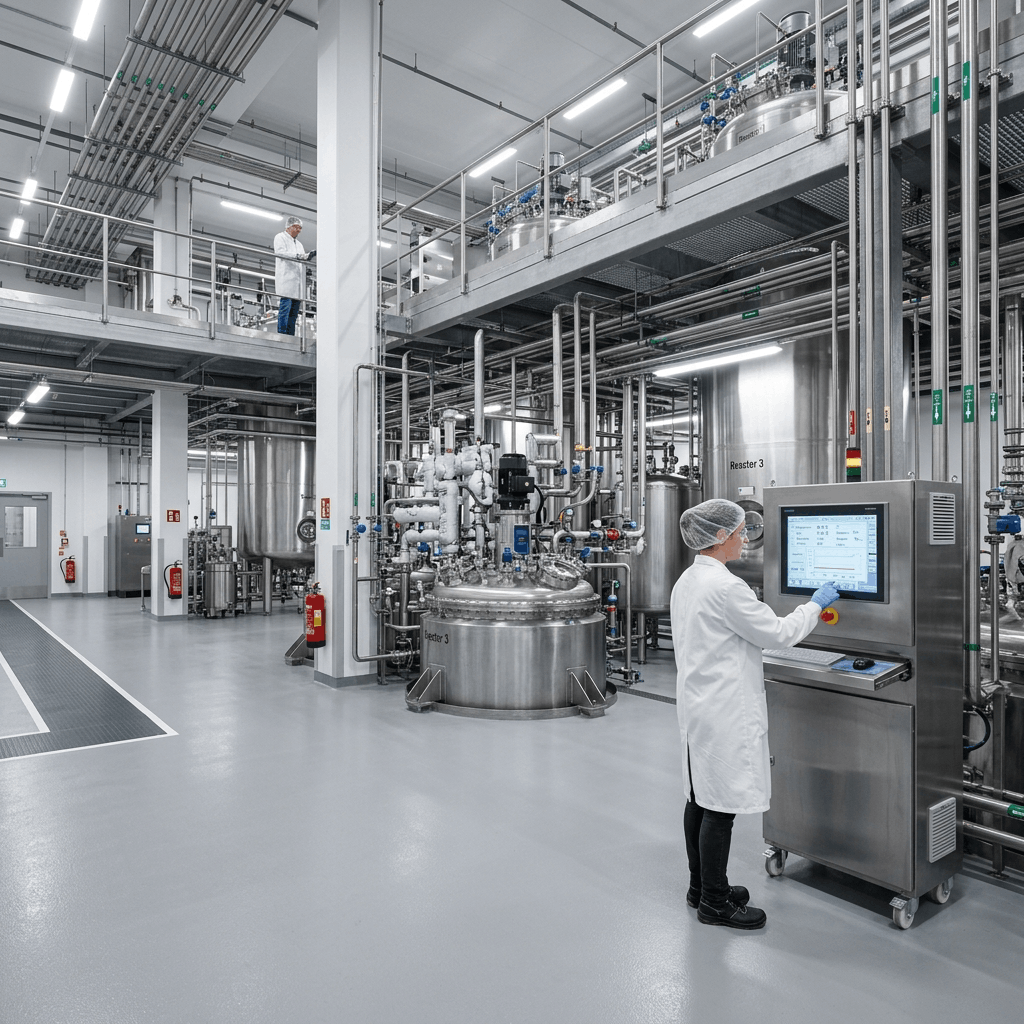
If you build bicycles, you know exactly how many wheels, gears, and handlebars you need to assemble 100 bikes. This is discrete manufacturing — and a standard ERP handles it well. But what if you manufacture paint, craft beer, pharmaceutical syrups, or chemical solvents? You deal in litres, grams, temperature curves, chemical reactions, and variable yields. This is process manufacturing, and it presents a completely different set of operational challenges that a standard ERP system simply cannot solve.
Process manufacturing accounts for over 40% of India's total manufacturing output, covering industries from food & beverage and pharmaceuticals to chemicals, paints, cosmetics, and petroleum. Yet many Indian process manufacturers still run on discrete ERP systems or, worse, spreadsheets — losing millions annually to yield variations, failed batches, compliance penalties, and expired inventory. This guide examines the 8 critical challenges unique to process manufacturing and exactly how specialized Process Manufacturing ERP software solves each one.
Process vs Discrete Manufacturing: The Core Difference
Before diving into the challenges, it's critical to understand why process manufacturing is fundamentally different from discrete manufacturing — and why this difference demands specialized software.
| Aspect | Discrete Manufacturing | Process Manufacturing |
|---|---|---|
| Production Input | Parts, components, assemblies | Raw ingredients, chemicals, liquids |
| Production Method | Assembly (bolt, weld, screw) | Mixing, blending, heating, reacting |
| Planning Document | Bill of Materials (BOM) | Recipe / Formula / Formulation |
| Output Reversibility | Can disassemble back to parts | Cannot unmix once blended |
| Yield | Fixed (1 BOM = 1 product) | Variable (affected by moisture, purity, temperature) |
| By-Products | Rare | Common (co-products, by-products, waste) |
| Unit of Measure | Each, piece, unit | Kg, litre, ml, tonne (often dual UOM) |
| Shelf Life | Rarely an issue | Critical (FEFO rules required) |
| Regulatory Burden | Moderate | Heavy (FSSAI, FDA, GMP, NABL) |
| Examples | Cars, electronics, furniture | Food, pharma, chemicals, paint, cosmetics |
Managing Formulas and Recipes (Instead of BOMs)
In discrete manufacturing, a Bill of Materials (BOM) is rigid — 4 wheels, 1 frame, 2 pedals, always. In process manufacturing, you use a recipe or formula that must often be dynamically adjusted based on real-world conditions.
Consider a paint manufacturer: if the titanium dioxide pigment from this month's supplier has a slightly different particle size, the formula must be adjusted — more dispersant, longer mixing time, different viscosity target. Or consider a food manufacturer: if the wheat flour this season has a lower moisture content (say 11% instead of 13%), the recipe must automatically add more water to achieve the correct dough consistency.
How ERP Solves This
A Process Manufacturing ERP supports dynamic recipe management with:
- Recipe versioning: Multiple versions of the same formula, each linked to specific raw material grades or seasonal variations
- Scalable recipes: Automatic proportional scaling when batch sizes change (e.g., scaling a 100-litre recipe to 5,000 litres while maintaining correct ratios)
- Substitution rules: Pre-approved ingredient substitutions when a primary ingredient is unavailable (e.g., replacing palm oil with sunflower oil within defined limits)
- Potency and concentration tracking: For pharmaceutical and chemical manufacturers, the ERP adjusts ingredient quantities based on the actual potency of the incoming API or chemical lot
Strict Lot Traceability and Recall Management
Industries like food & beverage and pharmaceuticals are heavily regulated by entities like FSSAI (India), FDA (US), and EU GMP. If a batch of raw milk is contaminated with aflatoxins, you must trace exactly which finished cartons of yogurt contain that milk, exactly which distributors received those cartons, and exactly which retail stores are currently stocking them — all within hours, not weeks.
This is not optional. Under FSSAI regulations, food businesses must be able to complete a full traceability exercise within 4 hours of a recall notification. Failure to do so attracts penalties up to ₹5 lakh and potential licence suspension.
How ERP Solves This
A Process ERP tracks inventory at the lot and batch level throughout the entire production and distribution chain:
- Forward traceability: Starting from a raw material lot → which batches used it → which finished goods contain it → which customers received it
- Backward traceability: Starting from a customer complaint or finished goods batch → which raw materials were used → which supplier provided them → which other batches used the same raw material
- One-click recall execution: Instantly generate the list of affected customers, distributors, and retail outlets with exact quantities — turning a massive recall into a targeted 5-minute database query
Co-Product and By-Product Cost Allocation
When you refine crude oil, you don't just get petrol — you also get diesel, jet fuel, kerosene, LPG, and asphalt. When you process sugarcane, you get sugar, molasses, and bagasse. These are co-products (valuable secondary outputs) and by-products (low-value or waste outputs).
The accounting challenge is significant: how do you calculate the cost of petrol when one refining run produces six different products? A standard ERP assigns all production costs to a single output — which makes your cost calculations meaningless in a process manufacturing context.
How ERP Solves This
A Process ERP mathematically distributes costs across all outputs using configurable allocation methods:
- Weight-based allocation: Costs distributed proportionally by output weight (e.g., 60% of costs to sugar, 25% to molasses, 15% to bagasse)
- Market-value allocation: Costs distributed based on the market selling price of each co-product
- Hybrid allocation: Combining weight and value methods for more accurate costing
- By-product credit: Revenue from by-products (e.g., selling bagasse to paper mills) automatically credits the main product cost, reducing the effective cost of sugar production
This is essential for accurate margin analysis. Without proper co-product costing, a chemical manufacturer might believe Product A is profitable and Product B is a loss-maker — when in reality, both are profitable, but the cost allocation was wrong. Delight ERP's production management module handles multi-output costing natively.
Catch Weight and Variable Yield Management
If you process meat, cheese, or seafood, you buy raw material by the crate but sell it by the exact kilogram. A crate of chicken breasts might weigh 20 kg today and 21.5 kg tomorrow. This is known as "catch weight" — and it's a nightmare for standard ERP systems that assume one unit always equals one unit.
Variable yield compounds this problem further. A batch of 1,000 kg of raw tomatoes might produce 850 litres of tomato sauce on Monday but only 780 litres on Tuesday — because the tomatoes had higher water content. If your ERP assumes a fixed yield, your inventory records, cost calculations, and procurement plans will all be wrong.
How ERP Solves This
- Dual unit-of-measure tracking: Track inventory simultaneously in two units — number of crates for logistics, exact kilograms for invoicing
- Actual vs. standard yield tracking: The ERP records the expected yield from the recipe and the actual yield from the production run, calculating variance automatically
- Yield trend analysis: Over time, the ERP identifies patterns — e.g., tomatoes from Supplier A consistently yield 5% more sauce than Supplier B — enabling data-driven procurement decisions
- Automatic cost adjustment: When actual yield differs from standard yield, the ERP recalculates per-unit cost in real time, ensuring your pricing remains profitable
Shelf-Life, Expiry Date & FEFO Routing
Chemicals degrade. Food spoils. Pharmaceuticals lose potency. Managing perishable inventory is not just about profitability — it's about regulatory compliance and consumer safety. An expired product reaching a customer can result in FSSAI penalties, product liability lawsuits, and catastrophic brand damage.
How ERP Solves This
A Process ERP enforces FEFO (First-Expired, First-Out) picking rules in the warehouse:
- FEFO warehouse routing: Directs forklift drivers to pick the pallet of ingredients that will expire soonest, not just the pallet that arrived first (FIFO)
- Customer-specific shelf-life rules: A major retail chain might require 75% remaining shelf life on delivery. The ERP blocks shipments that don't meet this threshold, preventing costly rejections at the customer's receiving dock
- Expiry alerts and auto-quarantine: Ingredients approaching expiry are automatically flagged and quarantined, preventing them from entering production
- Shelf-life extension tracking: For products requiring re-testing (e.g., chemicals that can be retested and re-certified), the ERP manages the retest schedule and updated expiry dates
Indian food manufacturers using integrated supply chain management with FEFO routing report a 25–40% reduction in expired inventory write-offs within the first year of implementation.
In-Process Quality Control at Every Stage
In discrete manufacturing, you can inspect the finished product at the end of the line. If a car door doesn't fit, you reject that door. But in process manufacturing, you cannot wait until the end — if the chemical mixture is wrong at step two, the entire 5,000-litre batch is ruined. The raw materials, energy, and labour are all wasted.
This makes in-process quality control (IPQC) absolutely critical for process manufacturers. Every step of the production process must have defined quality parameters that are tested and verified before proceeding to the next step.
How ERP Solves This
A Process ERP integrates Quality Control checkpoints directly into the production routing:
- Mandatory QC gates: A machine operator cannot proceed to the heating phase until they log the pH level of the mixture and the system verifies it falls within the acceptable tolerance range (e.g., pH 6.8–7.2)
- Statistical Process Control (SPC): Real-time charts monitoring process variables (temperature, pressure, viscosity) against control limits, triggering alerts when a process is drifting out of specification
- Lab integration: Test results from the Quality Assurance lab (HPLC, spectroscopy, microbial counts) flow directly into the ERP, linking test data to specific batch numbers
- Non-conformance management: When a QC test fails, the ERP automatically creates a non-conformance report (NCR), quarantines the batch, and triggers a corrective action workflow
Regulatory Compliance: FSSAI, FDA & GMP
Process manufacturers operate under some of the most stringent regulatory frameworks in any industry. Non-compliance carries severe consequences — from financial penalties and production shutdowns to criminal liability for company directors.
Key Compliance Requirements by Industry
| Industry | Regulatory Body | Key Requirements | ERP Feature Needed |
|---|---|---|---|
| Food & Beverage | FSSAI | Batch traceability, HACCP documentation, labelling compliance | Lot tracking, QC checkpoints, label management |
| Pharmaceuticals | CDSCO / FDA | GMP compliance, batch records, stability testing | Batch genealogy, electronic batch records, expiry tracking |
| Chemicals | MoEFCC / PESO | Hazmat handling, SDS documentation, emission tracking | Material safety data, storage rules, waste tracking |
| Cosmetics | CDSCO / BIS | Ingredient declaration, stability testing, GMP | Formula management, batch traceability |
How ERP Solves This
- Electronic Batch Records (EBR): Complete digital record of every parameter, ingredient, test result, and operator action for each production batch — audit-ready at all times
- Automatic document generation: Certificates of Analysis (COA), Safety Data Sheets (SDS), and compliance declarations generated automatically from production data
- Audit trail: Every change to a recipe, batch record, or quality parameter is logged with timestamp and user ID — meeting 21 CFR Part 11 requirements for pharmaceutical manufacturers
- GST & e-invoicing: Full Indian tax compliance with automatic GSTR-1/3B generation, e-invoicing (IRN), and e-way bill integration
Delight ERP's Process Manufacturing ERP is built with Indian regulatory compliance at its core — supporting FSSAI traceability requirements, GST automation, and industry-standard quality documentation.
Process vs Discrete ERP: Feature Comparison
To clarify why a specialized Process ERP is essential, here's a direct feature comparison:
| Feature | Standard / Discrete ERP | Process Manufacturing ERP |
|---|---|---|
| Production planning | Bill of Materials (BOM) | Recipe / Formula with version control |
| Ingredient substitution | ❌ Not supported | ✅ Pre-approved substitution rules |
| Batch traceability | Basic serial number tracking | Full lot-level forward & backward trace |
| Co-product costing | ❌ Single output costing | ✅ Multi-output cost allocation |
| Catch weight | ❌ Fixed UOM | ✅ Dual UOM with variable weight |
| Shelf-life management | Basic expiry tracking | FEFO routing, customer shelf-life rules |
| In-process QC | End-of-line inspection | QC gates at every production step |
| Yield variance analysis | ❌ Not tracked | ✅ Actual vs standard yield with trend analysis |
| Potency/concentration | ❌ Not supported | ✅ Auto-adjusts recipe based on potency |
| Regulatory compliance | Basic | FSSAI, FDA, GMP, HACCP ready |
Choosing the Right Process Manufacturing ERP
When evaluating Process Manufacturing ERP systems for your Indian business, use this checklist:
- Recipe/formula management: Does it support dynamic recipes with versioning, scaling, and substitution rules?
- Batch traceability: Can it perform one-click forward and backward traceability at the lot level?
- Co-product costing: Does it support multi-output cost allocation with configurable methods?
- Catch weight: Can it handle dual units of measure with variable actual weights?
- Shelf-life management: Does it enforce FEFO rules and customer-specific shelf-life requirements?
- Quality control: Are QC checkpoints integrated into the production routing (not just end-of-line)?
- Regulatory readiness: Does it generate electronic batch records, COAs, and comply with FSSAI/FDA requirements?
- GST compliance: Does it support Indian GST (GSTR-1/3B, e-invoicing, e-way bills) natively?
- Industry experience: Does the vendor have proven implementations in your specific process industry?
- Mobile access: Can quality inspectors, warehouse staff, and plant managers access the system on mobile devices?
Built for Process Manufacturers
Delight ERP's Process Manufacturing module handles recipes, batches, traceability, QC, and GST — purpose-built for Indian food, pharma, and chemical manufacturers.
Explore Process ERP → Book Free DemoConclusion
Process manufacturers live in a world of variables — temperatures, yields, chemical reactions, shelf-life constraints, and regulatory mandates. Trying to force a discrete manufacturing ERP to manage a chemical plant, food factory, or pharmaceutical facility is an exercise in frustration that costs real money in failed batches, compliance penalties, and operational inefficiency.
By adopting an ERP built specifically for recipes, batches, and strict compliance — like Delight Process Manufacturing ERP — process manufacturers achieve the precision their industry demands. From dynamic recipe management and lot-level traceability to co-product costing and FEFO shelf-life routing, every feature is designed for the unique realities of mixing, blending, and reacting rather than assembling.
The Indian process manufacturing sector is growing at 12% annually. Companies investing in specialised ERP systems today are building the operational foundation for sustainable, compliant, and profitable growth. Whether you're a food processor in Pune, a chemical manufacturer in Vadodara, or a pharma company in Ahmedabad — the right Process ERP transforms your operations from reactive firefighting to data-driven precision.
Streamline operations, reduce costs, and scale faster with Delight ERP.