
If you have spent any time in the corporate world, you have undoubtedly heard the acronym "ERP" thrown around in board meetings, IT discussions, and financial planning sessions. It is often touted as a magical solution to all business woes, a "must-have" technology for any company trying to scale. However, despite its ubiquity, many professionals struggle to articulate exactly what an ERP system is, let alone explain how it actually functions beneath the surface.
In this comprehensive beginner's guide, we are stripping away the confusing technical jargon. We will define what Enterprise Resource Planning software is, explore the underlying mechanics of how it works, break down its core modules, and explain exactly why modern businesses simply cannot survive without it.
The Chaos of a Disconnected Business
To understand the value of an ERP, you must first understand the nightmare of a business operating without one. Imagine a growing manufacturing company. The sales team uses a standalone CRM to track customer orders. The warehouse uses a basic inventory software to track stock. The factory floor uses Excel spreadsheets to schedule production. And the finance team uses QuickBooks to manage the money.
None of these systems talk to each other. This creates "data silos." When a salesperson closes a massive deal, the warehouse does not automatically know they need to ship the product. The factory does not automatically know they need to manufacture more. The accounting team doesn't automatically know to generate an invoice. Employees must physically email, call, or manually re-type data from one system into another. This manual process is slow, expensive, and guarantees catastrophic human errors.
What Does ERP Actually Stand For?
ERP stands for Enterprise Resource Planning. It is a category of business management software—typically a suite of integrated applications—that an organization uses to collect, store, manage, and interpret data from many different business activities.
The goal of an ERP is to eliminate the disconnected chaos described above. Instead of having five different software programs for five different departments, an ERP replaces them all with one massive, unified system. Everyone in the company logs into the exact same software.
How Exactly Does an ERP System Work?
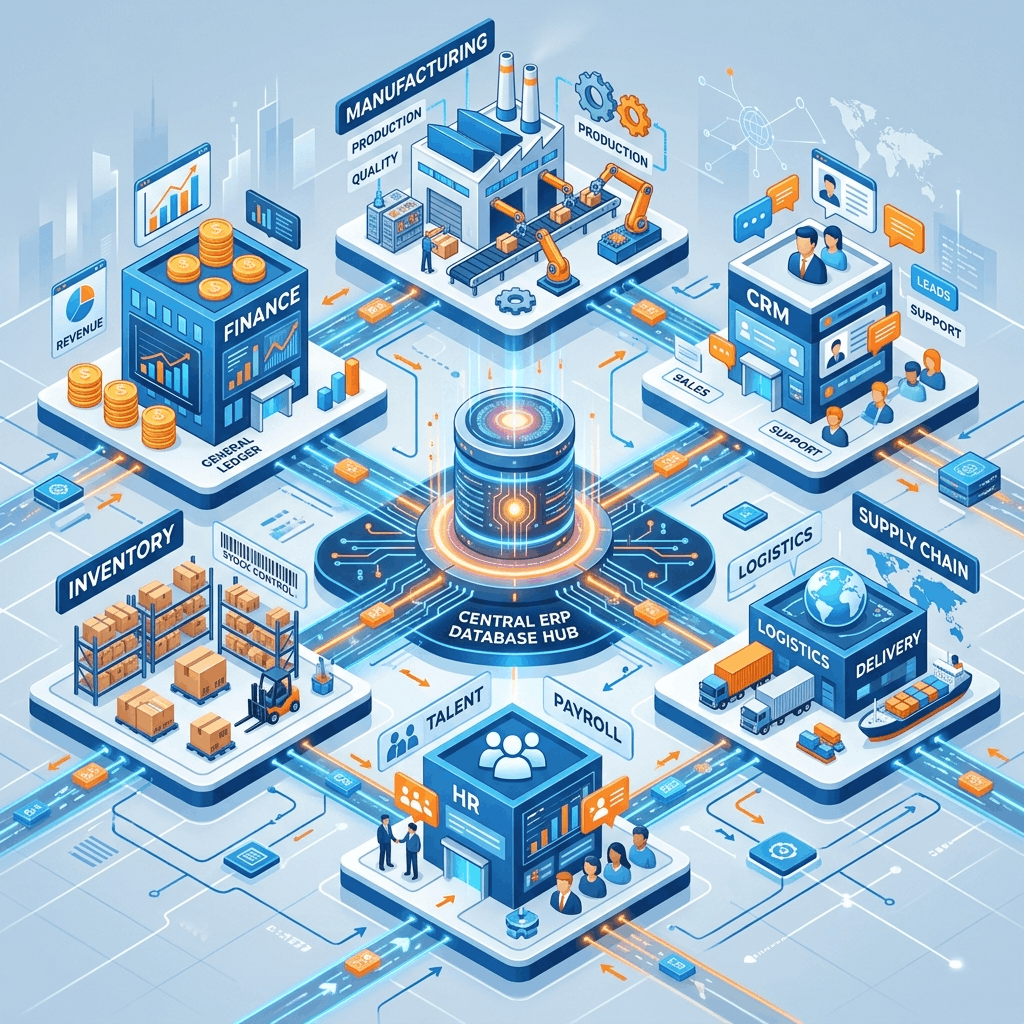
The fundamental secret behind how an ERP works lies in its architecture: The Centralized Database. This is the heart of the system.
In a standalone environment, the sales team has a database, and the warehouse has a separate database. In an ERP, there is only one database. When a salesperson enters a new order into the ERP, that data is instantly pushed to the central database. Because the warehouse is looking at the exact same database, their inventory levels automatically drop, and a shipping notification is instantly generated. Because the accounting team is looking at the exact same database, the accounts receivable ledger is automatically updated.
The software acts as the central nervous system of the enterprise. An impulse (data entry) in the hand (sales) is instantly registered by the brain (finance) and communicated to the legs (warehouse).
The Anatomy of an ERP: Core Modules
An ERP system is broken down into specific "modules" that handle the distinct functions of different departments. While these modules act like separate apps for the users, they are all intimately connected on the backend.
1. Financial Management & Accounting: This is the most critical module. It manages the general ledger, accounts payable/receivable, fixed assets, and financial reporting. Every other module eventually feeds data into this one.
2. Inventory and Warehouse Management: This module tracks the physical location, quantity, and value of raw materials and finished goods across multiple locations. It automates reorder points to prevent stockouts.
3. Supply Chain Management (SCM): SCM manages the flow of goods from your suppliers to your warehouse, handling purchase orders, vendor evaluations, and logistics tracking.
4. Manufacturing & Production: Crucial for factories, this module manages Bills of Materials (BOMs), machine scheduling, labor routing, and Work-In-Progress (WIP) tracking.
5. Customer Relationship Management (CRM): This module manages the front-end of the business: tracking sales leads, managing customer communications, forecasting sales, and handling post-sale support.
Unify Your Modules with Delight ERP
Why stitch together fragile software tools? Get accounting, inventory, manufacturing, and CRM all in one unified platform.
Talk to an ERP Expert → Explore Our ModulesWhy Do Companies Need ERP Systems?
Businesses do not buy ERP software because it looks pretty; they buy it because it drives massive, quantifiable returns on investment (ROI). Here is why companies make the leap:
- Radical Efficiency: By eliminating manual data entry across disparate systems, companies save thousands of hours of administrative labor every year.
- Inventory Reduction: With accurate, real-time data, companies stop over-ordering safety stock, freeing up massive amounts of working capital that was previously tied up in dusty warehouses.
- Flawless Customer Service: When a customer calls, the support rep can instantly see their order status, shipping history, and payment status, leading to rapid issue resolution.
- Strategic Decision Making: CEOs can look at a single dashboard and instantly know which product lines are profitable, which factories are underperforming, and exactly how much cash is in the bank.
The Future is Cloud ERP
Historically, ERP systems were incredibly expensive, requiring companies to purchase their own physical servers and hire IT armies to maintain them (known as On-Premise ERP). This meant only Fortune 500 companies could afford them.
Today, the industry has shifted almost entirely to Cloud ERP (SaaS). The software is hosted securely by the vendor and accessed via a web browser. This eliminates the need for expensive hardware, significantly lowers the upfront cost, and allows employees to access the system securely from anywhere in the world. It has democratized enterprise software, making powerful ERP tools accessible to small and mid-sized businesses (SMBs).
Is Your Business Ready for an ERP?
If your company is struggling to fulfill orders accurately, if your financial close takes weeks instead of days, and if your team is drowning in spreadsheets, you have outgrown your current software ecosystem.
An ERP system is the foundation upon which modern business empires are built. At Delight ERP, we specialize in implementing Customized Cloud ERP Solutions that fit your exact business workflows. Stop letting disconnected data hold your company back. Embrace the power of centralization and unlock your true growth potential.
Streamline operations, reduce costs, and scale faster with Delight ERP.