
In This Article
The Balance of Speed and Perfection
In the manufacturing industry, profitability is dictated by a delicate balancing act. On one hand, you must produce goods as quickly and cheaply as possible to maximize throughput. On the other hand, every single item that rolls off your assembly line must be flawless.
If you build too slowly, you lose money to overhead and delayed shipments. If you build too fast and ignore defects, your clients will return the products and destroy your reputation. This critical balance is maintained through two intertwined disciplines: Production Planning and Quality Control.
The 4 Pillars of Production Planning
Production Planning is the administrative brain of the factory. It determines exactly how a company's resources (raw materials, machines, and human labor) will be utilized. It relies on four sequential pillars:
- Routing: This determines the exact path the raw material will take. Which machine cuts it? Which machine welds it? Routing defines the sequence of operations.
- Scheduling: Once the route is defined, scheduling assigns the exact dates and times. It ensures that Machine A is available on Tuesday at 9:00 AM so the order can be completed by Friday.
- Dispatching: This is the execution phase. It involves physically handing the digital Work Orders to the factory floor staff, authorizing them to pull raw materials from inventory and begin work.
- Expediting: Sometimes things go wrong (a machine breaks or a worker calls in sick). Expediting is the process of adjusting the schedule on the fly to get production back on track.
The Absolute Necessity of Quality Control
While Production Planning focuses on how to build the product, Quality Control (QC) ensures that the final result actually meets the required standards. Without strict QC, all your fast production planning is worthless.
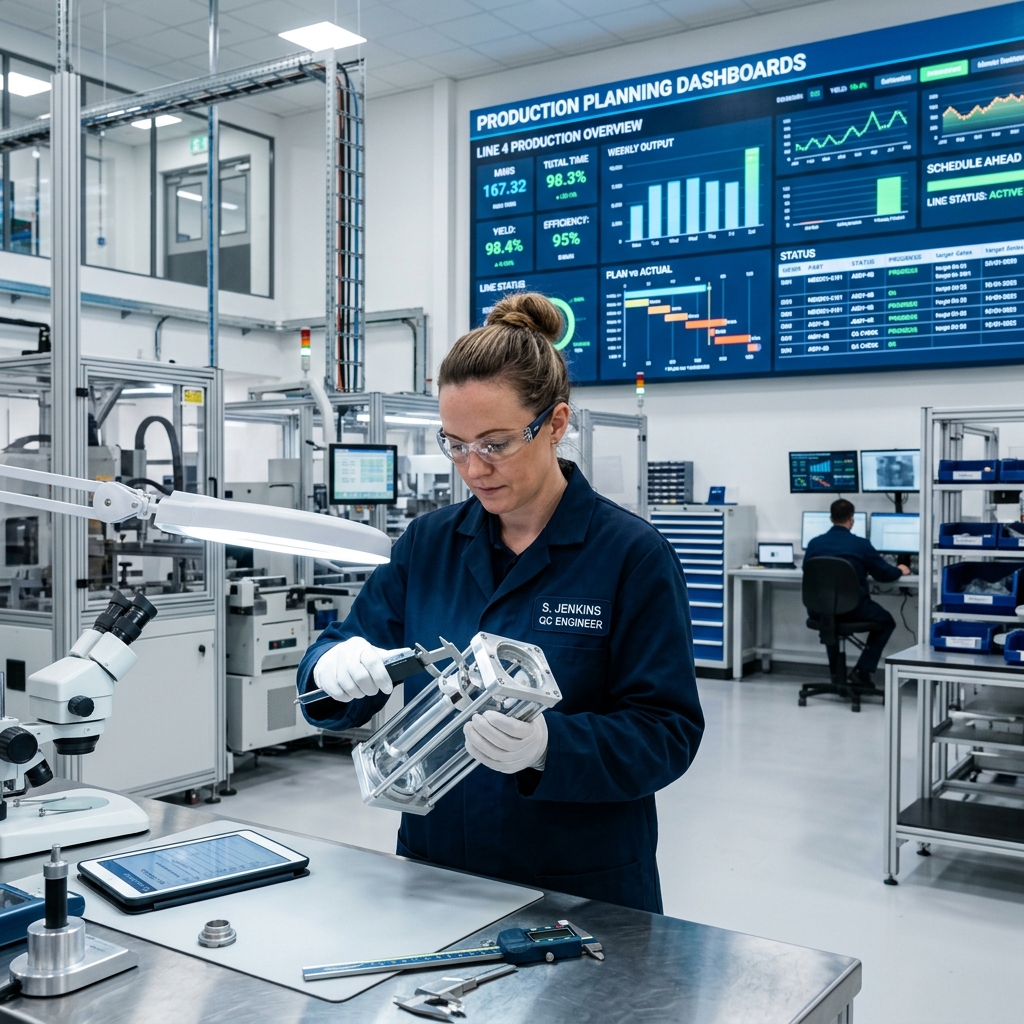
Quality Control involves establishing precise engineering tolerances. For example, if a metal pipe must have a diameter of exactly 50mm, with an acceptable tolerance of +/- 0.1mm, QC is the process of physically measuring the pipes coming off the line to ensure they fall within that microscopic window. If a batch fails, it must be scrapped or reworked.
The Inevitable Conflict (Speed vs. Quality)
Historically, the Production Manager (who is incentivized by speed) and the Quality Control Manager (who is incentivized by perfection) are in constant conflict. The Production Manager wants the assembly line to move faster; the QC Manager wants to halt the line to run more rigorous tests.
When these two departments use disconnected systems (like paper checklists and Excel spreadsheets), the conflict escalates. The factory floor becomes a chaotic environment where defective products are rushed out the door to meet an arbitrary deadline.
Solving the Conflict with Cloud ERP
The only way to resolve this conflict is to integrate both disciplines into a single, unified Manufacturing ERP Software platform.
With a modern ERP, quality checks are hardcoded directly into the production routing. When a worker finishes welding a component, the ERP system physically blocks them from moving the component to the painting station until they input the required QC measurements into their tablet. The software forces the factory to slow down exactly when it needs to, guaranteeing perfection without sacrificing overall efficiency.
Scaling Your Factory Floor
You cannot scale a manufacturing business purely by buying more machines or hiring more workers. If your foundational processes are chaotic, adding more volume will simply create more chaos and more defects.
By implementing a robust system like Delight ERP, you digitize and automate your Production Planning and Quality Control. The software becomes the unyielding master of the factory floor, ensuring every single product is built flawlessly, on time, and highly profitably.
Frequently Asked Questions
Streamline operations, reduce costs, and scale faster with Delight ERP.