In the modern, highly interconnected business landscape of 2026, the traditional boundaries between internal operations and external supply networks have entirely vanished. A company is only as strong, agile, and resilient as its weakest supplier. Procurement is no longer just an administrative function tasked with buying goods at the lowest possible price; it is a highly strategic operation that directly impacts product quality, profit margins, and ultimate customer satisfaction.
As organizations scale, managing hundreds or thousands of vendors using decentralized spreadsheets, email threads, and paper contracts becomes a monumental liability. This is where dedicated Supplier Management Solutions step in. But a common question arises among Chief Procurement Officers (CPOs) and business leaders: Exactly when and where in the procurement lifecycle should these solutions be utilized? The simple answer is: everywhere. In this extensive guide, we will explore precisely when and how supplier management modules must be integrated into your core procurement system to drive unprecedented efficiency.
The Convergence of Procurement and Supplier Management
Procurement software typically focuses on the transactional aspects of buying: generating purchase requisitions, creating purchase orders (POs), and processing payments. Supplier Management (often called Vendor Management) is relational and strategic: it focuses on who you are buying from, how well they perform, and what risks they pose.
When these two systems operate in silos, disaster strikes. A buyer might unwittingly issue a massive PO to a supplier who has a history of late deliveries or whose regulatory compliance certifications expired last month. By fully integrating Supplier Management Solutions directly into your Cloud ERP and procurement architecture, the system acts as an intelligent gatekeeper—ensuring that every transaction is executed only with verified, high-performing partners. Let us break down the exact phases where this integration is not just useful, but strictly required.
Phase 1: Supplier Discovery and Strategic Sourcing
The procurement process does not begin when a purchase order is cut; it begins when a business need is identified and the market is scanned for capable partners. During the sourcing phase, procurement teams issue Requests for Information (RFIs), Requests for Proposals (RFPs), and Requests for Quotations (RFQs).
When to use Supplier Management:
- Vendor Portals: Instead of managing bids via chaotic email chains, supplier management solutions provide secure digital portals where prospective vendors can submit their bids, product specifications, and pricing matrices in a standardized format.
- Automated Bid Comparison: The software automatically collates the RFQ responses side-by-side, analyzing not just the price, but lead times, payment terms, and historical reliability if the vendor is a returning partner.
- Strategic Selection: By leveraging data from previous transactions, the procurement team can instantly see which vendor truly offers the lowest Total Cost of Ownership (TCO), rather than just the lowest sticker price.
Phase 2: Automated Onboarding and Compliance
Once a supplier is selected, they must be legally and operationally onboarded into your corporate ecosystem. Manual onboarding is a notorious bottleneck, often taking weeks to collect tax documents, bank details, and compliance certificates.
When to use Supplier Management:
- Self-Service Onboarding: Vendors are granted access to a secure portal where they upload their own documentation—such as GST registration certificates in India, ISO quality certificates, NDAs, and banking details. The system automatically verifies the completeness of the data.
- Compliance Tracking: Supplier management software actively tracks the expiration dates of critical documents (like insurance policies or environmental certifications) and automatically sends alert notifications to both the vendor and your procurement team 30 days before expiration.
- Risk Profiling: During onboarding, the system can integrate with third-party financial databases to run credit checks and risk assessments on the new vendor, ensuring your business is not tying its supply chain to a financially unstable partner.
Phase 3: The Requisition to Purchase Order Cycle
The core of daily procurement involves internal staff requesting materials (requisitions) and the purchasing department converting those into official Purchase Orders sent to suppliers.
When to use Supplier Management:
- Approved Vendor Lists (AVL): When an employee submits a requisition, the system strictly limits their choices to pre-approved, contracted vendors stored in the supplier management database. This completely eliminates "maverick spending" (unauthorized purchases from unvetted suppliers).
- Dynamic Contract Enforcement: As the PO is generated, the system cross-references the active contract within the supplier management module to ensure that negotiated volume discounts, correct pricing, and agreed-upon freight terms are automatically applied to the order.
- Automated PO Dispatch: The finalized PO is instantly transmitted to the supplier via the vendor portal or EDI (Electronic Data Interchange), bypassing email delays. The supplier can then acknowledge the PO directly within the system.
Phase 4: Real-Time Performance and KPI Tracking
A supplier might look perfect on paper during the RFP process, but their actual operational performance can only be measured once goods start flowing into your warehouses. Managing this reality is the primary function of a robust Supply Chain Management Software framework.
When to use Supplier Management:
- Delivery Accuracy: As the warehouse logs Goods Receipt Notes (GRNs), the system automatically calculates the supplier\'s "On-Time, In-Full" (OTIF) delivery percentage. Did they deliver exactly 10,000 units? Did it arrive on Tuesday as contracted, or Friday?
- Quality Control Integration: When the Quality Assurance (QA) team inspects the incoming batch, defect rates are logged directly against the supplier\'s profile. If a vendor\'s defect rate breaches the acceptable threshold of 2%, the system can automatically suspend future POs until a Corrective Action Report (CAR) is filed.
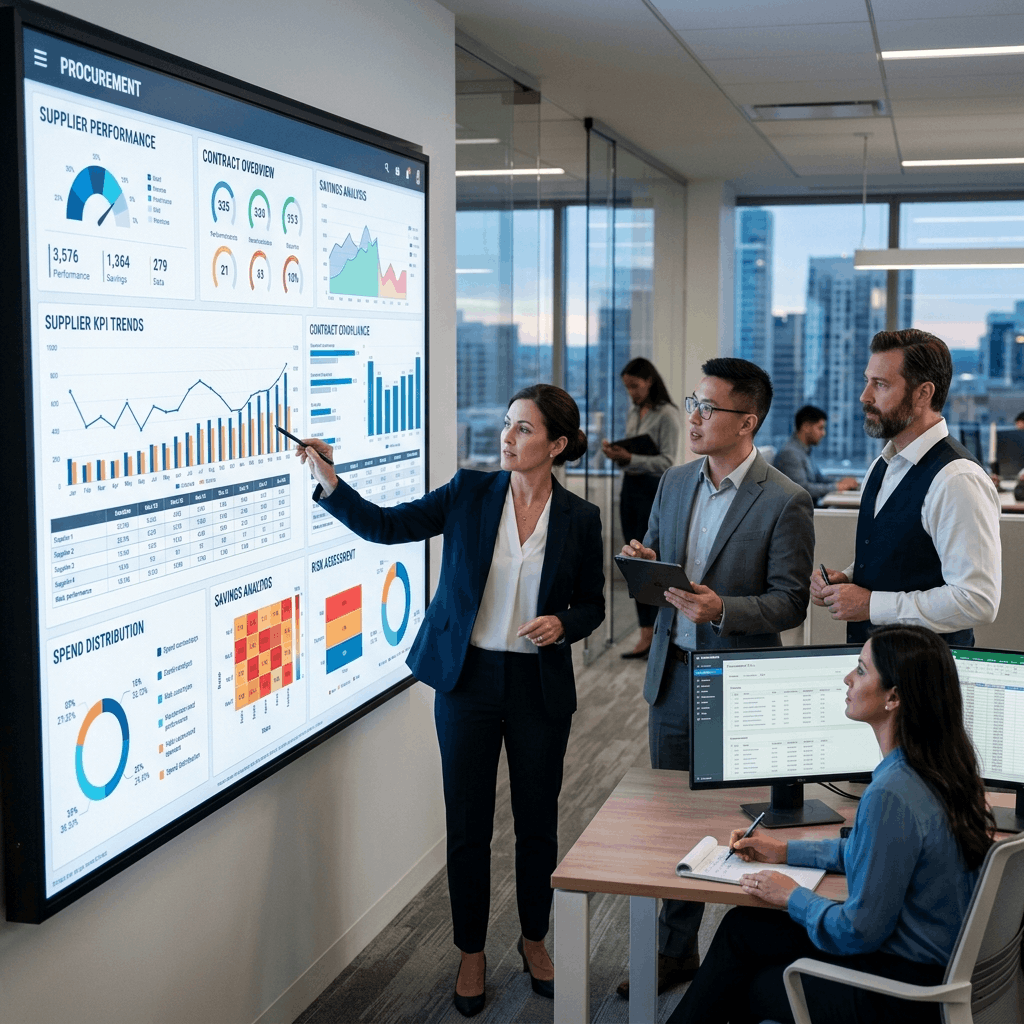
- Dynamic Scorecarding: The software continuously aggregates delivery speed, pricing consistency, and quality metrics to generate a real-time Vendor Scorecard. When it comes time to renegotiate contracts, your procurement team has hard, irrefutable data regarding the vendor\'s actual performance.
Stop Guessing. Start Tracking.
Are poor-performing vendors draining your profit margins? Gain 100% visibility into your supply chain with Delight ERP's integrated Procurement & Vendor Management modules.
Schedule a Software Demo → Explore FeaturesPhase 5: Invoice Matching and Accounts Payable
The culmination of a procurement transaction occurs when the supplier submits an invoice for payment. In decentralized systems, the Accounts Payable (AP) team wastes immense resources trying to verify if the invoiced amount matches what was ordered and what was actually received.
When to use Supplier Management:
- Automated 3-Way Matching: When the vendor uploads their invoice to the portal, the ERP system instantly performs a 3-way match. It compares the Invoice against the original Purchase Order and the warehouse\'s Goods Receipt Note (GRN). If all three perfectly align regarding quantity and price, the invoice is automatically approved for payment.
- Exception Handling: If the vendor invoices for 1,000 units, but the GRN shows only 950 were received (or 50 were rejected by QA), the system automatically flags the discrepancy and routes it to a procurement manager for resolution, preventing accidental overpayments.
- Early Payment Discounts: By processing clean invoices rapidly through automation, companies can leverage dynamic discounting—paying the supplier early in exchange for a 1% or 2% discount, significantly improving bottom-line profitability.
Phase 6: Risk Mitigation and Relationship Nurturing
The events of recent years—from global pandemics to geopolitical conflicts and shipping canal blockages—have proven that supply chains are fragile. Procurement is no longer just about buying; it is heavily focused on risk mitigation.
When to use Supplier Management:
- Geographic Risk Mapping: Advanced supplier management platforms allow companies to map their suppliers globally. If a natural disaster strikes a specific region, the system instantly highlights which components are at risk and automatically suggests pre-approved secondary suppliers in unaffected regions.
- Supplier Auditing: The software schedules and manages periodic on-site supplier audits. Corrective actions identified during the audit are tracked within the system until the vendor fully resolves them.
- Collaborative Innovation: Top-tier suppliers are often experts in their manufacturing domains. Through shared digital portals, suppliers can propose design changes, alternate cheaper materials, or process improvements directly to your engineering and procurement teams, transforming a transactional relationship into a strategic partnership.
Why Delight ERP is the Ultimate Procurement Solution
Attempting to patch together a standalone procurement tool with a separate vendor management application inevitably leads to data silos and complex API integrations that break down over time. The most effective approach for growing enterprises is an all-in-one architecture.
Delight ERP is engineered specifically to eliminate these boundaries. Our robust Supply Chain Management (SCM) software integrates Supplier Management natively into the core procurement, inventory, and finance modules. From the moment you issue an RFP, through the generation of E-Way bills and GST-compliant invoicing, to the final automated payment, Delight ERP ensures that every transaction is optimized, compliant, and deeply integrated into your company\'s broader operational strategy.
By deploying these intelligent solutions at every phase of the procurement lifecycle, modern businesses can eradicate manual errors, slash operational costs, and build a resilient supply chain capable of withstanding the unpredictable challenges of global commerce.
Streamline operations, reduce costs, and scale faster with Delight ERP.