
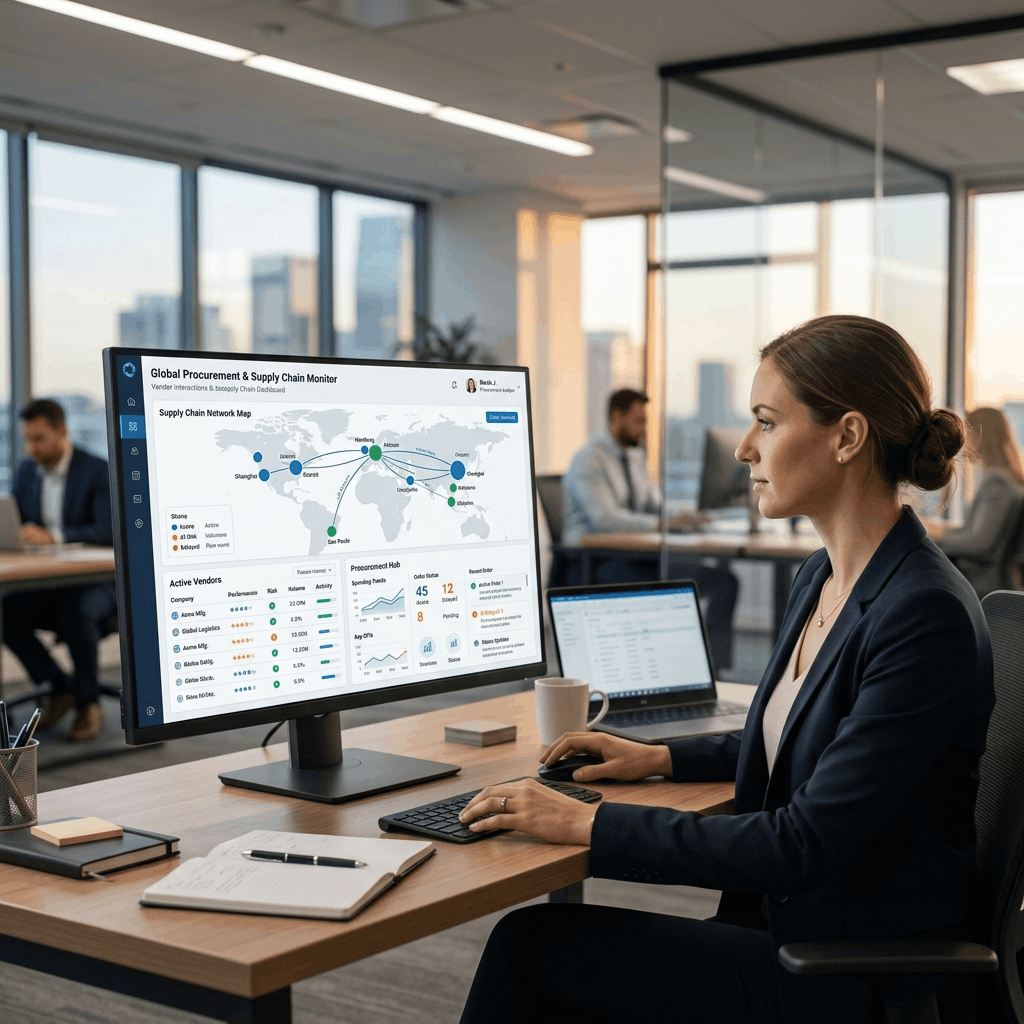
In today\'s hyper-connected global economy, a business rarely operates in total isolation. Whether you are a manufacturing titan reliant on raw material deliveries or a retail chain dependent on finished goods, your external vendors are effectively an extension of your internal operations. Managing this intricate web of external dependencies requires robust technology, specifically an Enterprise Resource Planning (ERP) platform.
A frequent question posed by IT directors, procurement managers, and business students alike is: Which process of the enterprise platform interacts with vendors? The reality is that vendor interaction is not confined to a single button or isolated module; it is a continuous, multi-phased workflow that spans across several distinct processes within the enterprise platform. In this comprehensive guide, we will dissect these specific processes to understand exactly how modern ERP systems engage, manage, and optimize external vendor relationships.
The Modern Enterprise and Vendor Ecosystem
Historically, vendor interaction was entirely manual, characterized by endless phone calls, faxed purchase orders, and mailed invoices. This created massive data silos. Finance didn\'t know what procurement ordered, and procurement didn\'t know what the warehouse actually received. The primary purpose of an Enterprise Platform is to shatter these silos.
When an enterprise platform interacts with vendors, it does so to achieve three primary objectives: ensuring continuity of supply, mitigating third-party risks, and optimizing the cost of goods sold (COGS). Let us examine the five core enterprise processes that handle these interactions.
1. Strategic Sourcing and e-Procurement
The very first interaction an enterprise platform has with a vendor often occurs before a business relationship is even formalized. This happens within the Strategic Sourcing or e-Procurement module.
When a company needs to acquire new raw materials or services, the platform is used to broadcast Requests for Information (RFIs), Requests for Proposals (RFPs), or Requests for Quotations (RFQs). Instead of managing this via email, vendors are invited to log into a secure digital portal to submit their bids. The enterprise platform then aggregates these responses, automatically comparing pricing tiers, lead times, and contract terms, allowing procurement managers to make objective, data-driven decisions.
2. Supplier Relationship Management (SRM)
Once a vendor is selected, they must be legally and operationally integrated into the company\'s supply chain. This is the domain of the Supplier Relationship Management (SRM) process.
The SRM module interacts with vendors by acting as a centralized repository for compliance. It collects and verifies tax identification documents, bank details, insurance certificates, and quality standards (like ISO certifications). Furthermore, the SRM process continuously interacts with vendor data to generate Performance Scorecards. By analyzing historical data regarding delivery accuracy and product defect rates, the enterprise platform automatically grades the vendor, alerting management if a supplier\'s performance drops below acceptable Service Level Agreements (SLAs).
3. The Procure-to-Pay (P2P) Cycle
The Procure-to-Pay (P2P) process is arguably the most frequent and heavily utilized point of interaction between an enterprise platform and a vendor. This cycle encompasses the entire lifecycle of a standard purchase.
- Purchase Requisition: An internal employee requests materials. The system ensures the request aligns with departmental budgets.
- Purchase Order (PO) Generation: The platform automatically generates a formal PO containing exact specifications, quantities, pricing (pulled from the SRM contract), and delivery dates.
- PO Dispatch and Acknowledgment: The platform digitally transmits the PO to the vendor via EDI (Electronic Data Interchange) or a vendor portal. The vendor interacts with the platform to electronically acknowledge and accept the PO.
4. Inventory and Warehouse Management Integration
The physical delivery of goods triggers another critical interaction point. While the vendor interacts physically with the warehouse staff, the enterprise platform processes the digital interaction via the Inventory Management process.
When the vendor\'s truck arrives, warehouse personnel use barcode scanners integrated with the enterprise platform to log a Goods Receipt Note (GRN). The platform immediately interacts with the vendor\'s data by cross-referencing the received quantities against the original Purchase Order. If the vendor short-shipped the order or delivered damaged goods, the platform instantly flags the discrepancy, updating the vendor\'s performance scorecard and notifying procurement.
Is Your Supply Chain Fragmented?
Stop managing vendors through messy email threads and spreadsheets. Unify your entire procurement lifecycle with Delight ERP.
Schedule an ERP Demo → Explore SCM Software5. Accounts Payable and Financial Settlement
The final interaction process resides within the Finance department: Accounts Payable. In legacy businesses, this phase is fraught with friction, lost invoices, and payment disputes. An enterprise platform automates this interaction flawlessly.
Through the vendor portal, the supplier uploads their digital invoice. The enterprise platform then executes a crucial process known as Automated 3-Way Matching. The system automatically compares the Vendor Invoice (1) against the internal Purchase Order (2) and the warehouse Goods Receipt Note (3). If all three documents match exactly, the platform approves the invoice and schedules an electronic funds transfer (EFT). If there is a mismatch (e.g., the vendor billed for 100 units, but only 90 were received), the platform blocks payment and alerts the vendor of the discrepancy.
The Technology Enabling These Interactions
How do these processes technically interact with external vendors? Modern enterprise platforms utilize several connection methods:
- Dedicated Vendor Portals: A secure, web-based dashboard where vendors log in to view their POs, submit invoices, and update compliance documents.
- Electronic Data Interchange (EDI): A standardized protocol that allows the enterprise platform to communicate directly with the vendor\'s own ERP system, transmitting POs and invoices computer-to-computer without human intervention.
- API Integrations: Modern RESTful APIs allow platforms to pull real-time catalogs, pricing, and shipping logistics directly from the vendor\'s servers.
How Delight ERP Optimizes Vendor Processes
Understanding the theory of vendor interaction is one thing; executing it flawlessly is another. Attempting to manage sourcing, inventory, and accounts payable across disconnected software tools reintroduces the very chaos you are trying to eliminate.
This is why scaling businesses turn to Delight ERP. Our unified platform seamlessly integrates Strategic Sourcing, Supplier Relationship Management, and the entire Procure-to-Pay cycle into a single, cohesive architecture. By providing intuitive Vendor Portals and automating 3-Way Invoice Matching, Delight ERP ensures that every interaction with your suppliers is accurate, transparent, and mutually profitable. When your enterprise platform communicates effortlessly with your supply chain, you gain the ultimate competitive advantage: speed and reliability.
Streamline operations, reduce costs, and scale faster with Delight ERP.