
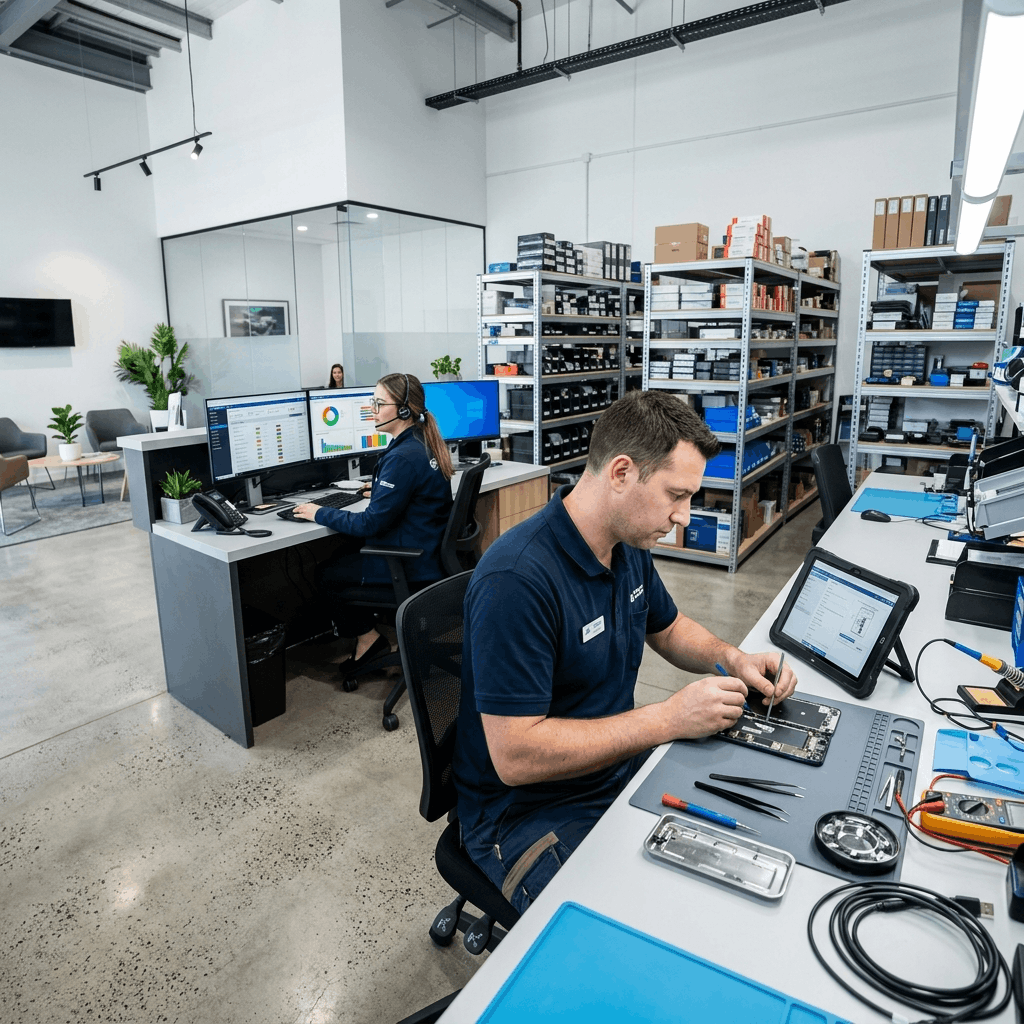
Most businesses pour enormous energy into acquiring customers — marketing campaigns, sales calls, trade shows, digital ads. But what happens after the sale? For many Indian businesses, after-sales service is an afterthought — managed through phone calls, WhatsApp groups, and paper registers. The result? Missed service requests, unhappy customers, lost warranty revenue, and a reputation that silently drives prospects to your competitors.
After-sales service is not just a cost centre — it's a revenue engine, a retention machine, and a competitive moat. And the technology that powers world-class after-sales service is Service CRM. This guide explains exactly why CRM is necessary for after-sales service, the specific features you need, and how Indian businesses are using Service CRM to transform customer support from a liability into a strategic advantage.
Why After-Sales Service Makes or Breaks Your Business
The numbers tell a clear story: acquiring a new customer costs 5–7 times more than retaining an existing one. Yet most businesses invest 80% of their budget in acquisition and 20% in retention. This is backwards — and it's costing Indian businesses crores in lost lifetime value.
Consider the economics:
- Repeat purchase rates: Companies with excellent after-sales service achieve 60–70% repeat purchase rates. Companies with poor service? Just 20–30%.
- AMC revenue: For equipment and machinery manufacturers, Annual Maintenance Contracts (AMCs) represent a predictable, high-margin revenue stream worth ₹15–25 lakhs annually for mid-sized companies.
- Spare parts margins: Spare parts and consumables typically carry 40–60% gross margins — significantly higher than the original equipment sale.
- Referral generation: Satisfied service customers generate 3–4x more referrals than satisfied first-time buyers. Word-of-mouth from service excellence is the most cost-effective marketing channel.
- Brand reputation: In the age of Google Reviews and social media, one unresolved service complaint can damage your brand more than 10 positive marketing campaigns can build it.
Service Ticket Management & Tracking
The foundation of after-sales CRM is the service ticket — a digital record of every customer issue from the moment it's reported to the moment it's resolved and confirmed by the customer.
What Service Ticket Management Solves
Without a CRM, service requests arrive through multiple channels — phone calls to the receptionist, WhatsApp messages to individual technicians, emails to the sales team, walk-in complaints. Many fall through the cracks. Nobody knows the complete picture. With a Service CRM, every request becomes a trackable ticket:
- Multi-channel ticket creation: Service requests from phone, email, WhatsApp, website form, and walk-in — all captured as tickets in a single system.
- Auto-assignment: Tickets are automatically routed to the right technician based on product type, location, skill set, or current workload — no manager bottleneck.
- Priority classification: Critical issues (production-line-down) are flagged as urgent and escalated immediately. Routine maintenance requests follow normal workflows.
- Complete ticket history: Every action — technician notes, parts used, time spent, customer communication, photos — is logged against the ticket in a chronological timeline.
- Status visibility: Customers can check their ticket status online or via WhatsApp. Sales managers can see all open tickets for their accounts. Service managers see team-wide performance.
Warranty & AMC Contract Management
Warranty and AMC management is where most businesses lose significant revenue. Without a CRM, the typical scenario is: a customer calls for service, the receptionist doesn't know if the product is under warranty, so they send a technician for free — even though the warranty expired 6 months ago. Or worse: a customer under active AMC waits 3 days for service because nobody checked their contract status.
How CRM Solves Warranty & AMC Chaos
- Automatic warranty validation: When a service ticket is created with a product serial number, the CRM instantly shows whether the product is under warranty, under AMC, or out of coverage — and whether the issue is covered under the specific terms.
- AMC contract management: Track all active AMC contracts with start date, end date, coverage terms (parts included/excluded), service visit limits, and payment status — in one centralised database.
- Warranty-to-AMC conversion: The CRM sends proactive alerts 60 and 30 days before warranty expiry, enabling the sales team to approach the customer with an AMC offer — converting expiring warranties into recurring revenue.
- AMC renewal tracking: Track AMC renewal rates, lapsed contracts, and revenue from service contracts — identify which customers are likely to churn and intervene proactively.
Delight ERP's Warranty Management module connects product sales, warranty registration, and service tickets into a unified workflow — ensuring no free service is given on out-of-warranty products and no AMC renewal opportunity is missed.
SLA Compliance & Escalation Management
Service Level Agreements (SLAs) define the quality standards you promise to your customers — response time, resolution time, uptime guarantees. Without CRM tracking, SLAs are just words on a contract. With CRM, they become measurable, enforceable, and improvable.
How CRM Enforces SLAs
- Timer-based tracking: The moment a ticket is created, the SLA clock starts. The CRM tracks elapsed time against committed response and resolution targets (e.g., 4-hour response, 24-hour resolution).
- Escalation rules: If a ticket approaches its SLA deadline (e.g., 3 hours elapsed on a 4-hour response SLA), the CRM automatically escalates to the service manager via email, SMS, and push notification.
- Multi-level escalation: If the first escalation doesn't resolve the issue, the CRM escalates further — to the regional manager, VP of Service, or even the CEO — based on configurable escalation chains.
- SLA compliance dashboards: Real-time visibility into SLA performance: percentage of tickets resolved within SLA, average response time, average resolution time, and SLA breaches by technician/region/product.
| SLA Metric | Without CRM | With CRM |
|---|---|---|
| Average first response time | 24–48 hours | 2–4 hours |
| Average resolution time | 3–5 days | 12–24 hours |
| SLA breach rate | Unknown (not tracked) | Below 5% |
| Escalation time for overdue tickets | When customer complains again | Automatic at SLA threshold |
| Service quality visibility | Zero (anecdotal only) | Real-time dashboards |
Field Technician Management with Mobile CRM
For businesses with field service teams — equipment manufacturers, HVAC companies, elevator maintenance, industrial machinery — managing technicians in the field is the biggest operational challenge. Without a mobile CRM, coordinators spend half their day making phone calls to figure out where technicians are and what they're working on.
What Mobile Service CRM Provides
- GPS-based job assignment: Assign service tickets to the nearest available technician based on real-time GPS location — minimising travel time and maximising daily job completion.
- Digital job sheets: Technicians fill out service reports on their phone — issue diagnosis, actions taken, parts used, time spent — with photos and customer signature captured digitally.
- Customer history on mobile: Before arriving at the site, technicians can view complete product history — previous service visits, parts replaced, recurring issues, and customer preferences.
- Spare parts request: Technicians request spare parts from the field — the inventory system checks stock availability and dispatches parts to the service location.
- Offline capability: Service calls often happen in basements, factory floors, or rural areas with no connectivity. The mobile CRM works offline and syncs when connectivity returns.
Delight CRM's Field Tracking module provides GPS-enabled job assignment, route optimisation, and digital job completion — purpose-built for Indian field service operations.
Spare Parts & Service Inventory
Nothing destroys service quality faster than a technician arriving at a customer site only to discover the required spare part isn't available. The customer has already waited for the technician — now they must wait again for the part. This doubles the resolution time and halves the customer satisfaction.
How CRM Connects Service to Inventory
- Product-to-parts mapping: The CRM maintains a bill of materials for service — linking each product model to its common replacement parts, consumables, and wear items.
- Real-time stock visibility: When a technician is assigned a ticket, they can see whether the likely spare parts are available in the nearest warehouse — before they leave for the site.
- Service van inventory: Track the inventory in each technician's service van — know exactly which parts each van is carrying and auto-replenish when stock drops below minimum levels.
- Parts consumption analysis: The CRM tracks which parts are consumed most frequently for each product model — enabling procurement planning that ensures high-demand parts are always in stock.
Customer Feedback & Service Quality Analytics
You can't improve what you don't measure. A Service CRM provides the data infrastructure to measure, analyse, and continuously improve your after-sales service quality.
Key Service KPIs Every CRM Should Track
| KPI | What It Measures | Target Benchmark |
|---|---|---|
| First Response Time | Time from ticket creation to first contact | < 4 hours |
| Resolution Time | Time from creation to resolution | < 24 hours |
| First-Time Fix Rate | % of issues resolved in one visit | > 80% |
| SLA Compliance Rate | % of tickets resolved within SLA | > 95% |
| Customer Satisfaction (CSAT) | Post-service survey rating | > 4.2/5 |
| Repeat Issue Rate | % of tickets for same problem within 30 days | < 5% |
| Cost per Service Call | Total service cost divided by tickets resolved | Decreasing trend |
- Automated feedback collection: After ticket closure, the CRM automatically sends a satisfaction survey via SMS or WhatsApp — capturing customer ratings and comments without coordinator effort.
- Technician performance scoring: Each technician's performance is tracked across resolution time, first-time fix rate, CSAT scores, and parts consumption — enabling data-driven training and recognition.
- Product reliability analysis: By analysing service ticket patterns, the CRM identifies product models with highest failure rates, most common failure modes, and average time-to-failure — feeding back into product quality improvement.
Revenue from After-Sales: AMC, Spares & Upgrades
After-sales service is not just a cost — it's a significant revenue opportunity that most Indian businesses under-exploit. A Service CRM transforms service interactions into sales opportunities:
- AMC revenue: Proactive warranty-to-AMC conversion and AMC renewal campaigns — driven by CRM alerts and customer data — can generate ₹15–25 lakhs annually for mid-sized equipment manufacturers.
- Spare parts sales: Every service visit is a spare parts sale. CRM data on parts consumption patterns enables proactive parts recommendations and bundled service packages.
- Upgrade and upsell: When a technician identifies aging equipment during a service visit, the CRM triggers an upgrade opportunity for the sales team — connecting service intelligence to sales action.
- Consumables subscription: For products requiring regular consumables (filters, cartridges, chemicals), the CRM automates reorder reminders — turning one-time sales into recurring consumable revenue.
After-Sales CRM vs Generic CRM: What's Different?
Many businesses try to use their sales CRM for after-sales service management. While understandable, this is like using a hammer as a screwdriver — similar tool, completely wrong application. Here's why dedicated Service CRM features matter:
| Feature | Generic / Sales CRM | Dedicated Service CRM |
|---|---|---|
| Ticket lifecycle management | Basic (open/closed) | Full (created → assigned → in-progress → resolved → confirmed) |
| Warranty validation | ❌ Not available | ✅ Auto-validates from sales/product data |
| AMC contract tracking | ❌ Not available | ✅ With renewal alerts and revenue tracking |
| SLA timer & escalation | ❌ Not available | ✅ Configurable per customer/contract tier |
| Technician GPS assignment | ❌ Sales rep tracking only | ✅ Service-specific with job sheets |
| Spare parts integration | ❌ Not available | ✅ Product-to-parts mapping with inventory |
| Customer signature capture | ❌ Not available | ✅ Digital job completion with signature |
| Service revenue analytics | ❌ Not available | ✅ AMC, spares, labour revenue tracking |
| Preventive maintenance scheduling | ❌ Not available | ✅ Calendar-based PM with auto-ticket creation |
Choosing the Right Service CRM
When evaluating Service CRM systems for your Indian business, use this 10-point checklist:
- Multi-channel ticket capture: Phone, email, WhatsApp, web form, and walk-in — all in one system.
- Warranty & AMC management: Auto-validation with coverage terms, expiry alerts, and renewal tracking.
- SLA engine: Configurable SLA rules with timer-based escalation and compliance reporting.
- Mobile technician app: GPS assignment, digital job sheets, photo/signature capture, offline mode.
- Spare parts integration: Connected to inventory for real-time parts availability and consumption tracking.
- Customer portal: Self-service ticket creation and status tracking for customers.
- Feedback automation: Post-closure CSAT surveys via SMS/WhatsApp with analytics.
- Service revenue tracking: AMC revenue, spare parts sales, and labour billing analytics.
- ERP integration: Connected to ERP for invoicing, accounting, and inventory management.
- GST compliance: Service invoicing with GST (SAC codes), e-invoicing, and revenue recognition.
Conclusion
After-sales service is not a post-sale obligation — it's a strategic weapon. The businesses winning in 2026 are those who treat every service interaction as an opportunity to deepen the customer relationship, generate additional revenue, and build a reputation that their competitors cannot match.
A dedicated Service CRM provides the infrastructure to make this happen — from service ticket tracking and warranty management to SLA enforcement, field technician coordination, spare parts optimisation, and service revenue analytics. Without it, your service team is operating blindfolded — reacting to complaints instead of proactively delivering excellence.
For Indian manufacturers, equipment companies, and service businesses — Delight Service CRM connects after-sales to your complete business ecosystem: sales CRM, manufacturing ERP, inventory management, and finance. It's not just service management — it's complete customer lifecycle management from first enquiry to lifelong loyalty.
Streamline operations, reduce costs, and scale faster with Delight ERP.